




A study on the nationalists struggle
Collin Abraham travelled throughout the land in the late 1960s earnestly working and implementing social welfare and development plans as a dedicated civil servant would.
Under the late Tun Abdul Razak's directive, Collin was part of the 11-man National Committee for Gerakan Maju responsible for overseeing the implementation of community development programmes. (It is worth mentioning that he was the only non-Malay and the most junior civil servant, the others mainly holding the post of Secretary-General in other Ministries.)
His work has ingrained in him a strong sense of "community" and understanding, perhaps more than most in the academia, the trivia and expectations of the rakyat. His long stint in the university as Associate Professor in Sociology (18 years) and as an academic activist has been a success.
He has written on a wide range of articles and published two books Speaking Out and the Naked Social Order .
Collin Abraham travelled throughout the land in the late 1960s earnestly working and implementing social welfare and development plans as a dedicated civil servant would.
Under the late Tun Abdul Razak's directive, Collin was part of the 11-man National Committee for Gerakan Maju responsible for overseeing the implementation of community development programmes. (It is worth mentioning that he was the only non-Malay and the most junior civil servant, the others mainly holding the post of Secretary-General in other Ministries.)
His work has ingrained in him a strong sense of "community" and understanding, perhaps more than most in the academia, the trivia and expectations of the rakyat. His long stint in the university as Associate Professor in Sociology (18 years) and as an academic activist has been a success.
He has written on a wide range of articles and published two books Speaking Out and the Naked Social Order .
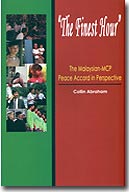 Now in retirement, he has once again shown his passion for his work by writing this book. It is a study of events that prompted the nationalists struggle for political independence for Malaya.
The theoretical framework of his book is that the British imperialism and colonial exploitation had entrenched a discriminatory political structure to maintain control by indirect means on the political and economic systems of Malaya.
This resulted in a lack of unity amongst the ethnically diverse local community which had enabled the British to preserve political hegemony by suppressing dissent for other alternative political solutions.
The writer has also provided us with historical narratives of the period long before our Independence. This part of our painful past will hopefully help us to fully appreciate and understand the historical impact and significance of imperialism and exploitation.
He also covered other equally important segments of our history; about how political hegemony was maintained by building into the ordinary working populace distortions and fictions, of how the differences and inequality of the various ethnicities were promoted and emphasised the divide and rule policies; to serve the ends of the "masters".
Understanding the past
More importantly and with some courage, the writer seeks to explain the role and collaboration between the Malayan Communist Party (MCP) and the Malay leftist movement in the struggle for independence. (I say with some courage because the atrocities committed by the MCP have not and will not be easily forgotten.)
The idea that the Malays and the Chinese (other than the Alliance troika) fought against the British together is hardly ever discussed or even known.
However it is still crucial for the past to be understood, no matter how painful it may be. The writer has undertaken considerable research on a very delicate subject which will certainly attract wide attention especially on some of his assertions and points of view.
The MCP signed a peace agreement with the Malaysian Government in 1989. This book is about that accord and why the writer prefers to identify the accord as Malaysia's finest hour is perhaps curious.
But this must be seen within the theoretical perspective within which the book is presented.
However, the narration as to the birth of the communist party, the reasons the Chinese workers and peasants found the MCP appealing, and how the British very cleverly pitted the Malays against the Chinese, are very revealing subject areas and deserve more research.
What is undeniable though is the existence of a strong Malay anti-colonial movement before the Second World War. Yet the Perak Rebellion and the rebellion led by Tok Janggut in Kelantan against the land tax imposition were quickly and mercilessly quelled.
It demonstrated that the Malays were helpless without arms. Thus, collaborating with the MCP because they had guns made sense to some of the Malay nationalists. The seeds for the struggle for our Independence was planted long before 1946 and Umno's struggle was one of the offshoots.
The modern Malay nationalist movements took root in the 1930s initially inspired by socialism and communism because of China and Indonesia. The main movements were initially the MCP and the Kesatuan Melayu Muda (KMM). As the wave of nationalism intensified, many other movements were formed such as the Angkatan Pemuda Insaf (later known as PETA), Angkatan Wanita Sedar, etc.
Bahaya dari gunung
These movements were branded as 'leftist' because of their early socialist persuasion, inspired by the Indonesian war of Independence against the Dutch. Leaders like Dr Burhanuddin Hilmi and Ustaz Baker Bakir were influential and had strong following amongst the Malays.
The gathering of more than 5,000 Malays at Gunung Semanggol in Perak is clear evidence of the support given by Malay leftists and Islamic groups to the idea of an armed struggle against the British.
This prompted Dato' Onn Jaafar to declare these grouping as " bahaya dari gunung " and regarded them as a threat to Umno.
During the Japanese Occupation, the (KMM) who were Japanese sympathisers fought against the British as the KMM aspired for an independent Malaya. The British were then cooperating with the MCP to defeat the Japanese.
Once the Japanese were driven out, the MCP shared the same fate as the KMM, they were both outlawed by the British and so they took to arms in their quest to remove the shackles of colonialism over Malaya. Consequently many of their leaders Abdullah CD, Rashid Maidin, Ahmad Boestaman were arrested and detained.
These movements disassociated themselves from Umno for various reasons but a predominant reason is the close association Umno had with the British administration as many Umno members were the "bangsawan Melayu" or from the Malay elite.
The collaboration between the Chinese and the Malays as detailed in this book, offers an invigorating and refreshing perspective. Whilst it was true that the Umno-led alliance had secured the dismantling of the Malayan Union and ultimately independence, the book also reveals that the British were not prepared to engage in long guerrilla warfare.
This was especially because the MCP had the support of the "Malay Left" who were opposed to "dealing with the British". Having been presented with the choice of either the Malay leftist movement who demanded instant independence and were ready to fight the British or Umno who is willing to negotiate for independence, the British opted for the latter.
Rebuilding the motherland
Thus, one can surmise that the prospect of an armed struggle had pressed the British to grant Independence to Malaya. This is not to suggest that the British wanted to retain Malaya as a colony indefinitely.
The decision to abandon colonies east of the Suez was decided as early as 1941 when Churchill was fighting the Nazis in Europe. In fact Churchill sent Gerald Templer to Malaya with the specific instruction of finding the best way to disengaged from the colony.
However, it is also true that after the war Britain was in dire straits financially and as Malaya was a rich colony they needed to keep Malaya as long as possible to fund the rebuilding of the motherland.
This book presents a perspective that demonstrates that there are other Malay and non-Malay nationalist movements and heroes who complemented Umno's struggle for an independent Malaya.
History, they say is about the victors, and not the vanquished. Hence in that sense, it is never a scientific source of knowledge.
Still, we must be hopeful that the truth will prevail in time, and history will reveal to us more about the past as historians dig deep into the records and present fresh understanding of our historical past.
Of course no historian attempts to set down all that has taken place, as not everything that has happened is known to the historian, however well informed he may be.
That is precisely why we need more historians and sociologists and researchers to write, explore and analyse our history. Every generation requires the facts to be recast in its own mould, not because the facts are changing or style varies.
It is because ideas and perceptions change and that affects the mode and manner of looking at and understanding things.
As Goethe asserts, "history must from time to time be rewritten not because new facts have been discovered, but because new aspects come into view."
Us and them
My interest in history and this book stems from the need to understand our past; so we may learn and not succumb to the errors we had gone through before.
I believe that we are not capable of being a developed nation, imbued with the criteria and achievements associated with being a civilised and modern country if we remain prisoners under a faulty political and economic systems instituted since colonial times.
We will soon celebrate 50 years of independence, but we remain divided according to race and class. Political and key economic sectors are still held in the hands of a few, much like the way the British controlled us before.
When confronted with internal problems or when seeking instant popularity it is not uncommon for politicians to draw the racial card or the religious groups to salvage them.
We still think that ethnicity and religion will save us from "the other" he is our enemy; but that "other" is none other than our fellow Malaysians. Just the way it was done for 200 years.
I urge all Malaysians who love this country and who want to see progress for our future generation to recognise who our real enemies are.
The people who still "colonise" our minds and our actions are the real enemies.
Of course, they are no longer the British, but they have adopted the same old strategies. Divide and rule the people, differentiate and classify them, instil fear into them and indoctrinate them with propaganda and perverse thoughts.
These people maybe Malays, Chinese or from any other ethnic groups. Regardless of who these "colonialists" are, they will, if allowed to perpetuate this thinking, continue to have political and economic hegemony.
The rakyat will not be united and they will suffer for this. When we can be one nation and be able to speak as one people, and care enough for the other fellow Malaysian, regardless of race, creed and class; then that will be Malaysia's Finest Hour. The journey to that destination is however a long one.
ZAID IBRAHIM is the Kota Baru member of parliament and a lawyer. The above is one of the four prefaces for the recently launched book authored by social scientist Dr Collin Abraham entitled The Finest Hour The Malaysian-CPM Peace Accord in Historical Perspective .


