
COMMENT | Ringgit weakness is symptom of a larger illness
However, if the ringgit exhibits a longer-term trend of continuing weakness that it has over the last 40 years or so, then it is extremely concerning and reflects continuing relative weakness of the economy compared to that of the US and other developed countries.
That is a rather worrisome trend caused by major structural weaknesses of the economy which erode both its competitiveness and its ability to bring in net foreign exchange into the country and to maintain investors' confidence - both foreign and local.
In practice, a weakened currency reduces the quality of life of all residents because the relative salaries of wage earners go down while the prices they pay in ringgit for goods and services go up, both of which impoverish the rakyat.
Those who benefit are the exporters because their ringgit-denominated wage costs remain stagnant while their export earnings increase inversely to the fall in value of the ringgit, giving them windfall gains. Thus, most business people who export want a lower value of the ringgit and often governments pay heed to them.
Conversely, if salaries are high relative to production per person then it is not possible to maintain competitiveness in international markets unless the currency is depreciated. Which highlights the importance of having a productive workforce through better education and training and moving production up the value chain.
Our neighbours down south, Singapore, have done tremendously well in this respect. They have improved incomes and quality of life to make the republic among the most developed of nations through successful transitions of the economy.
This increased prosperity is reflected in the increased value of its currency. It is instructive to follow the movement of the Singapore dollar relative to the ringgit. The chart shows...
COMMENT | The temporary fluctuations in the value of the ringgit caused by factors such as rising interest rates in the United States as the country tightens monetary policy to rein in inflation is really to be expected and is of no major consequence. After all, the US dollar is strengthening against most currencies.
However, if the ringgit exhibits a longer-term trend of continuing weakness that it has over the last 40 years or so, then it is extremely concerning and reflects continuing relative weakness of the economy compared to that of the US and other developed countries.
That is a rather worrisome trend caused by major structural weaknesses of the economy which erode both its competitiveness and its ability to bring in net foreign exchange into the country and to maintain investors' confidence - both foreign and local.
In practice, a weakened currency reduces the quality of life of all residents because the relative salaries of wage earners go down while the prices they pay in ringgit for goods and services go up, both of which impoverish the rakyat.
Those who benefit are the exporters because their ringgit-denominated wage costs remain stagnant while their export earnings increase inversely to the fall in value of the ringgit, giving them windfall gains. Thus, most business people who export want a lower value of the ringgit and often governments pay heed to them.
Conversely, if salaries are high relative to production per person then it is not possible to maintain competitiveness in international markets unless the currency is depreciated. Which highlights the importance of having a productive workforce through better education and training and moving production up the value chain.
Our neighbours down south, Singapore, have done tremendously well in this respect. They have improved incomes and quality of life to make the republic among the most developed of nations through successful transitions of the economy.
This increased prosperity is reflected in the increased value of its currency. It is instructive to follow the movement of the Singapore dollar relative to the ringgit. The chart shows the movement of the ringgit against the Singapore dollar from 1966, less than a year after Singapore was no longer part of Malaysia.
Until 1973, there was a currency interchangeability agreement between Singapore, Brunei and Malaysia, which effectively meant the currency values of the three countries were the same.
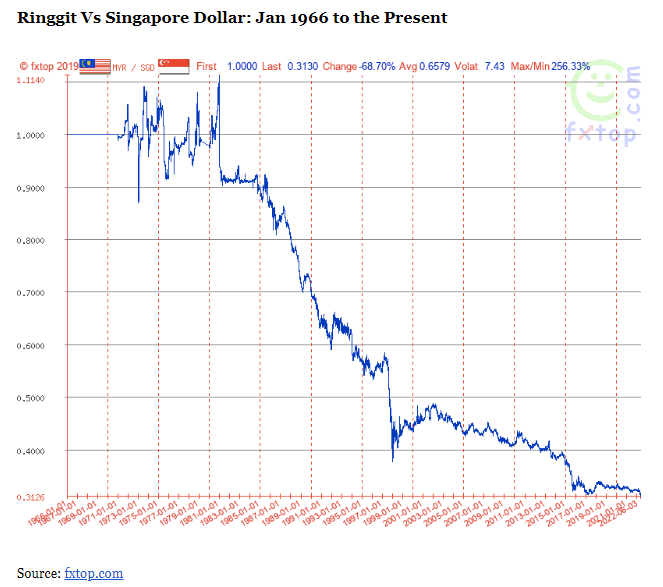
In the graph, this is reflected in the ringgit value being maintained at 1.0 against the Singapore dollar until about 1973. After that, it fluctuated at around 1.0 until around 1983, which means that the ringgit maintained its value against the Singapore dollar for a good 10 years or so after Malaysia left the currency interchangeability agreement.
This basically reflects a period of good economic management relative to Singapore. Despite the May 1969 riots, the country recovered well and put itself back on the path of growth, with strong institutions and government departments in charge of economic policy-making.
But all that changed when Dr Mahathir Mohamad became prime minister in 1981. He advocated a policy of heavy industrialisation and cheap labour in an attempt to grow the economy rapidly. To keep costs down, massive amounts of labour were recruited, especially from Indonesia.
He came up with dubious policies such as privatisation, much of whose projects in power and toll roads and many other areas went to cronies. Examples included an enormously lucrative independent power project to the well-connected YTL group and the North-South Expressway privatisation to a company linked to Umno. There are too many others which we can’t go into here.
By the time Mahathir was through in 2003, some 22 years later, the ringgit had dropped as much 60 percent in value to the Singapore dollar, only levelling out after Mahathir left the scene in 2003 after 22 long years at the helm, the period that without doubt caused the most amount of economic damage to the country.
The currency levelled off with Mahathir’s departure but saw a steep depreciation from 2016 onwards as a result of the onset of the exposure of the 1MDB kleptocracy under Najib Abdul Razak.
The Asean five
But as bad as we were relative to Singapore, the other countries in the original Asean five fared even worse (see table). Over a period of some 52 years, only Singapore saw its currency appreciate - and very significantly at that.
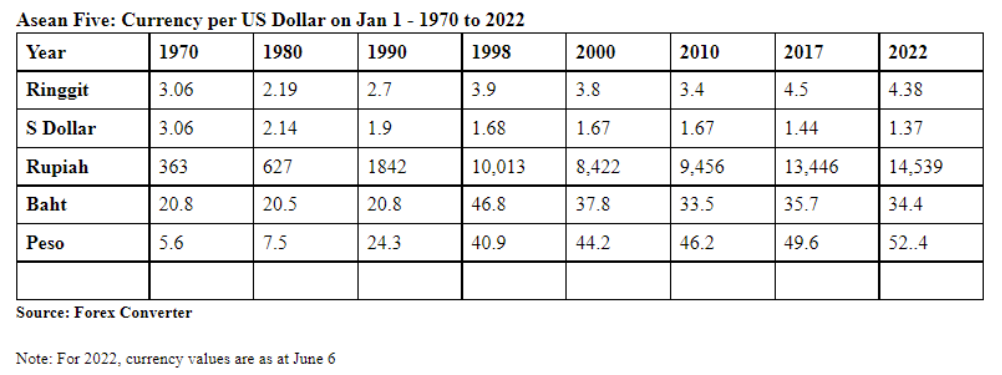
For this discussion, it is important to look at how each of the Asean 5 did relative to the US dollar. Except for Singapore, all the other countries tell a rather sorry tale with currency levels all very much lower than that of the level 52 years ago relative to the US dollar.
Indonesia, which Malaysians are now wont to compare favourably with our own country, has seen a truly devastating 97.5 percent decline in the value of its currency relative to the US dollar (see table). Imagine what that would have done to Indonesians. In 1970, a US dollar got you 363 Indonesian rupees, now you can get 14,539 rupees. Prices of goods and services have skyrocketed in rupiah terms. How did the Indonesians survive?
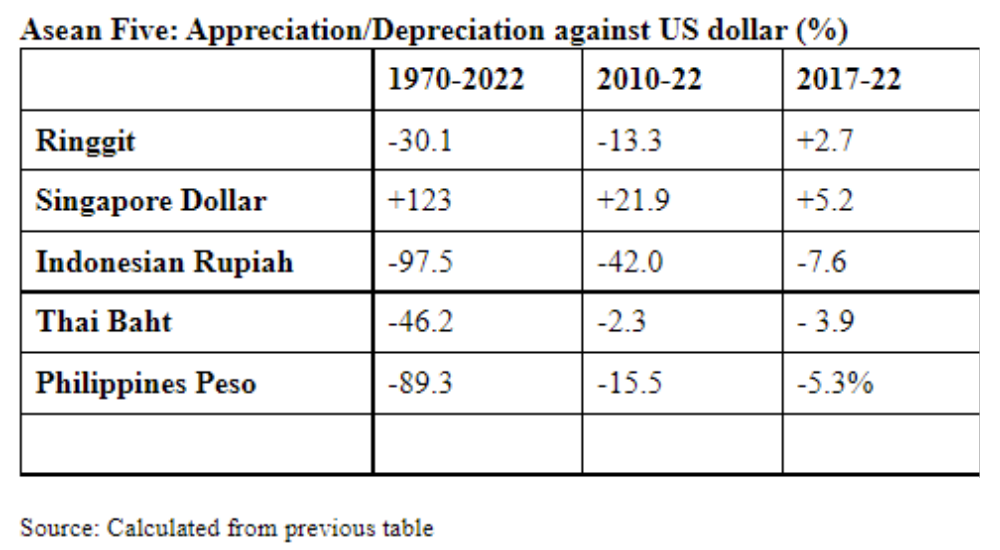
The Philippine peso lost nearly 90 percent of its value in 52 years, the Thai baht 46.2 percent and the Malaysian ringgit 30.1 percent, a sure indication of how continued poor economic mismanagement can affect currency values and hence living standards.
Singapore on the other hand, saw its currency appreciate 123 percent over the same period, a considerable achievement considering it is measured against one of the most dynamic and progressive economies in the entire world. Singapore’s living standards were not much higher than Malaysia’s at that time.
The sad part is that all of the other Asean countries have considerable resources, a critical population base, and a good starting point since independence but squandered it through political corruption, cronyism and patronage - the curse of the developing world. We are following the worst examples and going in their path.
While most of the loss in currency values took place between 1970 and 2000, in the last 12 years from 2010 to 2022, the general movement was still towards further losses relative to the US dollar (see table) ranging from a loss of 42 percent (Indonesia) to 2.3 percent (Thailand). But Singapore still saw its currency appreciate by a good 21.9 percent.
From 2017 onwards, the ringgit showed a slight appreciation of 2.7 percent while Singapore, the only other one in the Asean 5 to show an increase in the value of its currency, still saw a faster appreciation of 5.2 percent.
But Malaysia's currency was low in 2017, just ahead of the 2018 elections caused by what I call the kleptocracy risk premium when Malaysian financial markets were rated lower as the kleptocratic government headed by Najib Razak was internationally exposed.
At the moment, initial indications are that the ringgit is poised for a further bout of sustained weakness as both domestic and foreign confidence in Malaysia’s ability to weather the current crisis and resume pro-growth, equitable policies wanes. It’s early days.
Unless this kleptocratic, corrupt government is removed at the polls, a government which has condoned processes that weaken governance, encourage corruption and endorse blatant violations of capital market procedures, expect the ringgit to continue to weaken.
As I wrote in 2017 and which is no less true now: “Currency weakness is a symptom of a larger illness. If the disease is not treated and the rot is not stopped, the ringgit will keep on sliding lower and will impoverish Malaysia on a relative basis for many years to come.
“The bottom line, after taking into account short-term fluctuations, is that a country which is doing well economically and has in place the right policies to foster the competitiveness of its people through a variety of measures which includes excellent education, infrastructure, good governance, integrity and competence amongst others, will see its currency appreciate.”
We need to treat the larger illness - but this government simply won’t do it.
P GUNASEGARAM, a former editor at online and print news publications, and head of equity research, is an independent writer and analyst.
The views expressed here are those of the author/contributor and do not necessarily represent the views of Malaysiakini.