




Feeling the heat
Finally, after years of giving the cold shoulder to warnings of global warming and frigidly refusing to sign the Kyoto Pact on greenhouse gas emissions, the longtime and I trust not much longer Australian Prime Minister John Howard seems to be getting the message.
Everyone knows why it has taken him so long. Australia is the world's biggest exporter of coal, the commodity that helps fuel the pollution explosion in some of the hottest, dirtiest and most environmentally-unfriendly economies on earth after the US, like China.
But now, as Australia's coal customers in the People's Republic choke on the smoke and the global community wakes up to the threat of climate change and rising sea levels, stark reality is finally coming home to the Howard government.
Finally, after years of giving the cold shoulder to warnings of global warming and frigidly refusing to sign the Kyoto Pact on greenhouse gas emissions, the longtime and I trust not much longer Australian Prime Minister John Howard seems to be getting the message.
Everyone knows why it has taken him so long. Australia is the world's biggest exporter of coal, the commodity that helps fuel the pollution explosion in some of the hottest, dirtiest and most environmentally-unfriendly economies on earth after the US, like China.
But now, as Australia's coal customers in the People's Republic choke on the smoke and the global community wakes up to the threat of climate change and rising sea levels, stark reality is finally coming home to the Howard government.
Australian agriculture is wilting under the worst drought in a century, town and city water supplies are dwindling dangerously, and bush fires are blazing with ever more frequency and ferocity.
This is a doomsday scenario for Howard and his Liberal-National Party coalition, as they can see their reservoir of voters drying up. So, with the next election in sight, they're pouring money into long-overdue initiatives like the world's biggest solar power generator to sucker the electorate into thinking they're as green as they should always have been.
If ever the threat of global warming deserved to be taken seriously anywhere on droearth, it should have been in Australia, which - as every schoolchild there learns - is the world's driest continent, and whose inhabitants derive a perverse kind of pride from a poet's apt description of the country as "the wide brown land".
Now it's browner than ever, I gather, as some drought-stricken communities have had to resort to drinking water recycled from sewage. It's exactly as everyone in Australia should have been doing for decades, of course, since it's a criminal waste of such a scarce and precious resource as water to flush it down drains and sewers and let it flow out to sea.
There are none so blind as those who refuse to see, however, and Australian governments and citizens, urban and rural alike, have largely turned a blind eye or seen too late the obvious and ominous symptoms of environmental abuse.
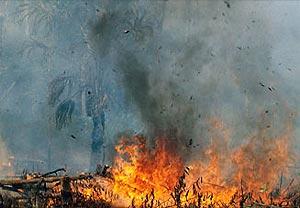 Massive soil-erosion, salination and desertification caused by over-clearing, over-grazing and over-cultivation. Rivers pumped dry to feed the insatiable thirst of wasteful irrigation schemes. Indigenous wildlife ravaged by habitat-destruction, indiscriminate hunting and feral imported flora and fauna. Coastlines degraded by rapacious sand-miners and resort developers. Seas polluted by sewage, fertiliser residues, pesticides, industrial sludge and all the other usual poisons and rubbish disposed of in traditional out-of-sight, out of mind style.
Certainly there have been some Australians who've made heroic efforts to bring sanity to all this madness. Growing numbers of people, from a small minority of progressive farmers, scientists and state agriculture departments to a Green political party and crusading environmentalist visionaries have worked tirelessly and often selflessly to make a difference.
Dereliction of duty
A small band of concerned citizens and NGOs are battling hard to make a difference in Malaysia too, though with precious little apparent effect thus far. As in many tropical countries, the effects of global warming here are somewhat masked by high rainfall and the greenness of the surviving vegetation.
In fact, far from perceiving the destruction of carbon dioxide-absorbing rainforests as an evil resulting in soil loss, landslides and flooding as well as contributing to global warming, the government here as notably also in Brazil and Indonesia is permitting or even promoting the clearing of even more jungle by opportunists hot-footing it to cash in on the fad for bio-fuels.
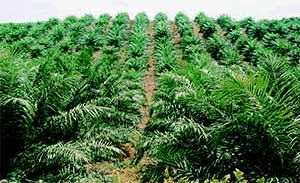 These would-be profiteers may yet get their fingers burned, however, as the world is finally awakening to the fact that the slashing and burning of forest to make way for 'bio-fuel plantations' produces more greenhouse gases than the fossil fuels they're suppose to supplant. And that, adding insult to such environmental injury, the refining of vegetable oils and other produce into ethanol consumes more energy than it creates.
Activities like the forming of Synergy Drive, the group of palm-oil producers recently thrown together with ungodly haste to be touted as the world's biggest publicly-listed plantation company, and the annual haze-producing arson by Malaysian and Indonesian eco-pirates in Borneo and Sumatra, may yet get an increasingly chilly reception from an ever more urgently aware and concerned international community.
And even the local community may start to realise that the Barisan Nasional (BN) government's dereliction of its duty to protect the environment with anything beyond pious but empty platitudes will result in more and more "natural" disasters.
 Just as the same government's failure to create more than the merest token of a public transport system in KL and other cities is proving more ruinously expensive every day in the cost of fuel, tolls, traffic jams and still more overpriced highway projects in addition to soaring greenhouse gas emissions.
Like Australia and almost every other country on earth, Malaysia has a great deal to do to clean up its act, both eco- and energy-wise. And it's not about to achieve it by cutting and burning more jungle and replacing it with oil palm, however obvious and attractive a ploy that may appear to those who have been committing and condoning such systematic environmental vandalism all these years.
Nor is it going to get away forever with blaming droughts and other climate changes entirely on factors beyond its control, like the El Nino phenomenon.
Let's hope the BN will soon be feeling the electoral heat as intensely as Howard's Liberal-Nationals in Australia, George W Bush's Republicans in the US, and all the other parties around the world that have so long coolly persisted in putting their own and their supporters' wealth and power before the well being of not just their own populations, but every human, animal and plant on the planet.


Are you sure you want to delete this comment?
This action cannot be undone.