




Notions in nomenclature
As a professional trafficker in words, I'm always concerned when perfectly good ones are rendered worthless for the rest of us by people misusing and abusing them for the purpose of political polemics, propaganda or outright perjury.
Take the apparently innocent but in fact hopelessly-prostituted word 'people's' for example, whose appearance in the name of a nation or political party is a virtually guaranteed to mean precisely the opposite.
The most obvious example of this is in the so-called People's Republic of China, which since 1949 has in stark and obscene reality been 'The Party's Dictatorship of China'.
As a professional trafficker in words, I'm always concerned when perfectly good ones are rendered worthless for the rest of us by people misusing and abusing them for the purpose of political polemics, propaganda or outright perjury.
Take the apparently innocent but in fact hopelessly-prostituted word 'people's' for example, whose appearance in the name of a nation or political party is a virtually guaranteed to mean precisely the opposite.
The most obvious example of this is in the so-called People's Republic of China, which since 1949 has in stark and obscene reality been 'The Party's Dictatorship of China'.
And as if China's abuse of 'people's' hadn't brought this formerly perfectly honourable word into sufficiently dire disrepute, it has also been employed by a good many other totalitarian states eager to promote their popularity.
These include such paradises as the Democratic Republic of Afghanistan, Democratic and Popular Republic of Algeria, People's Republic of Bangladesh, People's Republic of Burkina, People's Republic of the Congo, Democratic Republic of the Congo, People's Democratic Republic of Ethiopia, Democratic Republic of (North) Korea, Lao People's Democratic Republic, Socialist People's Libyan Arab Jamahiriya, Democratic Republic of Madagascar, Mongolian People's Republic, Democratic Republic of Sao Tome and Principe, and the Somali Democratic Republic.
Some horror spots are a little more subtle than the above and their names aren't such dead giveaways. Scratch the thin veneer, though, and all the euphemisms are there. The innocent-sounding Republic of Cuba, for example, is run - if that's what you can call it - by a body called the National Assembly of People's Power. The kleptocratic Federal Republic of Nigeria boasts not only the People's Democratic Party, but also the Alliance for Democracy and the All People's Party. And the Romanian government includes something called the Christian Democratic National Peasant's Party.
 Admittedly there are some nightmare nations that have more individual notions when it comes to nomenclature. The unspeakable Union of Myanmar, for example, where the military has kept Aung San Suu Kyi under almost permanent house arrest since even before her party won popular elections there in 1990, is run by a junta of generals through the so-called 'Law and Order Restoration Council' from a capital whose new name 'Yangon' translates to 'end of strife'.
The Republic of Haiti, Islamic Republic of Iran, Republic of Maldives, Republic of Sudan and Republic of Zimbabwe are all honest enough, in their self-descriptions at least, to exclude their unfortunate people from their names.
Alternative meaning
Despite these exceptions, the word 'people's' has been forever voided from most respectable peoples' vocabularies. Though The Star resolutely bills itself as 'the people's paper' - as if readers were still blissfully unaware that it peddles the MCA's version of the Barisan Nasional government line. Thus, like its fellow dodgy daily, the New Straits Times, it is truly neither a (news)paper nor the people's at all.
Not far behind 'people's' in the list of disgraced words, of course, is the closely-related 'democratic', consistently abused as it is by one-party states eager to claim legitimacy on the curious ground that their people get to vote without a choice of options.
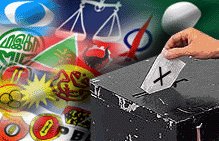 Or any genuine choice, as in Malaysia, where parties claiming to represent the interests of the three major racial groups keep themselves permanently in power through a system of stunning verbal virtuosity in which the word 'coalition' means, in effect, 'cartel'; 'stability' is code for 'the status quo'; and 'prosperity' appears to mean something like 'as much patronage and cronyism for the masters and as little trickle-down to the masses as it's possible to get away with'.
The word 'landslide' has come to mean a massive majority of parliamentary seats for the incumbent in government, however modest the majority of votes it wins or buys. Except, of course, for nervous residents of Ulu Klang and other areas prone to construction collapses, who are all too aware that the alternative meanings of 'landslide' are 'no official liability' or 'business associates of council members can continue building on slopes as steep as they like'.
In a system as insensitive as Malaysia's to the genuine well-being of the people, it's hardly surprising that the word 'sensitive' itself has virtually lost its original meaning, as government spokespersons have adopted and adapted it to describe situations they deem 'difficult', 'controversial' or what you and I, in our primitive, plain-speaking fashion, might simply call 'illegal' or 'corrupt'.
Along the same line of Malaysian officialese, 'certain' has come to mean 'uncertain', 'unknown', or 'unspecified', as in 'certain people' best unmentioned by name or 'certain activities' so sensitive as to be left unspecified, unpublicised, uninvestigated and above all unpenalised.
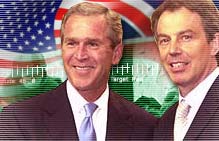 One word whose mangling can't be blamed on the Malaysian government or its agencies, however, is 'intelligence'. Already somewhat suspect in any case, it was robbed of any remaining shred of respectability or sense when George W Bush, Tony Blair and John Howard used it to justify the attack on Iraq by the 'Coalition of the Willing'. So now, along with the word 'propaganda' and the phrase 'public relations', 'intelligence' has come to mean 'a pack of self-serving lies'.
The words 'fair' and 'balanced' have become casualties of the war on Iraq too, thanks to blatantly biased coverage of the conflict by Rupert Murdoch's Fox News, the hysterical, jingoistic, Neo-con network whose slogan happens to be 'fair and balanced'.
It is a claim you'd have to be literally unbalanced to believe, as a New York judge suggested when Fox brought a breach of copyright suit against satirical author Al Franken for using the phrase 'fair and balanced' in the title of one of his books.
The upshot of this wholesale perversion of words by liars of every persuasion, unfortunately, is that there are less and less of them that we can trust.
'Trust' itself is a word that is a bit on the dubious side, come to think of it. Especially if it appears in a quote from a coalition politician in some publication trying to pass itself off as fair and balanced by proclaiming itself 'the people's paper'.


