




Regaining the urban Chinese vote
Barisan Nasional (BN) won the Ijok by-election, but at a cost. The results showed a significant swing of the Chinese vote away from the ruling coalition.
Coupled with survey findings released by the Merdeka Centre in February, this indicates that - should a general election be called now - BN parties that reply on the urban vote may lose quite a lot seats.
The question is how BN expects to regain the confidence of urban voters. The answers may be all too obvious, but the will and determination to implement changes may be lacking.
Barisan Nasional (BN) won the Ijok by-election, but at a cost. The results showed a significant swing of the Chinese vote away from the ruling coalition.
Coupled with survey findings released by the Merdeka Centre in February, this indicates that - should a general election be called now - BN parties that reply on the urban vote may lose quite a lot seats.
The question is how BN expects to regain the confidence of urban voters. The answers may be all too obvious, but the will and determination to implement changes may be lacking.
People living in urban centres care more about more matters than just faulty traffic lights, blocked drains and potholes in roads.
State of the economy
Over the past few years, the perception among the urban people, rightly or wrongly, is that the economic cake has stopped expanding.
The success of the New Economic Policy (NEP) depends on a rapidly expanding cake so that every ethnic group has an expanding share - everyone is satisfied because it keeps unemployment low and income steady. A shrinking cake reduces each group's share and creates the perception that others are encroaching into this as well.
To expand the economy, we need to improve the ease of doing business. We need to attract more Foreign Direct Investment again. We need to improve our ranking on the ease of doing business, currently at 28, and in economic freedom, now at 48.
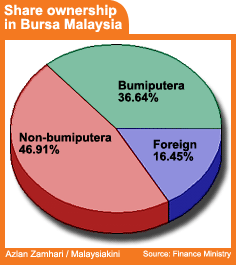 To do so we need to review the NEP to make the economy more competitive. The NEP has served its purpose. In the 1970s, when the NEP was first implemented, the cake was not too large but the effort then was mainly to take from the share owned by foreigners in our plantations and listed companies. So the different ethnic groups didn't really feel deprived. From the late 1980s to the mid-1990s, the policy of privatization kept the economy in good shape and the cake expanded at a rate fast enough to satisfy the different groups.
With the advent of the digital revolution and globalisation, there is also a need for higher productivity, efficiency, innovation and creativity. We need to remain competitive, in order not to be overtaken by countries such as Thailand and Vietnam.
Malaysia has a good foundation, thanks to a stable government and comparatively good management in the past. Unlike countries which have to protect budding economies, we have reached a stage ready to take on the world. In this respect, a Free Trade Agreement with the US has more pros than cons.
The level of inflation was one of the main grouses last year, and though it had eased to an enviable 1.9 percent in March, people still find that their disposable income has decreased because of the hike in petrol price and in electricity and water tariff. It will take some time for people to adjust to the new rates, and hopefully, inflation can be capped at this level.
Issues with governance
Malaysia is lucky, as I have always stressed. Compared to the likes of Myanmar, the Philippines, Congo, Somalia, Nigeria, we are much better off. This is in no small part due to a good administrative system and fairly good infrastructure left behind by the British. The beloved Tunku Abdul Rahman, our first prime minister, laid down a very good system for later generations of administrators to improve on.
Very few people realise that, from Merdeka up to 1980, Malaysia had a very good growth cycle, averaging about 7 percent a year (compound). This was partly due to the relatively good governance, a fair and independent judiciary, a good police force and a fairly efficient English- speaking civil service that communicated effectively with developed economies, bringing in much needed foreign know-how and investment.
 However, as the country became more prosperous, these institutions were perceived to be not as good as before. The problem of corruption is getting more acute. Corruption not only adds to the cost of doing business, but also distort market efficiency. Where the best and most efficient should win a contract, corruption decides who gets what. I believe this can be solved only with total resolve and commitment and an independent commission.
Another aspect of good governance is accountability and transparency. All government dealings, including agreement on toll-roads and procurement, must be transparent and open. When everything is done in a transparent manner, people will accept the government's explanation more readily even if certain undertakings fail.
In addition, ministers and civil servants must be held accountable for their actions. To get information is no longer a matter of the government doing us a favour; it is now considered a basic right of the citizen. Educated people expect to be told about everything.
The government also must walk the talk. It must deliver what it promises to the people. It must ensure the safety of the people and respect their basic human rights. A good government must also listen and accommodate. As Perak Regent Raja Nazrin Shah has said, it must avoid enforced solutions. Might does not equal right.
Ministers and senior government officers must set an example by being open, tolerant and forward looking. They must tolerate dissenting views, and be open to suggestions and alternative views.
Discontent over education
Even though mother-tongue education is guaranteed at the primary level, in reality, urban communities find it tough to set up new vernacular schools. Funds are not easy to come by and most of these schools depend on the community for funds for expansion. If only funds are as readily available as in a by-election, then this will cease to be a headache for the community.
Many Chinese and Indian Malaysian parents have to work very hard to save up their money to send their children abroad, since admission to certain choice faculties are very difficult for their children. Once educated overseas, many do not come back.
While the Indians and the Chinese accept that a quota should be set aside for the rural poor, especially rural Malays, they cannot understand why some very rich urban Malays are given scholarships when they can easily afford to pay for education.
 Another point of discontent is the double-standard in pre-university education. While the matriculation system takes only a year and the curriculum is much easier, STPM students need to study a much harder curriculum for two years. When it comes to university entrance, both are considered to be equal, when the STPM is generally considered to be one of the toughest pre- university entrance examinations in the Commonwealth. The two-tier system should be abolished and only one stream of pre-university course adopted.
In a nutshell, if the BN government can improve the economy and business environment, reduce inflation, reduce corruption and misconduct of political leaders, it would make a good start to winning back hearts and minds of voters.
With a better police force, civil service and education system, open, fair and accountable governance, and freedom for the press and dissenting views, it could be looking at a swing back in its favour from the Chinese electorate.
SU DAR REN a medical doctor with interest in politics and socio-economic issues. He believes in the preservation of nature and a green environment.


Are you sure you want to delete this comment?
This action cannot be undone.