


/file/publisher-c1a3f893382d2b2f8a9aa22a654d9c97/2023/10/144bf22848134dea3753272940d96435.jpg)

COMMENT | Madani budget lacks substance and oomph
Last week’s budget was unexciting, unenergetic, and cannot be described as, in the positive connotation of the word, sexy.
It was sorely deficient and therefore a deficit in terms of the increasing negative perception of the prime minister. No amount of PR can undo that - only sensible, solid, and courageous steps of which there was a pronounced absence.
The previous budget announced end-February was before the six state elections and therefore may, I repeat, may have been a reason for not taking the tough and reformatory measures necessary to push this country of ours forward after years, no decades, of being stuck in the mud and slime by dirty, corrupt politicians.
With the next general election due more than four years from now and Anwar firmly in the top seat with a near-two-thirds majority (one short because of the shenanigans of the crybaby Muda MP) there’s no more excuse now.
It is time to...
COMMENT | Oxford Languages defines oomph as “the quality of being exciting, energetic, or sexually attractive”. But PMX and Finance Minister Anwar Ibrahim’s budget this year lacked oomph and was only mildly better than the last one, which I described as bland but benign.
Last week’s budget was unexciting, unenergetic, and cannot be described as, in the positive connotation of the word, sexy.
It was sorely deficient and therefore a deficit in terms of the increasing negative perception of the prime minister. No amount of PR can undo that - only sensible, solid, and courageous steps of which there was a pronounced absence.
The previous budget announced end-February was before the six state elections and therefore may, I repeat, may have been a reason for not taking the tough and reformatory measures necessary to push this country of ours forward after years, no decades, of being stuck in the mud and slime by dirty, corrupt politicians.
With the next general election due more than four years from now and Anwar firmly in the top seat with a near-two-thirds majority (one short because of the shenanigans of the crybaby Muda MP) there’s no more excuse now.
It is time to take the runaway bull by the horns and bring back some semblance of order to the country.
Let’s take a look at the main issues:
Revenue and expenditure
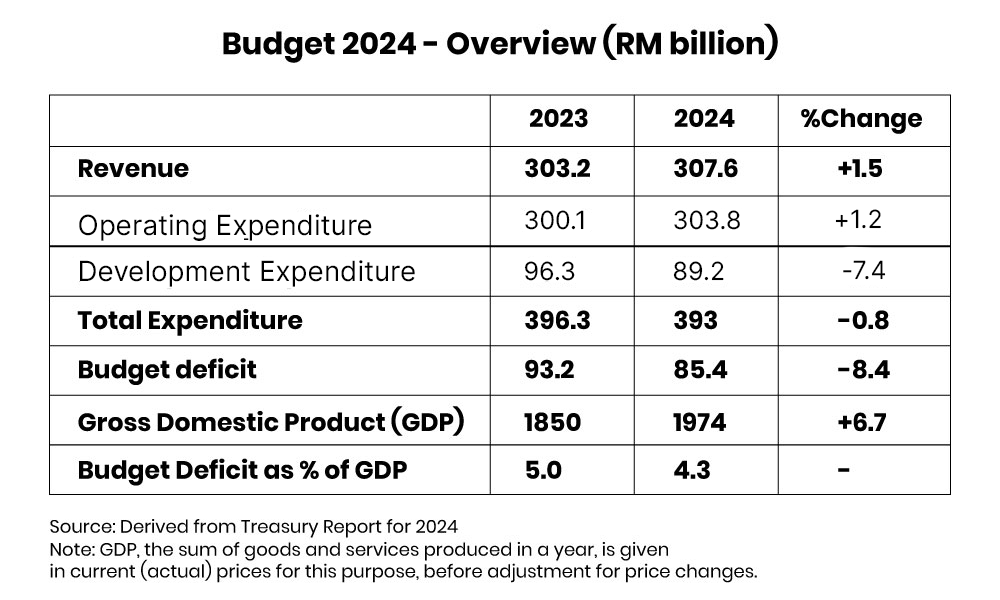
This is the heart of the budget (see table). The economy is expected to grow four to five percent after taking into account inflation and other price changes. This translates into a growth of 6.7 percent in actual price terms.
Revenue collection is expected to rise to RM307.6 billion in 2024 from RM303.2 billion this year, an increase of just 1.5 percent. Yes, that’s correct, less than a third of real economic growth and a little over one-fifth of nominal growth.
That’s certainly not the right way to increase revenues, especially since our tax collected in terms of percentage of GDP is among the lowest in the world at about 12 percent.
On the expenditure side, RM303.8 billion is for operating expenditure and RM90 billion for development expenditure, making a total of RM393.8 billion, and producing an overall budget deficit over revenue of RM85.4 billion. But note that total expenditure has decreased only a minuscule 0.8 percent or just RM3.3 billion.
Failure of subsidy rationalisation
That’s just a tiny fraction of the overall subsidies given by the government of some RM81 billion of which some RM60 billion are for fuel and electricity. Anwar said the oil subsidy given by Malaysia is the third highest in the world.
The move to targeted subsidies (where subsidies are removed to be replaced with direct grants to those who need them) is getting hardly any net expenditure reduction for the government.
Yes, some of it is because of increased hand-outs but the inevitable conclusion from this is that subsidy rationalisation is failing with operating expenditure still increasing by 1.2 percent in 2024. That indicates the net impact of lowering subsidies on government expenditure is still not biting next year.
This fact is not surprising as Anwar announced no concrete measures in terms of reducing oil subsidies in the 2024 budget apart from saying that diesel subsidies will be provided for logistics and transport operators. Heavily subsidised pump prices for all fuel still remain the same.
Where’s the revenue enhancement?
The other failure of the Madani budget is that there are no concrete measures for revenue enhancement which is reflected in the small 1.5 percent increase in revenue to RM307.6 billion despite GDP, the sum value of goods and services produced, increasing by 6.7 percent in actual prices.
That means the increases in some taxes are simply not making any big impact on the revenue base at all and more drastic measures are needed.
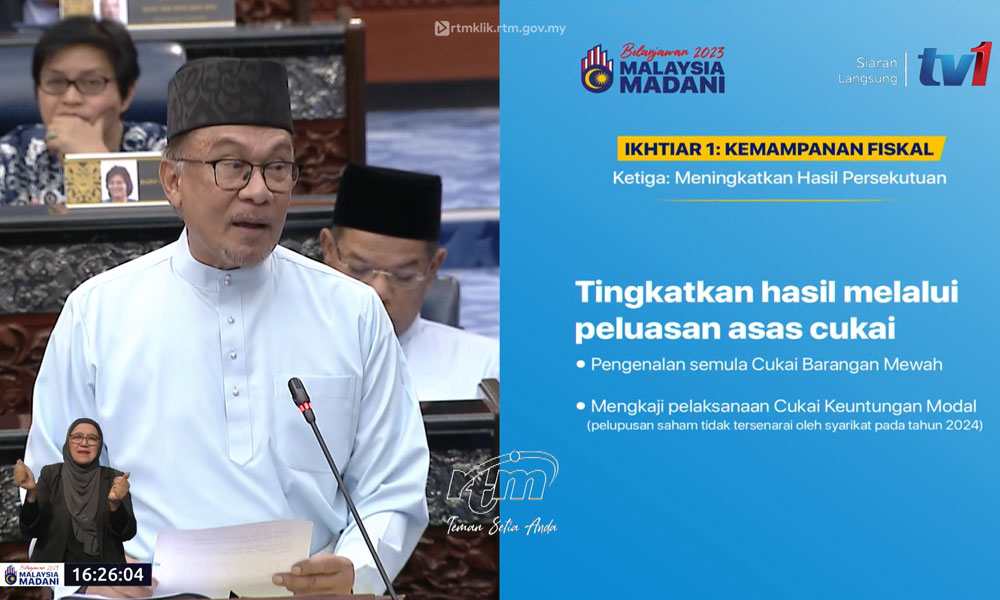
The increase in the sales and service tax to eight percent from six percent previously, a 33 percent hike, has been widely criticised especially by small and medium industries which will be particularly hit. Even so, this tax does not seem to have much of an impact in terms of revenue enhancement.
And then there is the introduction of a capital gains tax (CGT) for unlisted companies and assets as well as a luxury tax on watches and jewellery. Both are misplaced. There is no reason for exempting CGT for listed shares where transactions can be much larger, as I explained in this article.
Luxury taxes just push goods beyond affordability levels and simply mean that those who buy watches and jewellery will get them overseas instead of here and will bring them back on their wrists, necks, ears, and faces, or put them in their luggage. The government will get little revenue if any.
GST would have had an effect
Instead of raising the SST by two percentage points for an increase of a third, the SST could have been easily abolished and replaced with a goods and services tax (GST) of five percent, a reduction of one percentage point.
The poor would not have been affected by the system of over 200 exemptions for vital goods and services.
Besides, the GST requires meticulous accountkeeping and therefore less tax evasion which is easily done for both the SST and income tax by simply under-declaring sales and income.
This is one of the main ways for tax evasion and a rising black economy which is why most economies in the world have some form of value-added tax like the GST, as I explained here.
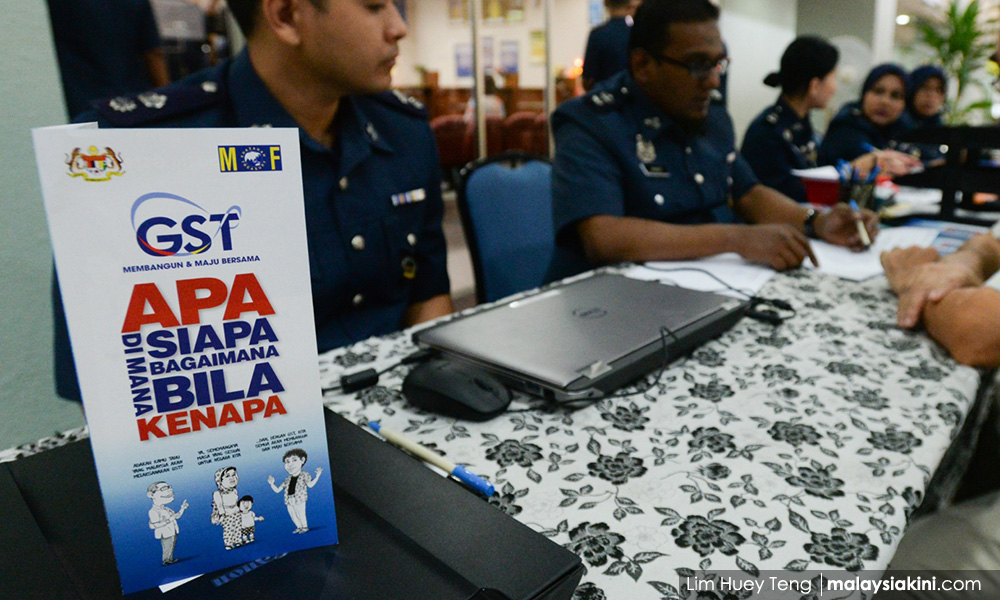
For these reasons, the GST would have been revenue-enhancing despite a reduction in the quantum compared to the SST. When the Pakatan Harapan government made an uninformed reversion to a six percent SST from a six percent GST in 2018, the estimated tax losses for a year amounted to a huge RM22 billion!
The imposition of a blanket CGT would similarly require good account keeping and keep down money laundering and illegal gains.
Because of the audit trail, it will also be easier to catch those involved in insider trading on the capital markets, deterring this practice and enhancing tax revenue. It will also deter people from under-declaring their income.
Corruption and easing business conditions
For decades now, the fairly easy solution of cutting corruption and making it easier to do business has not been taken, because of a corrupt government at the helm. Both the GST and CGT would have cut corruption.
Add on to these administrative measures where business licences don’t need approvals if they meet certain conditions and it will immediately cut avenues for corruption.
One other thing - what do we need approved permits and import duties for? Remove all of these and plug our economy into the world as I explained here.
Anwar needs to realise you can’t please everybody when you want to reform, even those within your own coalition. You need to have the courage of your convictions, and do some things even if others, especially the corrupt, are opposed to them.
Yes, corruption is the number one problem - but do something about it for God’s and the rakyat’s sake.
This budget, where time pressures were off, was the opportunity to finally do something, but Anwar has failed us.
He is getting a reputation for talking but not doing, for bluster but not courage, for pontificating but not solving, for showmanship but not implementation, for public relations but not the truth.
If economic policy, finance, and budgets are beyond him, then get someone else to do it - a technocrat who understands these things and has the courage and will to do, to solve, to implement, and to stick to the truth while doing it.
Anwar can play the role he is best suited for - smoothing things over. Some things sometimes may need more than smoothing over - you need to pull down structures and rebuild them anew. Anwar must realise that.
It’s not too late. You don’t have to wait till the next budget. Changes can be made as you go along. Right now, we need to make these changes if the budget is to be meaningful.
P GUNASEGARAM, like many people his age, watched the continued deterioration of this nation over the last half-century. He says it’s better to try for you may succeed rather than to play safe and fail anyway.
The views expressed here are those of the author/contributor and do not necessarily represent the views of Malaysiakini.
/file/1332/228846ee47b3dd0b46071b0b8098b8c1.jpeg)
/file/publisher-c1a3f893382d2b2f8a9aa22a654d9c97/2020/11/be213840d7714834dfb051e12712d821.jpg)
/file/1163/f862ee811fd17fbd597592fbfa207cb4.jpeg)
/file/publisher-c1a3f893382d2b2f8a9aa22a654d9c97/2023/10/ac9212bb40c601c901cb8de01f8e0a16.jpg)


Are you sure you want to delete this comment?
This action cannot be undone.