


/file/publisher-c1a3f893382d2b2f8a9aa22a654d9c97/2023/10/5fa67b916f16075de6b5219ea7b00179.jpg)

COMMENT | Jepak by-election - a sure thing?
COMMENT | Today, 22,804 Sarawakians in Jepak, a state constituency around the bustling town of Bintulu, have the opportunity to head to the polls. It is the first by-election in Sarawak since 2017, and the fourth by-election since the August state polls, excluding special elections due to 2022 election petitions.
This election is markedly different from other recent by-elections to date, in that, it takes place in Sarawak, in a state where the competitiveness of elections has significantly transformed and declined, especially since the formation of the unity government.
The two opposition parties are local parties, Parti Aspirasi Rakyat Sarawak and Parti Bumi Kenyalang. These are parties that emerged significant on the political scene in the December 2021 state election, only capturing a small share of the vote in these state polls as they focused on a pro-separatist message.
In 2021, pro-separatist parties, including Parti Bersatu Sarawak(PBS), captured nearly a quarter of the vote, a not-insignificant median...
COMMENT | Today, 22,804 Sarawakians in Jepak, a state constituency around the bustling town of Bintulu, have the opportunity to head to the polls. It is the first by-election in Sarawak since 2017, and the fourth by-election since the August state polls, excluding special elections due to 2022 election petitions.
This election is markedly different from other recent by-elections to date, in that, it takes place in Sarawak, in a state where the competitiveness of elections has significantly transformed and declined, especially since the formation of the unity government.
The two opposition parties are local parties, Parti Aspirasi Rakyat Sarawak and Parti Bumi Kenyalang. These are parties that emerged significant on the political scene in the December 2021 state election, only capturing a small share of the vote in these state polls as they focused on a pro-separatist message.
In 2021, pro-separatist parties, including Parti Bersatu Sarawak(PBS), captured nearly a quarter of the vote, a not-insignificant median performance of 22 percent in seats.
Contrary to what Jepak means, a smack or a slap, this election is a ‘sure thing’ for Sarawak Premier Abang Johari Openg’s Parti Pesaka Bumiputera Bersatu Sarawak (PBB), with the candidate Iskandar Turkee expected to win handily.

At issue electorally will be the level of endorsement for PBB, as turnout levels in Sarawak are traditionally lower than the national average, especially in by-elections, as well as differences in voting among different ethnic and age groups.
Politically, however, the by-election points to a new politics that is evolving in Sarawak, one in which Sarawakians are distancing themselves from the toxic extremist Islamist politics taking place in Peninsular Malaysia and instead grappling with differences among themselves.
Comparatively, there has been little attention to this election. This is in part because of the lower level of competitiveness. Equally important, there is inadequate attention to Sarawak politics. This piece looks at voting in Jepak, highlighting how Sarawak politics is (and is not) changing.
A look at the context
Jepak is in a state constituency that has undergone rapid and significant change in the past decade, echoing changes that are taking place in Bintulu with the expansion of the port and oil and gas sector.
As Bintulu has increased in economic importance, so has its population. While Bintulu still retains its old small-town charm, its growth parallels greater strength in the Sarawak economy and more confidence in itself.
Jepak is close to town but has suffered from both a lack of attention and, ironically, the development attention it has received. Like other growing small towns across Malaysia, there is a need for better transportation, infrastructure and connectivity. The Pan-Borneo Highway has improved but the stretch in northern Sarawak is not where it should be.
Similarly, Jepak’s connectivity is not where it should be. It has also faced problems with limited accountability in development, with inadequate compensation for native land.
In typical fashion in Sarawak by-elections, there are promises to resolve all the problems. Jepak is now being included in the masterplan for suburban development, made its own administrative district and those who lost Native Customary Land (NCR) in the Jepak Jaya development are now to be compensated.
The more youthful PBB candidate compared to his predecessor has promised greater attention.
While Aspiraasi’s Chieng Lea Ping, a local businessperson, similarly promises to address issues, he lacks the resources of PBB, instead promising to donate his salary back to the community. PBK’s Stevenson Joseph Sumbang, a former policeman, is also making appeals, hoping to increase his vote share from his 2021 run.
The opposition candidates are relying on their personal ties to their communities, while PBB is tied to a larger political machine.
Compared to the December 2021 state election, separatist sentiments are less openly expressed, with little open discussion of alliances with Putrajaya and more focus on issues at home. This speaks to an important feature of Sarawak politics, that is arguably deepening persistent parochialism. There is no desire to engage in the pernicious politics of ‘Malaya’.
Voting retrospective: ethnic voting
There are, however, commonalities with national trends. My analysis of voting patterns by ethnicity and age point to fascinating differences. The most striking voting differences are ethnic.
Jepak is a multi-ethnic constituency, with a majority (54 percent) of Malays/Melanau, but with a sizeable Iban community (34 percent), smaller Chinese community (six percent) and ‘others’ groups (five percent).
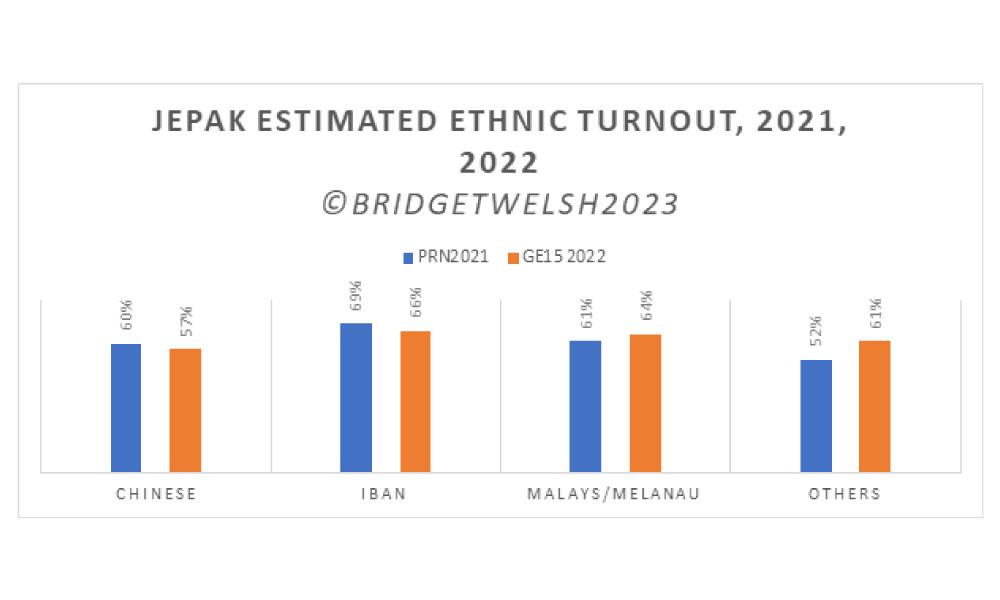
As the voting estimates show, turnout among the groups has varied, with Iban coming out the most, followed by Malays. Chinese turnout is the lowest in both past elections, but only modestly so. The Election Commission – which has a record of overestimating turnout recently – is hoping for the same level of turnout as the past, 65 percent. PBB is similarly hoping for this level of endorsement.
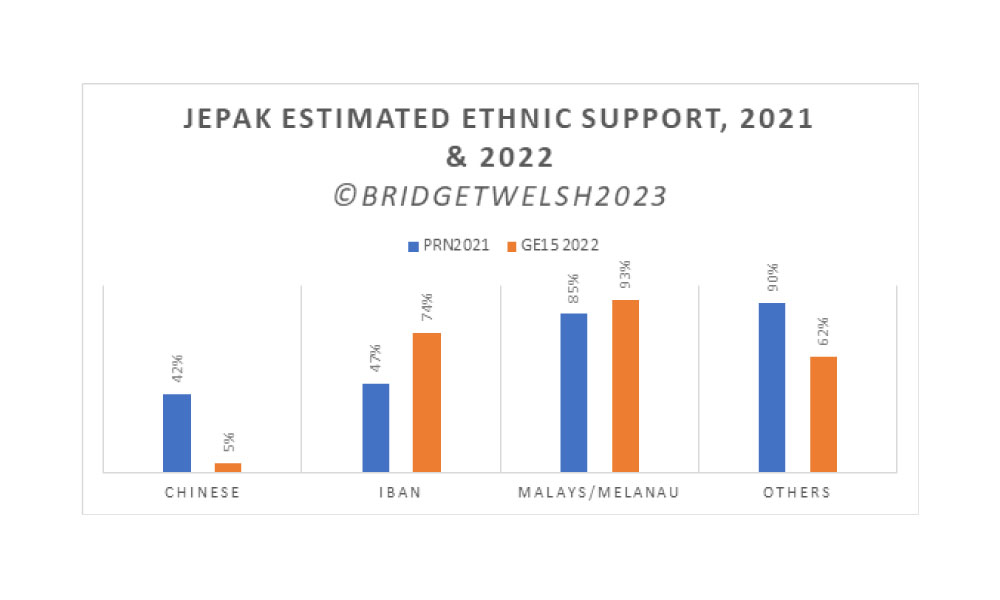
Where the differences are sharper are in patterns of support. PBB relies on Malay/Melanau voters. This is not untypical of patterns in PBB seats. What is interesting to observe is the changes in the Iban vote across the state 2021 and 2022 federal elections. The Iban voted for opposition parties in 2021 and returned to the PBB-led coalition of Gabungan Parti Sarawak (GPS) in 2022. Chinese voters supported PBB in 2021 and voted for Pakatan Harapan in 2022, a PKR candidate, as did the ‘other’ groups as well.
There is this unfortunate stereotypical view of voters in Sarawak that they are captured, controlled by vote buying, duped into supporting the dominant governing coalition. While one cannot deny the reality of vote buying on many Sarawakian voters, yet growing confidence and more online exposure have led to different voting patterns, especially in recent elections.
The Dayaks have persistent dissatisfaction with their secondary role in Sarawak, for example, fuelling support for alternatives to PBB. Federal elections also bring out different loyalties as well. There is this myth that all the ethnic groups get along in Sarawak, and, while ethnic relations are much better than in Peninsular Malaysia, it would be incorrect to assume that they have similar political alignments and do not have issues of concern.
Ethnic voting in Sarawak in Jepak – and my analyses elsewhere – show that ethnic politics do matter here, too, and that the incumbent government led by Abang Johari wrestles with winning support across communities, although not to the extent as Pakatan Harapan.
What has changed in Sarawak is the evolving political mobilisation of the Dayak communities and considerable vote swings among different ethnic communities. Despite GPS winning seats overwhelmingly in both previous elections, they have to work harder for it compared to the past, especially in a semi-urban area like Jepak where there is greater demand for deliverables.
Power of youth
As in the rest of Malaysia, younger voters are transforming politics in Sarawak. They led to the vote swings in 2016 and 2018 away from the incumbent coalition, while in 2021 and 2022 youth support favoured GPS.
Recall that in December 2021, the Sarawak state government denied the inclusion of Undi18 voters.
Voting patterns in that election and in 2022 show that they were too cautious in their exclusion of younger voters, as they won the majority of them.
In Jepak, voters under 30 make up a third of the electorate, in an electorate that has increased by a third due to the combination of inclusion of younger voters and automatic registered voters.
It is important to keep in mind that in both Sarawak and Sabah the significant increase in voters is driven by voters who did not register earlier above the ages of 21, as earlier conditions long favoured local headman registering voters. In 2022, an estimated 77 percent of younger voters under 30 voted for GPS, only slightly lower than older age cohorts. This level of support of younger voters in 2021 is estimated at 78 percent. This age cohort is strongly in the government’s favour and will be essential for their political fortunes moving forward.
An evolving new politics?
What advantages Sarawak’s governing coalition GPS is that the opposition is weak, lacking resources and reliant on using personal appeals along ethnic lines, and ties within the community.
While DAP held onto most of its seats in the 2022 federal election, it faced serious losses in the state election of 2021 and faces greater challenges in future elections as a Sarawakian backbencher partner in a coalition where it already is a secondary partner.
How the opposition has changed and will evolve is setting Sarawak in a new political direction. Two issues deserve mention. The consistent resonance of separatist sentiments matters; they are real as Sarawakians see themselves differently from the rest of Malaysia and want greater autonomy.
How many of the deliverables Sarawak’s leaders have provided - and whether they go down to the ground – will shape how these sentiments evolve. For now, deliverables have dampened some of the separatist anger, making this a more challenging vehicle for the political opposition to mobilise around.
With the DAP’s taming, the effect has been to reduce discussions of governance. This has allowed more space for the GPS leadership to go about its business without a meaningful check.
The impact has been more attention inwards, to personality differences and political competition (even within parties), and to differences among the communities. Without a clear external or domestic political ‘enemy’, the focus has been on each other, although more muted (for now).
Simultaneously, there have also been greater local demands for more equitable shares in development, as with greater prosperity there are now more expectations that these benefits should be shared.
In this regard, Jepak’s by-election showcases a smack of another kind, a reminder that all parts of the state, including areas receiving inadequate resources and attention in the past, deserve more. The vote result may be a ‘sure thing’ but future deliverables to the areas in need are much less of one.
BRIDGET WELSH is an honourary research associate of the University of Nottingham’s Asia Research Institute, a senior research associate at Hu Fu Center for East Asia Democratic Studies, and a senior associate fellow at The Habibie Centre. Her writings can be found at bridgetwelsh.com.
The views expressed here are those of the author/contributor and do not necessarily represent the views of Malaysiakini.
/file/publisher-c1a3f893382d2b2f8a9aa22a654d9c97/2023/10/c253880a70fa5481b5df748c19207f93.jpg)
/file/publisher-c1a3f893382d2b2f8a9aa22a654d9c97/2023/10/6aec24132aba5ed7bc8f2a681543ba52.jpg)
/file/publisher-c1a3f893382d2b2f8a9aa22a654d9c97/2023/10/31b69651ee9bd735a10682385cbaddb2.jpg)


