


/file/publisher-c1a3f893382d2b2f8a9aa22a654d9c97/2022/11/353584fc39fd4d5e5ee410515e858333.jpg)

COMMENT | Warning signs for Harapan and Umno in Sg Bakap
At the same time, the results were also surprising in that the margin of victory for the incumbent, Perikatan Nasional/PAS, in this case, was larger than expected.
The increase in the support for PN was driven by a small increase in its overall support and more importantly, a significant decline in the non-Malay turnout.
The many missteps in the Pakatan Harapan-BN campaign exacerbated the already challenging political and economic landscape for the Madani government at the national level.
If the key parties within the Madani government do not heed these warning signals, these trends will likely worsen, and the point of no return may be crossed well before the next general election.
Table 1 below compares...
COMMENT | The recent Sungai Bakap by-election result was not surprising. It follows the trend of by-election results after the 15th general election (GE15) where the incumbent party retained the seat.
At the same time, the results were also surprising in that the margin of victory for the incumbent, Perikatan Nasional/PAS, in this case, was larger than expected.
The increase in the support for PN was driven by a small increase in its overall support and more importantly, a significant decline in the non-Malay turnout.
The many missteps in the Pakatan Harapan-BN campaign exacerbated the already challenging political and economic landscape for the Madani government at the national level.
If the key parties within the Madani government do not heed these warning signals, these trends will likely worsen, and the point of no return may be crossed well before the next general election.
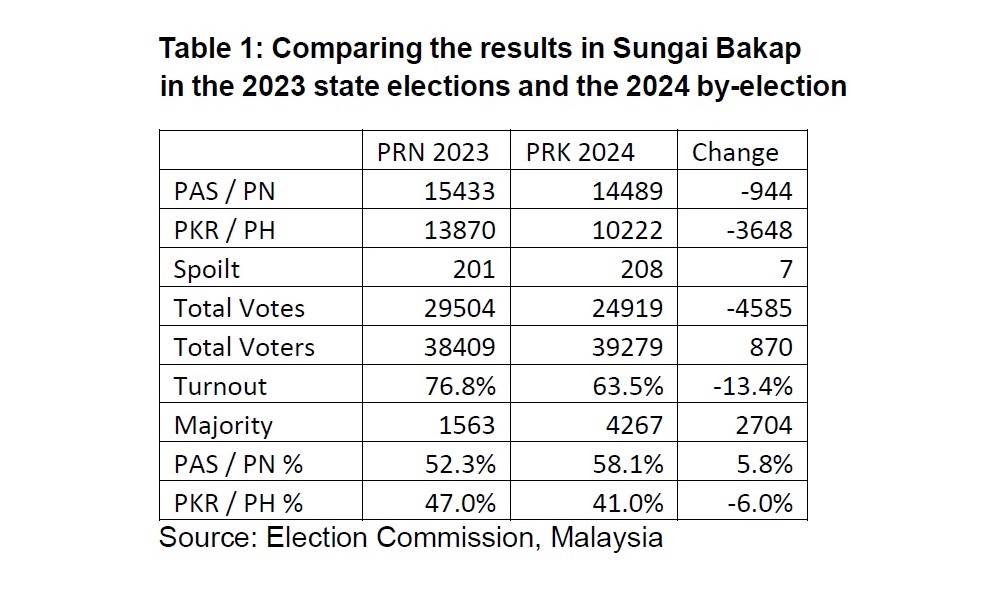
Table 1 below compares the results in the Sungai Bakap state seat for the 2023 state election and the recent by-election.
The winning majority increased from 1,563 to 4,267 in favour of PN and the support for PN increased from 52.3 to 58.1 percent while turnout fell by 13.4 percent from 76.8 to 63.5 percent.
One of the key highlights from this by-election is the much larger drop in the non-Malay turnout compared to the Malay turnout.
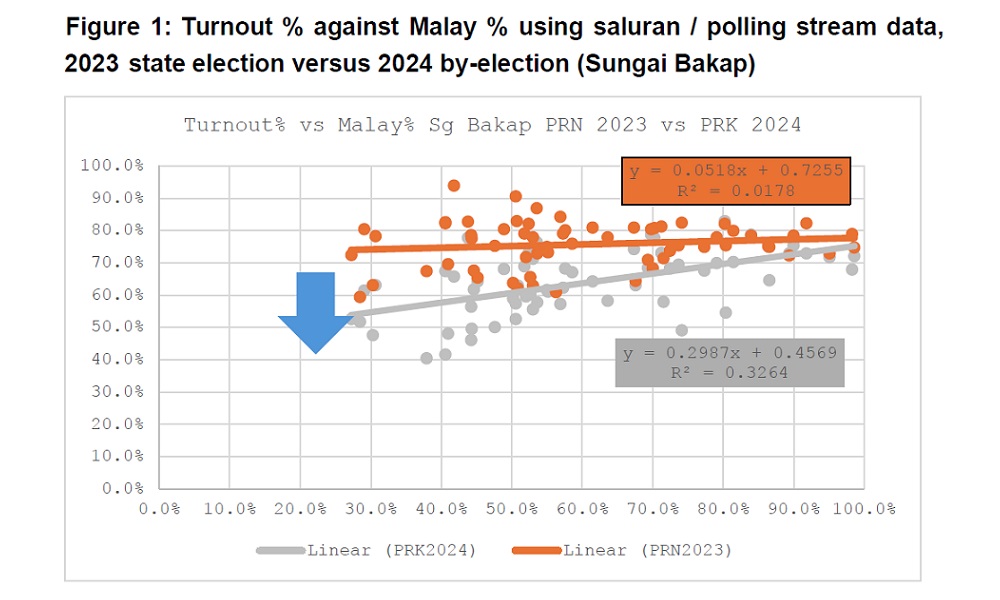
Figure 1 below shows the turnout percentage against the percent of Malay voters in each saluran or polling stream for the 2023 state election and the 2024 by-election.
For 2023, there is no significant difference in the turnout of the Malay versus the non-Malay voters as seen by the more or less horizontal line.
The situation is very different for the 2024 by-election where there is a significant drop in the non-Malay turnout and a much smaller drop in the Malay turnout.
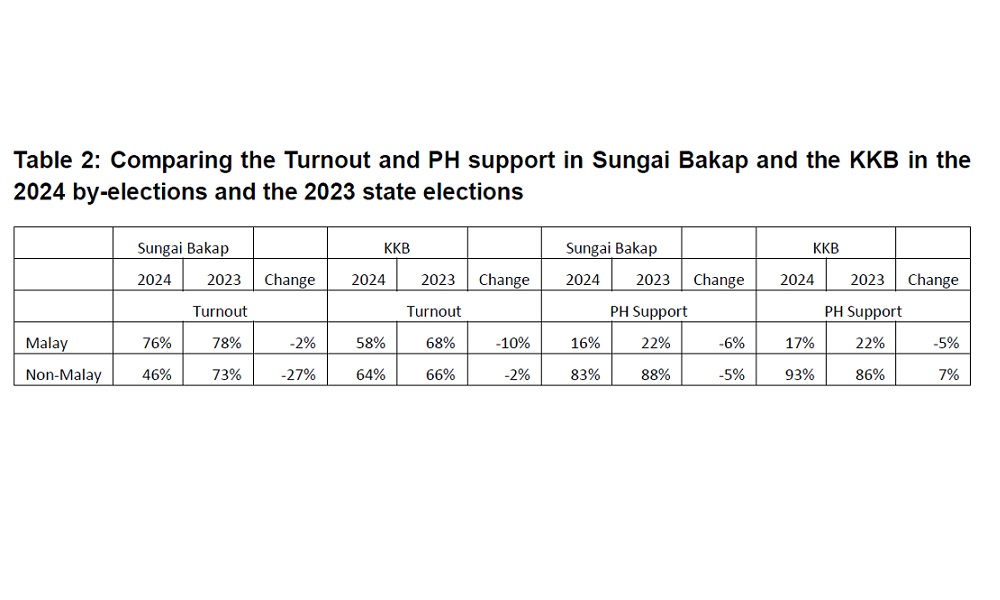
The estimated Malay and non-Malay turnout in 2023 were 78 and 73 percent respectively while the estimated Malay and non-Malay turnout in 2024 were 76 and 46 percent respectively.
This means that the estimated Malay turnout fell by two percent while the non-Malay turnout fell by a massive 27 percent from 2023 to 2024.
I was not able to estimate the Chinese and Indian turnout separately because of the relatively small percentage of Chinese and Indian voters in most of the polling stations.
With this differential in turnout among Malay and non-Malay voters, the Sungai Bakap seat effectively went from being a 60-40 Malay/non-Malay seat to 70-30.
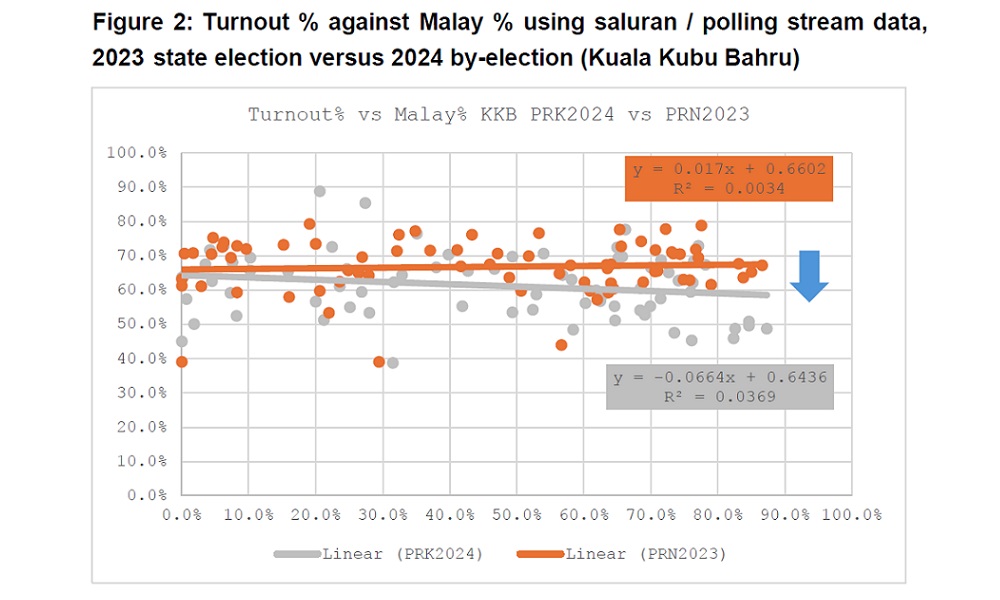
This is in contrast to the Kuala Kubu Baharu (KKB) by-election on May 7, where the turnout of Malay voters fell by 10 percent from 68 to 58 percent while the turnout of non-Malay voters fell by only two percent from 66 to 64 percent compared to the 2023 state elections. (See Figure 2 below)
This meant that KKB went from a 50-50 Malay/non-Malay seat to a 47-53 Malay/non-Malay seat.
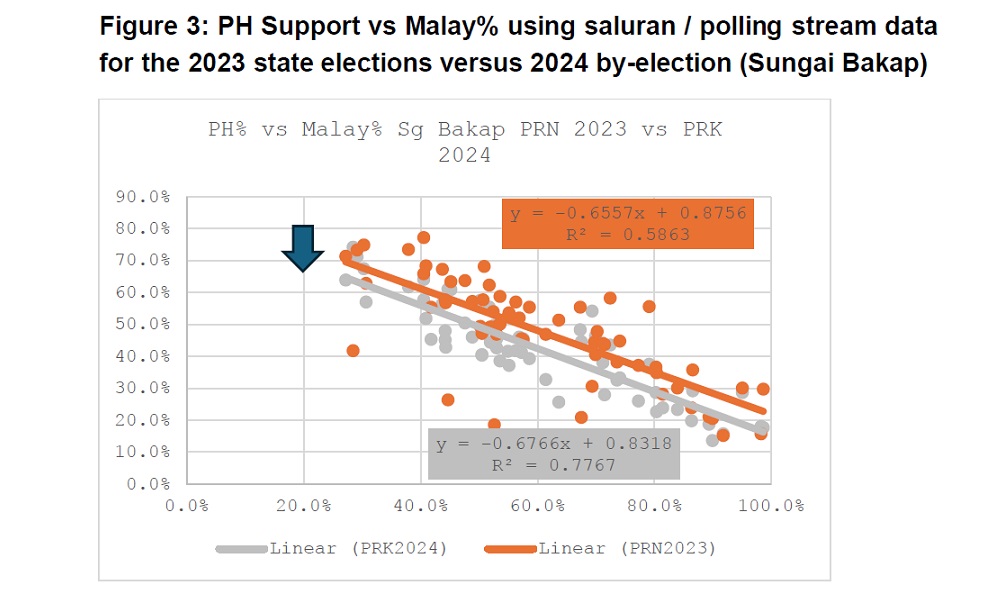
The shifts in Malay and non-Malay support for Harapan were more balanced among voters.
According to Figure 3 below, the estimated Malay support for Harapan fell by six percent from 22 to 16 percent while the estimated non-Malay support for Harapan fell by five percent from 88 to 83 percent.
Harapan suffered a double whammy in that not only did it lose some Malay and non-Malay support from 2023 to 2024, but there was also a significant drop in the non-Malay turnout, the overwhelming majority of whom supported Harapan in 2023 and previous elections.
In the KKB by-election, the estimated Harapan Malay support fell by five percent from 22 to 17 percent but this was compensated by the increase of six percent in non-Malay support from 86 to 93 percent.
The fact that the non-Malay turnout fell by less than the Malay turnout in KKB also explains why Harapan was able to maintain this seat with a similar majority and a slight increase in vote share, in contrast to the situation in Sungai Bakap (See Figure 4 below).
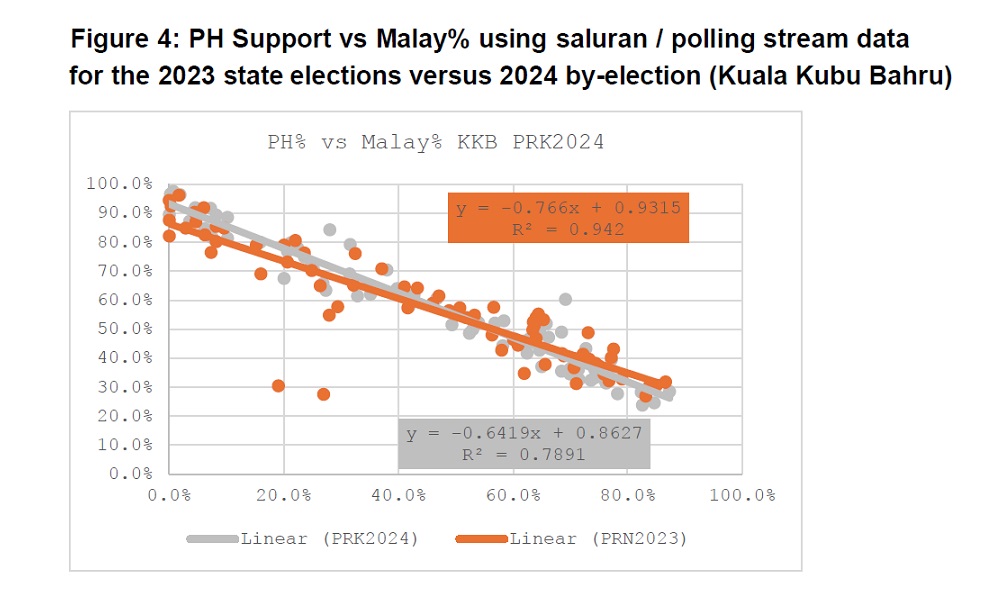
Table 2 below summarises the differences between the turnout rates and levels of Harapan support for the Sungai Bakap and KKB by-elections in 2024 and the results in the same seats in the 2023 state election.
It was always going to be an uphill task for Harapan to win back this seat from PN right from the start of the campaign because of the following reasons:
The challenge to counter the narrative of rising costs of living in the post-Covid landscape under the Madani government.
Poor communications with regard to the policy direction of the government.
The tough reality that there are more issues for the opposition to attack the government on, compared to the positive outcomes which the government can claim credit for.
The battle was made harder during the campaign because of:
The inability of the government to effectively explain the reasons for the introduction of the targeted diesel subsidy.
The incessant politicisation by the opposition of the Malaysia Airports Holdings Berhad (MAHB) privatisation exercise involving a minority share by Global Infrastructure Partners (GIP), which was acquired by Blackrock.
The unfortunate use of derogatory remarks by PKR elections campaign director Rafizi Ramli against the opposition and the unnecessary playing up of the differences in academic qualifications of the Harapan versus the PN candidate.
The dramatic fall in the non-Malay turnout reflected the growing disappointment among the Chinese and Indian communities towards the Madani government over unfilled promises and poor performance amid an uncertain economic landscape.
The poor handling of the Dual Language Program (DLP) and matriculation-related issues also likely contributed to this sense of unhappiness.
The lower turnout as a protest vote among the non-Malays and the slight shift in the non-Malay vote towards PN should be a warning sign to Harapan and Umno.
If this trend continues and if it cannot be reversed before GE16, a sizeable number of marginal seats won by Harapan in GE15 and some of the seats which Umno are hoping to hold on to via an electoral pact with Harapan may be lost to PN.
Will Sungai Bakap be a positive wake-up call for the Madani government? Time will tell, but I am not particularly optimistic at this point.
ONG KIAN MING is a former Bangi MP and former deputy international trade and industries minister.
The views expressed here are those of the author/contributor and do not necessarily represent the views of Malaysiakini.
/file/publisher-c1a3f893382d2b2f8a9aa22a654d9c97/2024/06/b1e43bcb0a9b1b75d006d110f2755b01.jpg)
/file/publisher-c1a3f893382d2b2f8a9aa22a654d9c97/2024/06/f64e07186d9e8aedd4330ae6ced72a56.jpg)
/file/publisher-c1a3f893382d2b2f8a9aa22a654d9c97/2024/06/911d89f45b27b24ff9107d258a2efb60.jpg)
/file/publisher-c1a3f893382d2b2f8a9aa22a654d9c97/2024/07/266c3dbd4eee112179f7531f152e59d9.jpg)


Report this comment
Are you sure you want to delete this comment?
This action cannot be undone.