




Water debate doused
When religious leaders from different faiths in Malaysia recently sought jointly to affirm the sacredness of water as the source of life, they were shooed away by authorities keen on scuttling interfaith harmony and in support of plans to privatize a common resource.
Plans to hold the highly symbolic interfaith forum on the right to water at the National Mosque, a major landmark in the capital Kuala Lumpur, had to be scuttled when the organisers were suddenly forced to move the venue to a location five kilometers away.
The last-minute change did not stop prominent leaders of the Muslim, Buddhist, Christian, Hindu and Sikh faiths signing a landmark joint declaration on water and affirming that it is a sacred gift bestowed by the Creator to people to be conserved and used to fulfill the basic needs of all living things on Earth.
When religious leaders from different faiths in Malaysia recently sought jointly to affirm the sacredness of water as the source of life, they were shooed away by authorities keen on scuttling interfaith harmony and in support of plans to privatize a common resource.
Plans to hold the highly symbolic interfaith forum on the right to water at the National Mosque, a major landmark in the capital Kuala Lumpur, had to be scuttled when the organisers were suddenly forced to move the venue to a location five kilometers away.
The last-minute change did not stop prominent leaders of the Muslim, Buddhist, Christian, Hindu and Sikh faiths signing a landmark joint declaration on water and affirming that it is a sacred gift bestowed by the Creator to people to be conserved and used to fulfill the basic needs of all living things on Earth.
"It symbolizes life in its pristine form," they declared. "The right to water is intrinsically linked to the right to life."
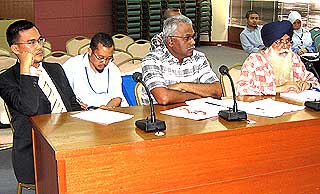 They also stressed that everyone is entitled to "sufficient, safe, acceptable, physically accessible and affordable water". They said the use of prepaid cards and water disconnections would be in violation of this right and that water conservation, preservation and protection were the responsibility of the people and the state. "Access to water therefore cannot be premised on profitability. People should enjoy this right without discrimination."
A great missed opportunity
That message, of course, is at direct odds with the Malaysian government's water-privatization plans. And organisers wondered aloud whether the abrupt orders to move their event were being carried out on behalf of business interests in the water sector. In recent years, Malaysia has seen private corporations eyeing the water sector in search of profits, while water management has been revamped in a move that will allow private firms to profit from billions of ringgit in water-infrastructure development projects.
The proceedings at the forum, attended by some 200 people, were largely overshadowed by the external circumstances leading up to the event having to change venue. "This was a great missed opportunity when all the religions could have come together [at the National Mosque] and discussed a critical issue confronting society," said Charles Santiago, coordinator of the Coalition Against Water Privatization pressure group.
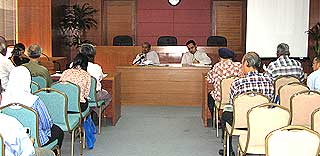 Holding it at the National Mosque "would have fostered a very good spirit in the context of 50 years of Merdeka [independence] to discuss the human right to water". He also said it would have been a great moment of unity in the country, currently divided on issues of ethnicity and religion, especially between advocates of a conservative Islamic state and those who prefer a more liberal tradition.
On July 31, Santiago said the mosque authorities had warmly received a delegation from the organizers. Mosque officials had told the organisers that the seminar would be historic and was in line with official guidelines to engage with civil society. In preparation, they also had advised the organisers on the proper attire for participants at the seminar.
Organisers now allege that police subsequently put pressure on the mosque to rescind its verbal approval. On August 2, a letter was issued by the chief imam of the National Mosque refusing to grant permission for the inter-faith meeting. Organisers then applied for a police permit and, upon contacting the police on August 3, Santiago said they were told that the permit had been approved and it could be collected later that day.
However, when one of the organisers turned up to collect the permit, he was questioned at length, and the permit was denied. Organisers also allege that the police or outside parties "manufactured information" to create a situation of fear, uneasiness and uncertainty surrounding their planned meeting. This contributed to the "National Mosque officials deciding not to host the meeting in spite of having earlier agreed to the event being held there", they said in a formal complaint to the Human Rights Commission of Malaysia.
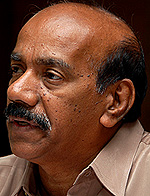 The conduct and actions of the authorities "demonstrated that they or the parties that gave them the instructions were unhappy that people of all faiths, and races are coming together to deliberate and discuss societal issues and future of the country", the complaint stated.
Critical position
Human Rights Commissioner Siva Subramaniam, after a meeting with the district police chief responsible for the area, said police told him they had rejected the permit on technical grounds. "They said the Imam Besar had not given permission to hold the meeting [at the mosque] and he had issued a rejection letter on August 2," Siva said in an interview.
Moreover, the police said the organisers needed five full days to apply for the permit and that they had to attach the permission of the owners of the premises in their permit application. "The rumors of potential unrest and protests were never a consideration in rejecting the permit," said Siva.
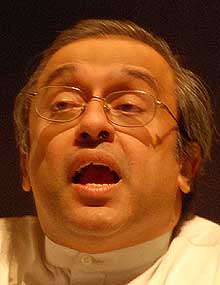 Chandra Muzaffar, director of the International Movement for a Just World, who delivered the keynote address at the forum, cited another factor likely responsible for the forced change of venue: "This was an event that would have brought the various religious groups together." He later added: "The forum would have taken a critical position on the state's policy toward water."
He went on to say it was unfortunate that the police seemed more interested in protecting the interests of the state than those of the people. He added that there was also a symbolic dimension to the incident, as the nation gears up to celebrate 50 years of independence from British colonial rule.
"The whole event raises fundamental questions about the nature of our [independence]," said Chandra, adding that laws that restrict the right to freedom of assembly are legacies of the colonial era that remain in the statute books but should have been abolished.


