


/file/publisher-c1a3f893382d2b2f8a9aa22a654d9c97/2024/08/f92faaee9a7df66175ba9310808ca04b.jpg)

COMMENT | Anwar's civil service pay hike brave, progressive
COMMENT | While many appear to publicly support Prime Minister Anwar Ibrahim’s announcement of a wage increase of 7-15 percent for civil servants in the support, managerial, and professional categories, many also privately sneer and snigger at the move.
What? Such a bloated civil service, on top of inefficiency, corruption, and incompetence. Why do they deserve a salary increment, they ask. However, examining it coolly and discarding the prejudiced image of the civil service we have shows a different picture.
The salary adjustment will likely catalyse similar moves in the private sector, despite resistance from the Malaysian Employers Federation, whose sole function appears to be to depress employee wages and always resist wage increases, including the minimum wage, to benefit employers.
The last time civil servants got a salary adjustment was over 12 years ago. Isn’t it high time they are given one? Living costs have gone up so much. Are private sector workers the only ones whose wages should be reviewed periodically every three years or so?
COMMENT | While many appear to publicly support Prime Minister Anwar Ibrahim’s announcement of a wage increase of 7-15 percent for civil servants in the support, managerial, and professional categories, many also privately sneer and snigger at the move.
What? Such a bloated civil service, on top of inefficiency, corruption, and incompetence. Why do they deserve a salary increment, they ask. However, examining it coolly and discarding the prejudiced image of the civil service we have shows a different picture.
The salary adjustment will likely catalyse similar moves in the private sector, despite resistance from the Malaysian Employers Federation, whose sole function appears to be to depress employee wages and always resist wage increases, including the minimum wage, to benefit employers.
The last time civil servants got a salary adjustment was over 12 years ago. Isn’t it high time they are given one? Living costs have gone up so much. Are private sector workers the only ones whose wages should be reviewed periodically every three years or so?
Government salaries are paid on a scale. Even competent workers - and there are many of them who work very hard - seldom get double increments, partly because of the large number of government workers. Moving from one scale to another is considered a promotion and not assured.
Most of the time, the vast majority get scale adjustments only. That means a 2-3 percent adjustment yearly, if it comes to that. It does not even keep up with price increases and denies them an opportunity to move up the income ladder in real terms.
Is the civil service truly bloated?
The truth is, this salary adjustment for civil servants is long overdue.
And where do so many Malaysians who should know better get the information that the civil service is bloated? Our country includes the armed forces, police, teachers, and health service personnel as civil servants.
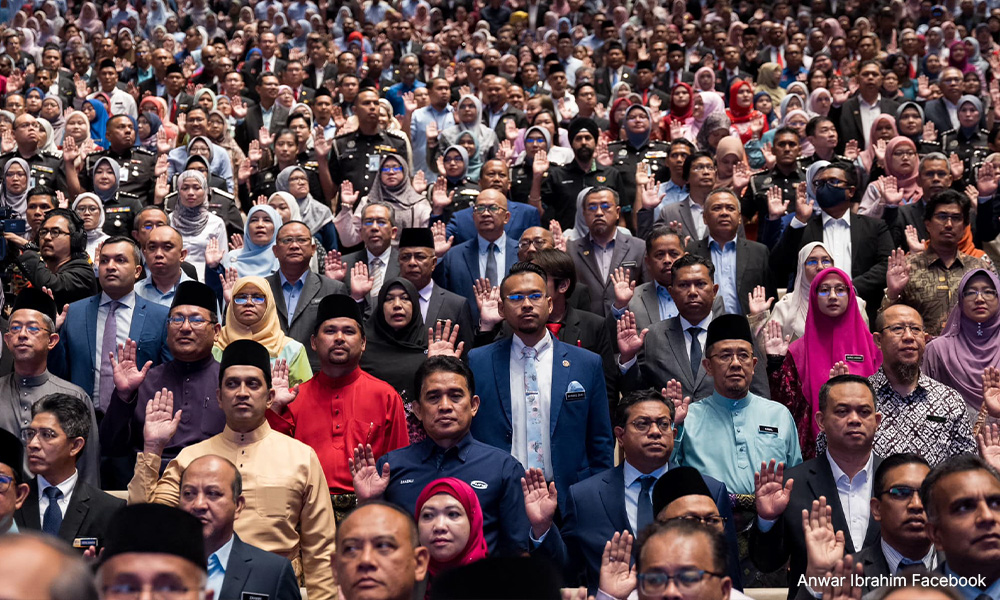
Exclude them (there are over 400,000 teachers alone) and the civil service population could drop precipitously, as I explained in this article. If a proper apples-to-apples comparison is made, the civil service is not bloated.
This is not to say that the civil service is super-efficient. There is much that can be done and improved and this has to come from the top and then percolate to all staff. That is something that Anwar should turn his focus on in the future.
When people talk sweepingly about corruption, inefficiency, incompetence, discrimination etc in the civil service, they are talking broadly - such things are present everywhere but more so only in some branches of government.
It’s unfair to tar the entire civil service for that. Much of the civil service is not corrupt and does an honest day’s work for less-than-fair wages, settling for a revision every 12 years for some adjustments to be made.
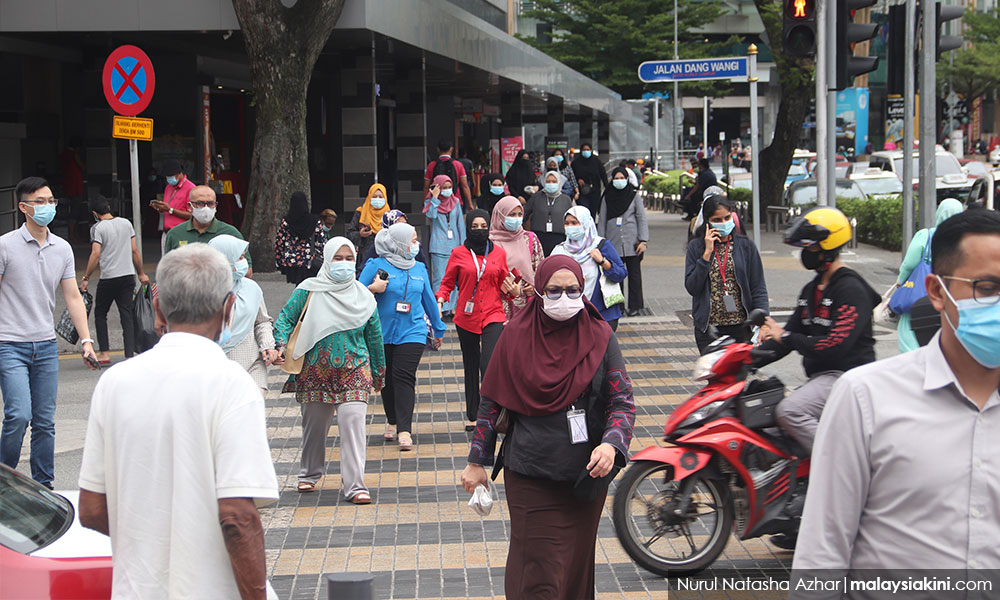
Anwar’s move to increase civil service salaries may help spark similar moves in the private sector. Roughly, the country has some 17 million workers, with the civil service employing just 1.7 million or only 10 percent of the workforce.

Reasonable and sustained wage adjustment must include the private sector, a huge portion of which has become extremely dependent on foreign imported labour estimated to be four to six million workers. Recognised legal migrant workers are around two million.
Over time, adjustments must include a plan to reduce such dependence or to regulate it strictly, ensuring that it does not descend into little more than slave labour as it does in many industries now.
Reducing wealth gap
The extent to which employers benefit from using labour is indicated by a statistic called labour share of gross domestic product (GDP), the sum of goods and services produced. This is a measure of wealth creation through GDP generation which goes to labour.
It is defined thus: “The labour share of GDP is the total compensation of employees given as a percent of GDP. It provides information about the relative share of output paid as compensation to employees, compared to the share paid to capital.”
Malaysia’s labour share was a paltry 32.4 percent in 2022, which means that the share to providers of capital or employers was 67.6 percent, more than twice labour’s share.
This is particularly inequitable because the total number of capital providers is likely to be a small fraction of total employees.
The table below gives a comparison with some countries. Some things may distort figures - for instance, Malaysia’s high dependence on imported labour for key industries such as plantations, manufacturing and semiconductors. But Malaysia’s figure is still very low compared to others.
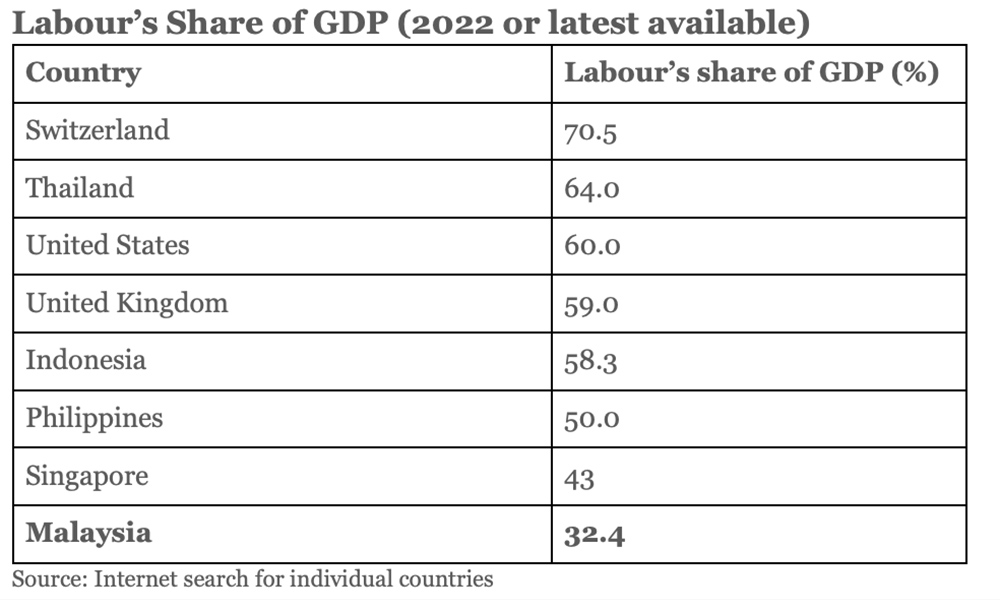
Note that Malaysia’s share has actually declined from 35.2 percent in 2017 to 32.4 percent in 2022.
However, under the Madani economic programme, the target is to increase this to 45 percent within a decade, which is still way too low in terms of the share with capital providers.
Look at Switzerland’s 70.5 percent and the US’ 60 percent for instance and even Thailand’s 64 percent and Indonesia’s 58.3 percent.
Another important point to note from this is that providers of capital are getting too much share of the GDP - too much of the profit of enterprises goes to employers rather than workers. So it may be necessary to induce employers to share more of their take with employees.
If employers take a lesser share, wage adjustments can be more rapid. That is why Anwar’s move to increase civil service salaries should be welcomed by all who want a more equitable distribution of income between labour and capital, between employees and employers.
P GUNASEGARAM says wage reforms for civil servants are probably the best thing the Madani government has done so far - and it is a significant achievement.
The views expressed here are those of the author/contributor and do not necessarily represent the views of Malaysiakini.
/file/publisher-c1a3f893382d2b2f8a9aa22a654d9c97/2021/06/b61113cf1bfe458ad0c2c28ec0a1e08f.jpg)
/file/publisher-c1a3f893382d2b2f8a9aa22a654d9c97/2024/08/acf190a75952822a6945865de417b68a.jpg)
/file/publisher-c1a3f893382d2b2f8a9aa22a654d9c97/2023/04/5df416ebb57b4cb662ccbf589adae4c9.jpg)
/file/publisher-c1a3f893382d2b2f8a9aa22a654d9c97/2024/01/03ec2a701d1557174becc27177139ab3.jpg)
/file/publisher-c1a3f893382d2b2f8a9aa22a654d9c97/2024/08/6b6e195d1163a585594b4acdee0acd27.jpg)
/file/publisher-c1a3f893382d2b2f8a9aa22a654d9c97/2024/08/77b4bff40caf22d665ec461fe01fde81.jpg)


Report this comment
Are you sure you want to delete this comment?
This action cannot be undone.