


/file/publisher-c1a3f893382d2b2f8a9aa22a654d9c97/2020/10/aef2b00854807196d5d5054cfba4b041.jpg)

COMMENT | Truth should be every leader's shield, not legal technicalities
Stand that principle on its head. Is a prime minister immune from a civil suit (e.g. a suit for breach of contract to buy a property)? What if he or she did enjoy such an immunity? What would happen?
Picture this: a prime minister stands before the highest court in the land, not as the nation’s chief executive, but as a defendant asking for shelter from the storm of civil litigation.
It is a scene that would have made Shakespeare reach for his quill - power that is seeking protection from the very justice it is meant to uphold.
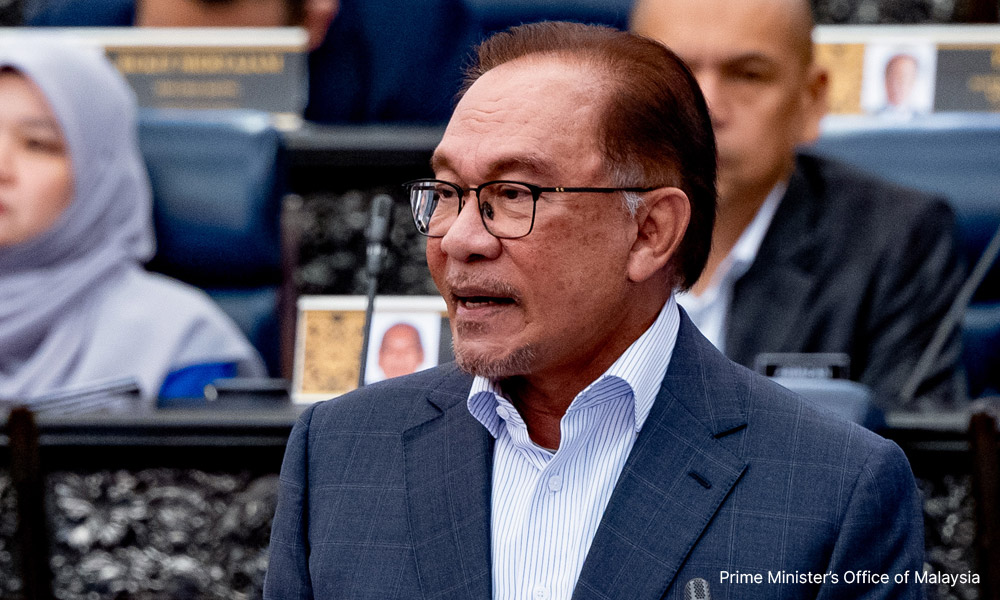
Yet, here we are in Malaysia, watching this constitutional drama unfold as Prime Minister Anwar Ibrahim asks our Federal Court whether...
COMMENT | Do you remember an essay I wrote in 2018? The one that argued that a former prime minister enjoyed no immunity from criminal prosecution?
Stand that principle on its head. Is a prime minister immune from a civil suit (e.g. a suit for breach of contract to buy a property)? What if he or she did enjoy such an immunity? What would happen?
Picture this: a prime minister stands before the highest court in the land, not as the nation’s chief executive, but as a defendant asking for shelter from the storm of civil litigation.
It is a scene that would have made Shakespeare reach for his quill - power that is seeking protection from the very justice it is meant to uphold.
Yet, here we are in Malaysia, watching this constitutional drama unfold as Prime Minister Anwar Ibrahim asks our Federal Court whether he can be shielded from a civil suit filed even before he occupied Putrajaya, just because he is now sitting there.
Contradiction of power and accountability
The nation finds itself in an odd contradiction. Anwar once thundered about “reformasi” and “accountability” from the opposition benches. He now seeks constitutional cover from the very system he once challenged.
It is like watching a poacher turned gamekeeper asking for protection: from the very laws he once broke – except this time, the irony cuts deeper, because the alleged conduct predates his ascension to power.
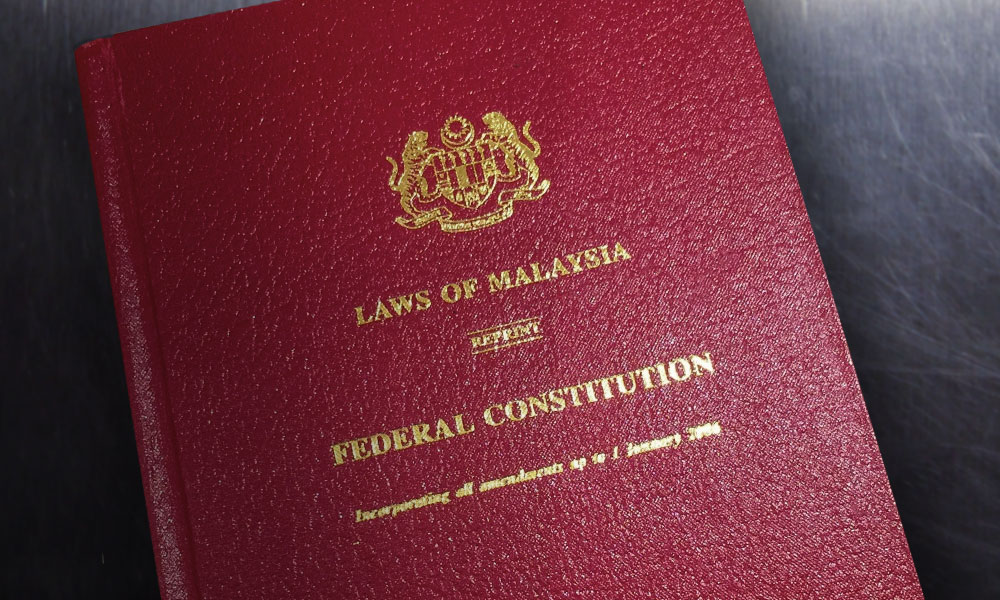
The Federal Constitution does not at all grant any prime minister immunity from civil suits.
Articles 39, 40, and 43 – which Anwar’s legal team now invokes – were designed to explain and delimit “executive” function (meaning the government’s source of power, duties, obligations, and liabilities).
They do not protect the executive person. So, the premier is not protected from a civil suit, particularly from a suit commenced for alleged conduct before he became prime minister.
As the great constitutional scholar AV Dicey observed, “No man is above the law, and everyone, whatever his rank or condition, is subject to the ordinary law of the realm.”
But here is where our constitutional contradiction reveals its teeth.
His Majesty the Yang di-Pertuan Agong himself can be tried in the Special Court - yet we have here a prime minister who now argues he should be untouchable in civil matters. Do you not think that’s odd?
How have other premiers fared when seeking similar shields? Hint, hint: it rarely ends well for those claiming immunity.
The Clinton chronicles
Across the Atlantic, US president Bill Clinton discovered that American courts take a dim view of claims for “executive immunity” for pre-presidential conduct. In Clinton v Jones 520 US 681 (1997), Paula Jones sued the sitting president for alleged sexual harassment that had occurred before he took office.
Clinton’s lawyers argued for absolute immunity, citing Nixon v Fitzgerald 457 US 731 (1982).

Yet, here is the constitutional rub.
The Supreme Court distinguished between “official acts” (which enjoy immunity) and “personal conduct” (which does not). The court ruled that Clinton was not entitled to any “temporary immunity” from civil litigation for “unofficial” conduct occurring before he took office.
Clinton learned what Anwar is now discovering: the office protects official acts, not personal conduct.
The Berlusconi Saga
Italy’s Silvio Berlusconi provides another cautionary tale. The media mogul turned prime minister faced numerous civil suits during his tenure. He repeatedly sought immunity through legislation – he got Parliament to pass the Lodo Alfano and Lodo Mondadori laws: these were designed to shield serving prime ministers from prosecution.
Each time he did that, Italy’s Constitutional Court struck down these immunity laws. In October 2009, the Italian Constitutional Court struck down the Lodo Alfano law for being unconstitutional.
The court ruled that such blanket immunity violated the principle of “equality before the law”. Berlusconi discovered that even in Italy’s often chaotic political system, the courts would not grant prime ministers a “free pass” from civil accountability.
The Boris Johnson debacle
In 2019, British prime minister Boris Johnson learned the hard way that even the royal prerogative has limits. To avoid why he was dying for a Brexit, he wanted to duck parliamentary scrutiny. So he prorogued (postponed) Parliament for five weeks - ostensibly for a “Queen’s Speech” (that happened in Malaysia too - can you remember when and how?)
The United Kingdom Supreme Court then delivered a unanimous judicial slap that echoed all across the hollow chambers of Westminster.
The Supreme Court ruled that Johnson’s advice to the Queen to prevent the parliamentary sitting was “unlawful, void, and of no effect” in R (Miller) v The Prime Minister UKSC 41. The joint judgment was delivered by Lady Hale and Lord Reed. They told off the prime minister - that parliamentary sovereignty trumped “executive convenience”.
As the Supreme Court noted, referring to the 1611 Case of Proclamations: “[The] King hath no prerogative but that which the law of the land allows him”.
Johnson’s attempt to use constitutional machinery for political ends was demolished faster than you could say “Get Brexit Done”. The lesson? Even in Britain, where prime ministerial power runs deep, the courts will not hesitate to check executive overreach.
It could be argued that Johnson was sued in his “official capacity”, and not in his “personal” one. True. If the Supreme Court could castigate his “official” conduct, would not a suit premised on his “personal” conduct have offered a larger, readier, and easier target?
The Malaysian misstep
Now, let us examine Anwar’s unprecedented gambit. His legal team argues that civil suits could “impair the effective discharge of his executive duties and undermine the constitutional separation of powers”.
It is such a creative argument that even my grandmother would have called it barmy – it is like claiming you cannot be sued for a car accident because “it might affect” your “driving confidence”.
The timing raises eyebrows sharper than a Federal Court judge’s gavel.
The civil suit was scheduled for trial on June 16. That date falls just before the retirement of Chief Justice Tengku Maimun Tuan Mat in July 2025. Anwar’s new legal team, appointed mere days before filing, rushed to seek delays and “constitutional cover”.
But here is the constitutional kicker: even US President Donald Trump’s immunity claims were limited to “official” acts. The US Supreme Court ruled in Trump v United States that former presidents have “absolute” immunity for actions within their “core constitutional powers” but only “presumptive immunity” for “actions within the outer limits of their official duties”.
If American presidents – arguably more powerful than Commonwealth prime ministers – cannot claim blanket immunity for personal conduct, what makes Malaysian prime ministers so special?
Our Federal Court has already spoken on this matter.
In Tony Pua v Najib Abdul Razak, the Federal Court ruled that prime ministers are “public officers” who can be sued for misfeasance in public office. The court established that the government can be held vicariously liable for any wrongdoing committed by any one of its officers.
Power and accountability
Power tends to seek shelter from accountability - to understand this, we must invoke the immortal words of Thomas Fuller in 1733: “Be ye ever so high, the law is above you”.
”De jure judiciaria,” Lord Denning quoted Thomas Fuller in Gouriet v Union of Post Office Workers [1977] QB 729. These words, carved into legal history, remind us that no office, however exalted, can ever place its holder beyond the reach of justice.
Fuller was not speaking in abstract terms. He was addressing the very real tendency of power to seek shelter from accountability. His words echo through the centuries because they capture an eternal truth: the moment we place any office above the law, we cease to be “a nation governed by law” and become “a nation governed by men” - not a good thing.
The sovereignty contradiction
The doctrine of sovereign immunity historically protected the Crown because, as the old maxim goes, “the King can do no wrong.” But this was never about personal infallibility – it was about ensuring government function.
In the UK, the Crown Proceedings Act 1947 dramatically altered this landscape. The Act made the government liable in civil proceedings while maintaining limited criminal immunity.
Even then, in the United Kingdom, the monarch remains personally immune, but through ancient mechanisms like the Petition of Right - not blanket constitutional cover.
Malaysia’s constitutional monarchy borrowed heavily from Westminster. But we never adopted such comprehensive sovereign immunity. Our Federal Constitution protects official acts, not personal conduct.
If Anwar succeeds, we will have created a constitutional monster. Every future prime minister could claim immunity from civil suits by arguing they are “too busy governing to face justice”. It is like giving every driver a “Get Out of Traffic Court Free” card because appearing before a court might “delay their travelling time”.
The constitutional architecture simply does not support prime ministerial immunity for personal conduct. Consider the absurdity: if a prime minister could claim immunity from civil suits, what stops him or her from claiming immunity from contract disputes, tort claims, or family court proceedings?
The rule of law
Article Eight of our Federal Constitution guarantees “equality” before the law. Granting prime ministerial immunity for personal conduct would shatter this principle: by hurling a gavel through the transparency of glass. Such a ruling could have far-reaching effects on the rule of law.
Some cannot be “more equal than others” (where do you think that sentence came from?)
The deeper irony cuts like a constitutional knife. Anwar, who once stood in prison declaring the system “was broken”, now asks that same system to shield him. He risks becoming the very caricature his younger self fought against.
Democracy demands that power be accountable, not comfortable.
If we accept that prime ministers can claim immunity from civil suits, we have essentially created a class of constitutional untouchables. It is the antithesis of everything reformasi represented.
The Federal Court now faces a choice that will define Malaysian constitutionalism for generations. They can either uphold the principle that no one, not even a prime minister, is above the law, or they can create a precedent that turns Putrajaya into a fortress of impunity.
As Nelson Mandela reminded us, “There is no easy walk to freedom anywhere”. The mountaintop of Malaysian democracy requires that even prime ministers remain answerable to the people they serve.
True immunity comes not from seeking “constitutional cover” - but from conducting oneself with such integrity that civil suits become unnecessary.
Truth, not legal technicalities, should be every leader’s shield.
The Federal Court’s decision will reveal whether Malaysia truly believes in equality before the law, or whether some people are indeed more equal than others.
The rakyat are watching. And history is taking notes.
GK GANESAN is a lawyer and an international commercial arbitrator.
The author thanks UK Menon, Gana Naidu, KN Geetha, TP Vaani, JN Lheela, and Lydia Jaynthi.
Malaysiakini has obtained permission to republish this article, which first appeared here.
The views expressed here are those of the author/contributor and do not necessarily represent the views of Malaysiakini.
/file/publisher-c1a3f893382d2b2f8a9aa22a654d9c97/2024/09/f08fc6aaf9e972335c471a4902ef0dec.jpg)
/file/publisher-c1a3f893382d2b2f8a9aa22a654d9c97/2025/05/2cef999115f8a1adc27df84a959c0333.jpg)
/file/publisher-c1a3f893382d2b2f8a9aa22a654d9c97/2024/09/69d573cda15eb188a7ecbae4b8593a2c.jpg)
/file/publisher-c1a3f893382d2b2f8a9aa22a654d9c97/2025/05/88256c52fe8880ba310467c5600377c3.jpg)
/file/publisher-c1a3f893382d2b2f8a9aa22a654d9c97/2025/04/09027e873dca737cfe9c70780cccfdb1.jpg)
/file/publisher-c1a3f893382d2b2f8a9aa22a654d9c97/2024/10/35de0eb137de0422a4218eba102fe46d.jpg)


Report this comment
Are you sure you want to delete this comment?
This action cannot be undone.