




Impunity for powers-that-be?
The sentencing of Alberto Fujimoro to six years in prison for crimes committed during his presidency of Peru is one more strand in the noose tightening up on leaders everywhere. L’etat c’est moi, Louis XIV famously commented and yes, the state was his.
Since the late 17th century we should hope that rules of accountability and transparency have spread - but this has not gone far enough. The higher up you are, the more people you have to protect you, it has always seemed.
And there’s the difference in attitude toward people at the top; when Syariah law started to get applied seriously in Aceh province, it seemed it was only the little people who got punished - for minor gambling. The governor for a long time escaped its consequences despite long-known and grave abuses of power.
The sentencing of Alberto Fujimoro to six years in prison for crimes committed during his presidency of Peru is one more strand in the noose tightening up on leaders everywhere. L’etat c’est moi, Louis XIV famously commented and yes, the state was his.
Since the late 17th century we should hope that rules of accountability and transparency have spread - but this has not gone far enough. The higher up you are, the more people you have to protect you, it has always seemed.
And there’s the difference in attitude toward people at the top; when Syariah law started to get applied seriously in Aceh province, it seemed it was only the little people who got punished - for minor gambling. The governor for a long time escaped its consequences despite long-known and grave abuses of power.
Of course many heads have rolled because their successors have wanted to teach a political lesson. When Flight Lt Rawlings seized power in Ghana in 1979, he had three former heads of state gunned down on the beach for corruption, a charge no one doubted, but one that later could well have been applied, on the same rough standard, to himself. It was not a judicially-inspiring way of dealing with the problem but it certainly made everyone scared of Rawlings.
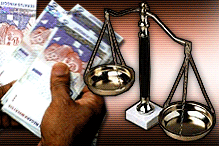 Things are changing. Financial dealings can now be exposed by private citizens. A check has two ends, and if you can hide the transaction at your end you can’t necessarily hide the recipient’s identity.
A case in point is Pavel Lazarenko, who was Ukraine’s premier from 1995-97, during which he allegedly stole about US$1 billion. What isn’t alleged is that he was convicted of fraudulent transfers in San Francisco in 2004 and earlier in Switzerland. He has appealed, but meantime wears an electronic bracelet. A henchman partner who turned state’s evidence is already awaiting sentencing and admits to millions of dollars of theft. What is interesting is that every financial transaction they made has come to light. One check leads to another.
And interesting patterns emerge. Hundreds of thousands of dollars are transferred to people charged with political assassination back home - just after they’ve attempted or succeeded in their dirty work. We know the exact amount and the dates of the checks, in the hundreds of thousands of dollars.
Meantime they try to hedge in their favour back home. Judges making a few thousand dollars a year in Ukraine suddenly ‘decide’ to protect Lazarenko’s position - he with a billion dollars or so to play with.
But that didn’t work in San Francisco where he and his pals bought a US$40 million worth of real estate empire. They should have tried Panama instead, where they were at least able to buy passports under faked names. He’s getting away with keeping all his dirty money at the civil court level but he won’t enjoy too much of it in jail, once sentenced.
No price on honour
There’s a better model. See how much the world honours successful leaders who have cleaned up corruption.
Anand Panyarachun twice was appointed to sweep Thai floors clean and as they said, you could easily park at Government House; translated, it meant the favour-seekers didn’t even dare come around with paws out. Everywhere he goes he is honoured, on international boards, VIP treatment everywhere. There’s no amount of money that could buy that kind of honour, coming from honest and honourable leadership.
The American model is that if you are really successful you make a fortune in book contracts. It’s an honourable way of paying off good leaders. They also get hundreds of thousands of dollars for appearing at bank board retreats and making a few trite remarks.
 Bill Clinton has to use his newly and legally acquired millions earned that way to pay off his legal expenses incurred during his presidency. But if he’d had more thought about what he did in the vestibule of the West Wing and not lied to a jury, none of that would have been necessary.
Lyndon Johnson feathered his post-presidential nest by getting laws passed, further enhanced by Richard Nixon, that ex-presidents needed protection wherever they went. That was translated to mean millions of dollars of upgrades at his ranch on the Perdanles River.
Nixon was even smarter; the US government had spent millions expanding his San Clemente estate, adding guest houses - ah, for secret service agents. But when he was disgraced and a demand went out that he pay back for all those improvements he shrewdly demanded that the government come and get them, knowing full well that would be far more expensive. But all this had a veil of legality.
When I was on the board of the White House-created US Institute of Peace, I not entirely facetiously proposed that we give automatic grants to any third world head of state that left office constitutionally.
We couldn’t have matched the billions guys like Mobuto got out of the Congo but we could have drawn attention to the rewards of doing things right. In fact when I proposed it, there wouldn’t have been many grants going to Africa at all, but now there have been real and lively transitions in several countries, including the South African powerhouse.
Let’s revise the old aphorism, into ‘doing well cuz you’re doing good.’
W SCOTT THOMPSON is a national security expert who served four American presidents and is a professor emeritus at the Fletcher School of Law and Diplomacy. He is the author or editor of 13 books on world political issues and resides in Washington, Bali and Manila.


