




50 years and what have we got to show?
Merdeka, the 50th anniversary of independence and freedom on Aug 31 last year that began with grand display of fireworks, heralding a year-long celebration, was soon followed by street demonstrations of discontent.
Merdeka, the 50th anniversary of independence and freedom on Aug 31 last year that began with grand display of fireworks, heralding a year-long celebration, was soon followed by street demonstrations of discontent.
The lawyers’ march for justice, the rally for free and fair elections and the Hindraf rally for justice against discrimination followed by the government's violent retaliation took the jubilation out of Merdeka.
The first of three major street demonstrations began within one month of Merdeka Day. Lawyers, concerned over the method by which judges are appointed, felt that the judiciary was not truly free from executive interference. This concern was brought to a head when a video clip exposed a lawyer purportedly brokering the appointment of judges with a senior judge.
 So on Sept 26 some 2,000 lawyers and activists, led by the Bar Council, went to Putrajaya by bus. Having been stopped by the police, they then marched from the Palace of Justice to the Prime Minister's Department to submit two memoranda.
One, calling for a royal commission of inquiry into the video clip and two, for the setting up of a judicial commission for the appointments and promotions of judges. They carried banners reading ‘No to Corruption’, ‘Stop the Patronage’ and ‘Stop the Rot’.
They marched on despite the refusal of a police permit. They marched on the constitutional guarantee that all citizens have the right to assemble peaceably and without arms as stipulated in the Federal Constitution under Article10 (1) (b)}.
It was a march for justice but the government condemned the lawyers' action.
The second major demonstration took place on Nov 10. Bersih, the Coalition for Clean and Fair Elections, had called for a People's Gathering to rally for electoral reforms. Tired of election rigging and exorbitant spending of money in favour of the ruling coalition, they are crying out for free and fair elections.
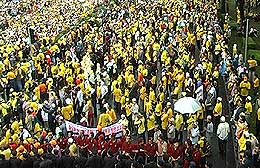
The prime minister issued a warning: ‘Face the consequences’, he said forecasting that something bad was going to happen. In spite of the warning over 40,000 people turned up braving the rain. Trains were stopped at the outskirts and the city centre stations were closed.
Rallies' impact downplayed
Even soldiers in army uniform visibly mingled with the police out in full force. The red-helmeted FRU (Federal Reserve Unit) personnel with shields and batons had positioned themselves strategically well in advance. They had their water-cannon juggernauts and fleets of vehicles ready to deport any number of people who could be arrested.
They cordoned off all entry points to Dataran Merdeka with roadblocks and barricades. When the people marched the FRU confronted by firing tear gas and opening up their water cannons. The Bersih rally still made its way by different routes to present their petition to the King.
The same government has been in power in Malaysia since Merdeka. It is so deeply entrenched with electoral constituencies strategically delineated and re-delineated. With its well-oiled machinery including a controlled media, a majority of votes are virtually guaranteed. The opposition feels that the playing field is not level.
 Election Commission Chairperson Abdul Rashid Abdul Rahman declared that all the general elections, at least the last six of them in which he was involved in, had been free and fair with no irregularities like vote-rigging. He has thrown a challenge to prove him wrong. But why should the people bear the burden of proof?
The people are not happy with the way elections are conducted. Their gut feeling says that something is not right. The ‘rakyat’ can demand that the EC show proof that elections are free and fair. If they want to dispel suspicion, then they should show it and not say it. Free and fair should also be fearless.
The event has become a debate among the people. Why is the government afraid to address the issue of a free and fair elections? Clear Perspex ballot boxes do not a transparent election make.
The third major demonstration took place on Nov 25 when 30,000 Indian Malaysians rallied to march to the British High Commission to hand over a petition to Queen Elizabeth II to demand the historical restitution of the rights of British-imported Indian indentured labour.
The rally was led by Hindraf, the Hindu Rights Action Force, a coalition of 30 Hindu non- governmental organisations. They carried life-size portraits of Queen Elizabeth and Mahatma Gandhi. The message on their banners addressed the Queen ‘to respect our humble request and rights’.
The mainstream media, as expected, downplayed the event while the BBC, Al Jazeera, CNN and others carried headline footage of the event. The local channels of communication dished out disinformation.
‘They can beat us today’
On the eve of Merdeka in 1957 The Straits Times carried a feature ‘What comes after Merdeka’ by Dr Lim Tay Boh, the acting Dean of the Faculty of Arts, University of Malaya. As an economist he said: ‘Merdeka is a means of enabling the masses of this country to satisfy their aspiration for a higher standard of living’
Indeed, over half a century, Malaysia has seen a rapid economic development. ‘Such development would not be successfully accomplished unless the revolution in our political life is completed by social revolution,’ said Lim.
 He went on to predict, ‘Unless this is done successfully, economic development will only have the result of concentrating the wealth from production in the richer classes without raising the living standards of the masses who have relatively low income’.
Lim's prophesy has come true in so far as we have failed in the equitable distribution of the country's wealth. People are disgruntled, angry and frustrated.
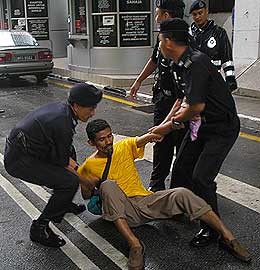
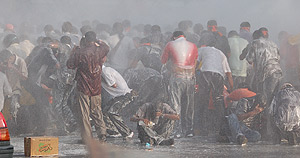
Riot police used tear gas and water cannons on the crowd. ‘We are people who work hard to live. We don't work in air-conditioned offices like the KL people. We work under the sun and rain. We are hardy. Let them hit us with anything. We will stand still,’ said Raman, a bus driver, one of the many at the Hindraf rally.
They took the blasts and sat on the road, the road paved by the sweat of their forefathers even before Merdeka. They feel they are discriminated against in employment in government departments while their Tamil primary schools are left in deplorable conditions.
When plantations are destroyed for development they are left stranded, unemployed and homeless. Likewise, Hindu temples are indiscriminately destroyed when they are in the way of development projects. When one converts to Islam the non-Muslim members of the family get a raw deal. Unemployed youth, as everywhere else, get into trouble and they are brutally treated by the police.
‘This is the end. We have come here to protest against how the government treats us. They can beat us today. They can put us in prison. We don't care. We want to tell the government that we are fed up,’ said 52-year-old S Aiyakannu from Old Klang Road, Kuala Lumpur.
The authorities came down hard on the Indians using the Internal Security Act and incarcerated its leaders. The streets are quiet now but below the surface, anger and frustration are no longer merely simmering.
What ‘silent majority’?
 The government says that the silent majority had accepted and praised and thanked the government in addressing the situation. Has this ‘silent majority’ whispered into the ears of the prime minister?
Who is the ‘silent majority’? Is it the ‘electorate’ that repeatedly gives the government the mandate to carry on? Given the electoral process, it would appear to be so.
Elections will probably be announced before the end of March this year. In all likelihood, the same government will be back in power.
Just how much independence the judiciary can muster and just how much of the cake the marginalised will get and just how much of a dent the opposition can make on an armed government remains to be seen.
A truly and genuinely independent and forceful judiciary can ensure a free and fair election and hold the executive accountable to a just distribution of wealth and resources. Fifty years of independence and what have we to celebrate?
DAVID ANTHONY has worked extensively with plantation workers, is president of the Society for Christian Reflection and a founder member of Man's Action Network to end violence against Women (ManV).


Are you sure you want to delete this comment?
This action cannot be undone.