




What now for Suharto?
As I’ve mentioned in several previous columns, I don’t believe there’s a hereafter or next life or whatever else you choose to call the place that human souls are supposed to go when their owners shuffle-off the mortal coil.
But in case I’m mistaken, the death of high-profile killers and crooks like the late ex-president of Indonesia, Mohammed Suharto, always sets me wondering what their post-mortem existence might have in store for them.
Are they greeted at the pearly gates, like the recently-deceased in those ever-popular St Peter jokes, to be summarily judged on their records and consigned for all eternity to heaven or, if there’s any justice at all in eternity, to hell?
As I’ve mentioned in several previous columns, I don’t believe there’s a hereafter or next life or whatever else you choose to call the place that human souls are supposed to go when their owners shuffle-off the mortal coil.
But in case I’m mistaken, the death of high-profile killers and crooks like the late ex-president of Indonesia, Mohammed Suharto, always sets me wondering what their post-mortem existence might have in store for them.
Are they greeted at the pearly gates, like the recently-deceased in those ever-popular St Peter jokes, to be summarily judged on their records and consigned for all eternity to heaven or, if there’s any justice at all in eternity, to hell?
And if so, what does hell consist of? The conventional lake of forever-burning fire, with nothing for the damned to drink but salt water? Or a range of punishments designed to better fit their unforgivable crimes?
I like to imagine them all serving an eternal life sentence on a kind of dictators’ death row. Or, better yet, slaving away in the service of all their subjects and opponents that they sent to their eternal rewards.
All this has tremendous poetic appeal - the thought of Hitler having to cook and clean for the six million Jews, gypsies and others he slaughtered; Pol Pot single-handedly staffing a heavenly hospital for the shades of the victims of Year Zero; Mao and Stalin forced to slave away forever to feed the millions of souls they caused to die of famine; and Marcos and Suharto having to beg for small change and a few crumbs from all their late countrymen and women they robbed of life, liberty and loads and loads of loot.
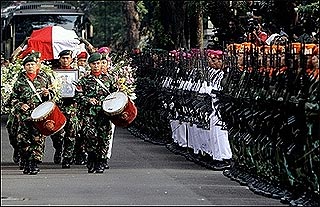 But of course there’s always the chance that justice is as uncertain in the hereafter as it is in the here and now. Maybe, as the ancient Egyptians fondly imagined, you really can take your worldly wealth with you.
And possibly St Peter or whoever else turns out to be the arbiter of eternal justice is as crooked as many of the judges in Indonesia, the Philippines, China, Malaysia and a great many other earthly jurisdictions. In which case it could be business as usual in the next life just as it was in this one, corruption, cronyism and all.
So if I had any say in what kind of afterlife I’d wish on dictators and their ilk, I’d opt for reincarnation on earth, where we can all keep a close eye on them.
At first we’d need powerful microscopes, of course, as karma would oblige major-league murderers and thieves to come back in their next lives as truly insignificant and undesirable creatures.
As HIV viruses, perhaps, or pathogenic bacteria which, if they lived their short lives well and truly, could evolve through the generations into vermin visible with the naked eye, like maggots, lice or leeches.
Crimes against humanity
But in all fairness I have to concede that not everybody reviles dictators in general or Suharto in particular as much as I do, or shares my enthusiasm for punishing them posthumously, if possible, if they cheat the jailer or executioner in this life.
 A whole string of US presidents rewarded Suharto (
photo
)for his authoritarian anti-communist antics, and paid his regime billions in aid despite knowing he’d steal it. And a succession of Australian prime ministers turned a blind eye to his atrocities in Irian Jaya, Aceh and even, for many years, East Timor.
A whole string of US presidents rewarded Suharto (
photo
)for his authoritarian anti-communist antics, and paid his regime billions in aid despite knowing he’d steal it. And a succession of Australian prime ministers turned a blind eye to his atrocities in Irian Jaya, Aceh and even, for many years, East Timor.
And a former Australian PM, Paul Keating, the man who had the temerity to call Dr Mahathir Mohamad "recalcitrant", developed what many have since considered a suspiciously close personal friendship with Suharto.
Malaysia’s Foreign Affairs Minister Syed Hamid Albar, also appears to be quite a Suharto fan, lamenting to AFP that his demise is "a great loss to the region as well as to the nation of Indonesia".
 Mahathir, apparently regaining his memory following his recent forgetful appearance before the royal commission, characteristically went completely overboard in proclaiming his admiration for his former colleague, claiming that he knows "for a fact" that allegations that Suharto killed 500,000 people in a bloodbath after he seized power are "absolute nonsense".
"Even though Indonesia was not an ideal democracy during Suharto’s time, the fact remains that he brought stability to Indonesia," AFP quoted him as saying, and adding the disclaimer that "of course there is a price to be paid".
The price paid by the Indonesian people for Suharto-style stability, as everybody but Mahathir recalls, was 500,000 to 1 million deaths, somewhere between US$15 and $35 billion in plunder by the Suharto family, untold amounts more by cronies, and devastation of the nation’s civil institutions including the press and the judiciary.
In an article for AP , Anthony Deutsch quoted Jeffrey Winters, associate professor of political economy at Northwestern University, as saying that "when Indonesia does finally go back and (re-does) history, (its people) will realise that Suharto was responsible for some of the worst crimes against humanity in the 20th century".
Or, as Ratna Sari Dewi Sukarno, widow of Indonesia’s first president, more succinctly put it to AFP , Suharto "was Indonesia’s Pol Pot".
Whatever, he sure made pots of money from robbing the economy and ripping-off charities, yet for the whole decade following his downfall his protestations of infirmity enabled him to get away with it all.
And for all we know he may still be evading justice, either off somewhere safe and sound in the afterlife or in the earthly comfort of his magnificent mausoleum alongside his late wife and partner in plunder, Madam Tien percent.
But his children and some of his cronies may not be so lucky. Maybe now that the Godfather is dead, the democracy that’s emerging from the ruins of his rule might get up the nerve and resolve to start prosecuting some of the partners-in-crime that he’s no longer around to protect.


