




Crossing the rubicon, Part 1
Congratulations to voters for their unprecedented and bold step in rejecting racist politics to an unimaginable scale and magnitude - and to citizens for the calm and measured manner in which the results were accepted, despite continuous provocation and propaganda of the vernacular media.
Tribute is also due to Prime Minister Abdullah Ahmad Badawi for graciously accepting the will of the electorate, and for resisting the temptation to resort to emergency type authoritarian rule.
Has May 13, 1969 been banished from the national consciousness, and forever passed into historical oblivion?
Congratulations to voters for their unprecedented and bold step in rejecting racist politics to an unimaginable scale and magnitude - and to citizens for the calm and measured manner in which the results were accepted, despite continuous provocation and propaganda of the vernacular media.
Tribute is also due to Prime Minister Abdullah Ahmad Badawi for graciously accepting the will of the electorate, and for resisting the temptation to resort to emergency type authoritarian rule.
Has May 13, 1969 been banished from the national consciousness, and forever passed into historical oblivion?
This article first considers the results of the 12th general election on March 8 and the reasons for the worst-ver performance by Barisan Nasional (BN), and in Part 2 the prospects for the second Abdullah administration. I am not sufficiently familiar with the political situation in Sabah and Sarawak: hence, my comments will be largely confined to Peninsular Malaysia.
What is known to all is that for the first time in 50 years of independence, the BN lost its two-thirds majority in the federal Parliament, winning 140 out of 222 seats, that PAS retained control of the Kelantan government and that four states fell to the opposition.
In any system of parliamentary democracy, 140 seats would provide a very safe, comfortable and workable majority. However, since 1957, successive leaders of Alliance and BN have placed such great emphasis on securing and maintaining a two-thirds majority in Parliament that the only measure of success is not forming a simple majority government like elsewhere, but one enjoying two-thirds majority. Thus, by BN’s own yardstick, the results were a calamity and Abdullah begins his second administration on the defensive.
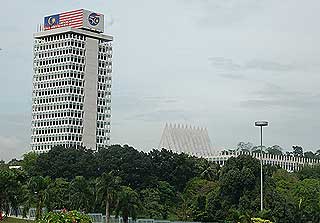 Of the 165 parliamentary seats in Peninsular Malaysia, BN only won 85 while the three opposition parties won 80 seats. BN secured 48.7 percent of the popular vote, while the opposition obtained 51.3 percent.
It may not be totally accurate to state that only five of the 11 states are controlled by the opposition, what happened in Kuala Lumpur must also be taken into account for it is the commercial and administrative capital of the nation: the jewel in the crown. The opposition won 10 of the 11 parliamentary seats, with Zulhasnan Rafique being the sole BN winner in Setiawangsa.
In all, 497,741 votes were cast for the 11 seats in Kuala Lumpur - BN only secured 188,875 votes (37.9 percent) while the opposition secured 308,377 votes (at 62 percent). BN’s share of the popular vote was also substantially reduced in Kedah (46.4 percent), Penang (40 percent), Perak (46.2 percent) and Selangor (43 percent). The opposition had to rely on voter support which transcended race, religion, gender and age in order to gain such substantial increases in the frontline states.
What is even more striking is that in 30 parliamentary seats, BN won by a small majority ranging from 51 votes in Sarikei, Sarawak, to 3,070 votes in Stampin, also in Sarawak. The 30 seats that saved BN only gave it a combined majority of 56,822 votes.
Bear in mind that, to form a simple majority government, only 112 out of 222 seats are required. The opposition parties, having already won 82 seats, by coincidence needed 30 more seats to govern the nation - and in these 30 seats BN’s majority only totaled a mere 56,822 votes. Of these 30 seats, 22 truly marginal seats are in the peninsula (9 in Perak and 3 in Penang) and the remainder in Sabah and Sarawak
These statistics conclusively establish that Malaysia entered into uncharted waters in the 12th general election. Past patterns of voting were not followed.
Firstly, the swing was so great that thousands of Malays voted for DAP and thousands of Chinese and Indians voted for PAS. PKR, a non-racial party, is the greatest beneficiary. From a one-seat party, it emerged as the largest opposition party and the second largest national party, after Umno, winning 31 parliamentary seats with 18.4 percent of the popular vote.
Secondly, the practice of voters, particularly among the Chinese community, supporting opposition candidates for parliamentary seats and BN candidates for state seats ceased, with them supporting opposition candidates for both parliamentary and state seats in very large numbers.
Causes of BN debacle
(i) Common causes
The causes for BN’s poor showing have popularly been mentioned to include bread-and-butter issues like its mismanagement of the economy, and particularly in not effectively dealing with inflation and the increasing cost of living; its mismanagement of law and order which has seen unprecedented crime rates and the clear failure of governmental institutions like the police and the law enforcement agencies to cope; and the hugely unpopular policies of the third level of government - local councils - which have approved excessive development without any concern for the environment, the accrued rights of adjacent land-owners and in wholesale disregard of planning laws.
The small and medium businessmen, invariably Chinese, often faced insurmountable difficulties in “doing business” and “making money”. The typical Indian voter suffered from a marginalised and discriminated complex. PKR de facto leader Anwar Ibrahim’s sustained campaign after his release from imprisonment in 2004 persuaded sufficient Malays that the New Economic Policy (NEP) has not assisted them, but instead only benefitted a small coterie of Malay entrepreneurs enjoying close links with Umno. All these factors doubtless weakened BN.
(ii) Umno
In my opinion, however, the most important reason why 51.3 percent of the popular vote was cast for the opposition in the peninsula was the repugnance of these voters for the hubris displayed by Umno after holding continuous and unbroken power since 1955. In this sense, Malaysia is not unique. The PRI in Mexico, the LDP in Japan and the Congress Party in India all suffered similar fates after lengthy uninterrupted power. Power not only corrupts, it also breeds arrogance.
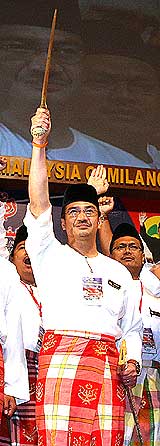 However genial Abdullah may give the impression to be, the perception was that he was powerless to stop the aggressive postures of the Umno power-brokers, whether when they took extreme, insensitive actions like unsheathing and kissing the keris or when making racist remarks without concern for the sensitivities of the minority races. Such inflammatory behaviour was not replicated by PAS and PKR leaders who, in contrast, appeared tolerant.
The decimation of MCA, MIC and Gerakan was punishment by its traditional supporters because these parties had failed to stand up to Umno’s dominance of the BN. From its establishment in 1952 to contest the municipal elections of Kuala Lumpur, the Alliance was never a partnership of equals. Umno has always been the dominant party. However, during the early decades of independence, the myth was perpetuated that MCA and MIC enjoyed some degree of power, and its leaders certainly had the ear of Tunku Abdul Rahman, Abdul Razak Hussein and Ismail Ali.
Even after the May 1969 riots, the non-Malay parties were represented on the National Operations Council and agreed to the establishment of the NEP. However, in recent years Umno’s dominance was so extensive that none of the other 13 component parties in BN have been able to contradict or soften its strident tones on ethnic and religious issues.
Thus, eve of election threats by BN leaders that if non-Malay voters rejected MCA, MIC and Gerakan the cabinet would not contain their representatives did not have any effect (unlike in past elections) because the majority of non-Malay voters had already determined that having MCA, MIC and Gerakan members did not benefit them, and rejecting such ineffective leaders would have no negative practical results. Indeed, these threats may have been counter-productive. Hence, Umno’s pre-eminence not only injured Umno which only won 65 parliamentary seats in the peninsula, but also damaged MCA (15 seats), MIC (3 seats), Gerakan (2 seats) and PPP (none).
Umno leaders were fond of citing the mandate doctrine, that is, that having been elected at the 2004 general elections they could act as they wish and were not accountable for any government policy or statement, and the electorate’s only recourse was to reject them at the next general election - that is exactly what happened to many of them on March 8.
The fundamental tactical error committed by Umno in the months leading up to the general election was its decision to discount the non-Malay vote on the premise that a large majority of Malay voters would support it. The premise proved entirely wrong. One cannot understand how Umno failed to take into account the obvious fact that PAS and PKR were focused on wooing Malay voters, who were thus presented with a stark and real choice. Umno’s strategic decision of concentrating on securing substantial Malay support at the expense of alienating non-Malay voters was best exemplified by its treatment of the Hindu Rights Action Force (Hindraf) and the Article 11 issue.
(iii) Hindraf
In 11 general elections since Merdeka, the Indian Malaysian community was proportionately the greatest supporter of BN and was rewarded by a disproportionate number of parliamentary and state seats. Overnight, the Hindraf movement destroyed Indian support for BN. P Uthayakumar, more than any other Indian leader, bravely articulated the plight of the marginalised Indian of Tamil origin (as opposed to the small, but successful, members of the Sikh, Malayalee and Jaffna communities). The Tamilian’s sense of hopelessness and powerlessness in a land of plenty (which attracted 3-4 million immigration workers) was demonstrated by their simplistic and naïve belief that litigation in a British court of law would result in the Queen of England paying each of them compensation for past injustices!
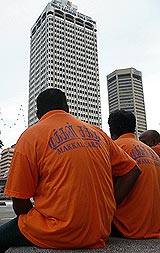 The heavy hand of government in dealing with the Hindraf march and the detention of their five leaders under the dreaded Internal Security Act 1960 (ISA) completely alienated the Indian community, inspired the Chinese community who quietly supported Hindraf in their own way and ironically, from Umno’s perspective, did not drive droves of Malay voters to Umno as the traditional protector of Malays when they are threatened. The Malay electorate was more sophisticated, and more understanding of the plight of the hardcore poor Tamil citizen.
Makkal Sakthi
(people power), inspired by Cory Aquino’s movement that toppled the brutal and corrupt Marcos regime in the mid-1980s, was the rallying cry at all opposition
ceramahs
.
The heavy hand of government in dealing with the Hindraf march and the detention of their five leaders under the dreaded Internal Security Act 1960 (ISA) completely alienated the Indian community, inspired the Chinese community who quietly supported Hindraf in their own way and ironically, from Umno’s perspective, did not drive droves of Malay voters to Umno as the traditional protector of Malays when they are threatened. The Malay electorate was more sophisticated, and more understanding of the plight of the hardcore poor Tamil citizen.
Makkal Sakthi
(people power), inspired by Cory Aquino’s movement that toppled the brutal and corrupt Marcos regime in the mid-1980s, was the rallying cry at all opposition
ceramahs
.
Umno’s brushing aside of freedom of religion issues, compounded by terribly unjust decisions of the court, led to a significant Article 11 movement which galvanised the Chinese community, always jealous of its educational, cultural and religious rights. Umno’s insensitive and intolerant position on religious issues, and MCA and Gerakan’s inability to stop the rhetoric pushed Chinese voters to the opposition. Longevity in power results in a belief that one has a divine right to rule; Umno certainly suffered from this complex, thereby losing touch with reality and the wishes of the electorate.
(iv) Abdullah’s ‘kitchen cabinet’
Abdullah did not learn the lessons of the 11th general election in 2004 which gave him 201 out of 222 Parliamentary seats and 64 percent of the popular vote. Promises were not kept, and the ‘nice guy’ image was slowly eroded by what seemed to be drifting, dithering leadership. In the areas that the prime minister deserved praise, that is, opening up democratic space for every Malaysian and the disappearance of the climate of fear associated with Mahathirism, did not win him votes. Constant sniping by Dr Mahathir Mohamad and Abdullah’s “elegant silence” damaged Abdullah at the polls.
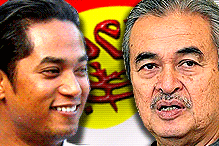 Without doubt, the greatest millstone around Abdullah’s neck was his son-in-law, of 'Khairy Chronicles' notoriety, who was blamed, rightly or wrongly, for every action or inaction of the prime minister. In the short space of four years, he became the most hated man in Malaysia, earning epithets like Rasputin and
budak nakal
. The term ‘kitchen cabinet’ literally meant in Malaysia, the premier’s son and son-in-law deciding matters in his kitchen.
Without doubt, the greatest millstone around Abdullah’s neck was his son-in-law, of 'Khairy Chronicles' notoriety, who was blamed, rightly or wrongly, for every action or inaction of the prime minister. In the short space of four years, he became the most hated man in Malaysia, earning epithets like Rasputin and
budak nakal
. The term ‘kitchen cabinet’ literally meant in Malaysia, the premier’s son and son-in-law deciding matters in his kitchen.
The dreaded ‘4th floor’ was savagely mauled during ceramahs , to the obvious delight of the cheering crowds. These young, raw, inexperienced advisers established an impenetrable Berlin wall or Praetorian Guard around the prime minister, who thus was deprived of advice from experienced, politically savvy Umno stalwarts like Musa Hitam and Tengku Razaleigh Hamzah, ironically leaders of Team B in the 1986-1987 Umno power struggle, and of whom Abdullah was then a senior member.
Despite these factors, BN may still have obtained a two-thirds majority in Parliament and not lost five states (and Kuala Lumpur), especially because of past gerrymandering exercises of the constituencies which substantially benefitted BN at every election, but for two new powerful forces.
Part 2: Anwar Ibrahim and the Internet
TOMMY THOMAS is a lawyer and political observer.


