




Crossing the rubicon, Part 2
And what are these two new powerful forces? They are first, Anwar Ibrahim, and, secondly, the Internet.
And what are these two new powerful forces? They are first, Anwar Ibrahim, and, secondly, the Internet.
(v) Anwar Ibrahim
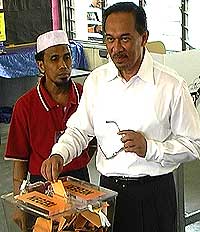 16. Without doubt, the greatest star of this general elections was Anwar Ibrahim, who skillfully galvanised the frustrations felt by the three major communities in West Malaysia and brilliantly exploited the underlying tensions in contemporary society. Additionally, Anwar acted as the glue that held PAS and DAP together, ensuring that the opposition avoided three-cornered electoral contests, and the voters always presented with a stark choice between a Barisan Nasional candidate and one from the three-member opposition coalition.
Anwar charmed the Malay heartland into accepting that NEP is not the only economic option open to them, and that its abuses were all due to Umno’s greed. His energy recorded heights never seen in Malaysia at the ceramah across the nation which he cris-crossed on numerous occasions during the election campaign. Rather than engaging him, Barisan Nasional dealt with Anwar by two principal methods: ignoring him and demonising him: both failed miserably. The sustained attack against Anwar by the mainstream media on the final days of the campaign not only failed in its objective: it backfired and resulted in thousands of undecided voters opting for the opposition. Anwar’s restrained conduct after the elections marks him as the nation’s prime minister in waiting.
(vi) Internet
17. Next, the major impact of the Internet. For decades, Malaysians were starved of alternative views: the national newspapers are licensed, owned, controlled and directed by Barisan Nasional, or by businesses aligned to Barisan Nasional, while radio and television are controlled by Angkasapuri. The internet, blogs and YouTube dramatically revolutionised the availability, accessibility and speed of information, and the airing of alternative views and news. In an instant, news not only became democratic, but also egalitarian. Malaysiakini crashed on polling night because it could not handle the traffic. Raja Petra’s Malaysia Today was compulsory viewing, and thousands watched opposition ceramah through YouTube. Jeff Ooi raised RM113,000 in two weeks from online donations through his blog Screenshots. Lim Guan Eng delivered an address to the nation on the eve of polling through YouTube.
Even if technology is very much an urban phenomenon, rural voters were rapidly educated on issues raised on the internet by their urban relatives, usually their children. The Barisan Nasional’s principal failure was to rely wholly on the discredited mainstream media and, by default, conceding the internet to the opposition. Because content matters to the more discerning Internet user, Barisan Nasional’s failure to engage in debate and discussion proved fatal.
The prospects
(i) Prime Minister Abdullah Ahmad Badawi
18. On the morning of March 9, 2008, barely 12 hours after the results were announced, Dr Mahathir Mohamad called for Abdullah to step down. This was followed by a letter from his son, Mukhriz asking for the prime minister’s resignation. Abdullah’s decision not to refer Mukhriz’s letter to the disciplinary committee of Umno but to send it to Umno Youth was incomprehensible. Umno Youth did not take any action against Mukhriz, although he repeatedly stated that he stood by the letter. Tengku Razaleigh Hamzah then announced his decision to stand for Umno presidency. The signal is therefore as a lion wounded at the polls, Abdullah is vulnerable to attack from any direction by all and sundry.
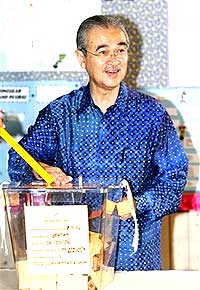 19. Three major decisions awaited Abdullah in the new administration. First, the formation of the cabinet, secondly, Perlis and finally Trengganu. In all areas, he displayed the same style of leadership which was not acceptable to more than half of West Malaysia’s voters. His dropping of Radzi Sheikh Ahmad and Rafidah Aziz, the secretary general of Barisan Nasional and Umno and the leader of Umno Wanita, was unfathomable. Although Rafidah has had more than her share of critics over the years, her technical ability in defending Malaysia’s interests in international trade issues is of world class standards. Her exclusion was perceived as punishment for attacking Khairy Jamaluddin in her post-election analysis.
Radzi’s replacement as secretary-general of Umno, Tengku Adnan Mansor (of Lingam tape notoriety) and the return of Muhammad Muhd Taib (of cash into Australia notoriety) into the cabinet and head of Selangor Umno are hardly consistent with good political governance.
Although the appointments of Zaid Ibrahim and Amirsham Aziz are imaginative, the overall impression of the new cabinet was tepid.
20. The mainstream media focused on the problems facing the opposition in forming state governments in Perak and Selangor. What they wholly neglected to inform Malaysians were the problems faced by Barisan Nasional in Perlis and Terengganu. In each of these states, Barisan Nasional had a very comfortable majority, and there is no question of any opposition asserting an alternative claim to forming a government. Instead, it was an intra-Umno dispute in Perlis, which saw the Raja of Perlis exercising his constitutional right in appointing Dr Mat Isa Sabu as the menteri besar, despite Abdullah’s choice of Shahidan Kassim. The problem is much graver in Terengganu. Exactly two weeks after the elections, and in a state where 24 seats were won by Umno, with only one candidate being nominated by Umno (unlike Perlis), Idris Jusoh has still not been sworn as menteri besar.
Hence, there is a constitutional crisis in Terengganu, and the mainstream media has been absolutely silent for a fortnight. The discretion of the Sultan of Terengganu (or the Regency Council) is not absolute when determining whether a state assemblyman is likely to command the confidence of the majority of the 32-member state legislature, that is,17 members. Since no other assemblyman has claimed that he enjoys the support of 16 other assemblyman, Idris must be appointed. Yet, he is not, and the reasons never publicly disclosed, which has given rise to speculation and conjecture. Again, Abdullah’s impotence in breaking the constitutional impasse is damaging him. If I could paraphrase WB Yeats, things fall apart when the centre cannot hold.
21. In these circumstances, one questions the medium to long term stability of Abdullah’s government. Abdullah must demonstrate firm and decisive leadership in the coming months to avoid the perception that he is a hapless, helpless skipper of a boat (which may result in support for Tengku Razaleigh) or a captain of a sinking ship (which may lead to defection to a Anwar-led coalition). In either scenario, his prime ministership is vulnerable. The Umno general assembly is scheduled to be held in August 2008 when elections will be conducted. It would be self-serving for Abdullah to postpone the assembly. Would there be a Abdullah and Najib Abdul Razak contest against Tengku Razaleigh and Muhiyiddin Yassin: any number of other permutations is equally possible. During the run-up to August, the unseen hand of past Umno masters, Mahathir and Anwar will be significant.
Art of government
(ii) The opposition
21. Having regard to its experience in ruling Kelantan and Trengganu, PAS is best placed to govern Kedah. In Penang, Perak and Selangor, the three opposition parties must quickly learn the art of government: the honeymoon period of 100 days would pass before one notices. The five states should form a coordinating council consisting of the leaders of the three parties, and major decisions should be made thereat to ensure consistency and harmony. The expectation of the Malaysian public must not be let down, and, if that means Nik Abdul Aziz, Abdul Hadi Awang, Mustapha Ali, Lim Kit Siang, Lim Guan Eng, Karpal Singh, Anwar Ibrahim, Dr Wan Azizah Wan Ismail and R Sivarasa, among others, having to meet regularly to give proper and effective leadership to the five states, so be it. Otherwise, the same electorate will ditch them in 2012/3.
What is critical is an honest, open and decisive government. If the electorate is impressed, then the opposition will not only be returned to govern these five states, but the nation at the federal level.
22. Although party hopping is not illegal in Malaysia, it is morally reprehensible. Because "money politics" was the principal factor in past party defection, particularly Sabah’s PBS in 1994, the Malaysian electorate will not believe any cross-over is based on conviction. Instead, both the party welcoming such parliamentarians or state Assemblyperson, and the individuals concerned would face credibility issues which would harm them electorally in future elections.
(iii) The economy
23. It would be unrealistic to consider the prospects of the federal and state governments in the coming years without a brief discussion of the economy. It is absolutely indisputable that the federal government’s inability to control inflation caused it electoral damage. From time immemorial, Malaysia has enjoyed the distinction of being one of the cheapest countries in the world; thus, Malaysia often leads the McDonald table on purchasing power parity. The Malaysian ringgit always stretched more than any other currency. This state of affairs changed for the worse during Abdullah’s first administration. The shopping basket became far more expensive, and out of reach for millions of Malaysians. The increases in fuel prices was the culmination, and, at the same time, the harbinger of rising cost of living.
24. The leaders of Barisan Nasional always blamed inflation on increasing oil prices which are beyond the control of any single nation. There is some justification for that argument. However, it does not tell the whole story. It must never be forgotten that Malaysia is a net exporter of petroleum.
 Probably 2/3 of the oil that Petronas sells is obtained on and offshore Malaysia. According to oil experts, it costs between US$10 to US$15 to produce a barrel of oil in Malaysia. Petronas today sells a barrel at US$110. One does not have to be a rocket scientist to appreciate that Petronas (along with other oil giants) is making obscene profits in the present market: indeed, since the Iraq Invasion of 2003, oil prices have been on the steady rise.
The oil won and obtained on and offshore Malaysia belongs to the whole nation and to its people. It does not belong to the federal or state government or to Petronas. They merely are our trustees. However, the actual amount of petroleum produced and sold by Petronas is a great secret. Under the Petroleum Development Act, 1974 ("PDA"), Petronas, although a company, is not required to disclose its accounts to the Companies Commission. Neither does Petronas produce its accounts to Parliament or to the Cabinet. Petronas is merely required to show its accounts to the prime minister. This is wholly unacceptable.
25. Accordingly, the PDA must be immediately amended at the forthcoming sitting of Parliament, and its accounts must be publicly disclosed; and not just its accounts for 2007/8, but also its accounts from its establishment in 1974. Malaysians are aware that the income made by Petronas have in the past been applied to rescue Bank Bumiputera after the BMF fiasco, to build Putrajaya and KLIA. What is not known is how its income has been utilised for other "national" projects. More importantly, if the full extent of Petronas prosperity becomes publicly known in times of real hardship for the average Malaysian, the government will have much room to maneuver to address creeping inflation.
26. Another method available to the federal government to deal with rising costs is to review the lop-sided independent power plant (IPP) contracts which are favourable to private companies to the detriment of Tenaga (and Malaysians). The government can introduce legislation, which will hopefully receive all-party support, in the next session of Parliament to enact an Unfair Public Contracts Act which will empower the government to intervene in the public and national interest by compelling the IPPs to re-negotiate with Tenaga on fair and equitable terms. A precedent exists in the Danaharta Act, 1998 which gives Danaharta wide powers to tackle the problems created by excessive lending by banks, which, in the main, Danaharta has successfully carried out.
Alternatively, the government can impose excess tax on the profits earned by the IPPs as a result of their one-sided contracts. What is not an option is for the cabinet to fold its arms and state that it is powerless to act because of negative signals to the market if contracts are re-negotiated. When contracts are wholly against the public interest, they are against public policy and may be void. These methods are in addition to the traditional monetary and fiscal tools available to every government, which should be creatively applied to reduce interest rates and taxes to soften the pain suffered by the ordinary citizen in contemporary Malaysia.
Respond to new challenges
(iv) Aspirations
27. Only time will tell whether the 12th general elections was a one-off phenomenon or represents the beginning of the end of race based political parties. Five years after its establishment, Onn Jaafar proposed in 1951 that Umno’s membership be open to all the races. This was roundly criticized and he resigned, paving the way for Tunku’s presidency. Does PKR’s performance in winning 31 parliamentary states comprising 20 Malays, seven Chinese and four Indians indicate a change after 57 years. Are we seeing the start of less communal parties in the coming years. If so, Umno, MCA, Gerakan and MIC would face major problems in attracting non-communal support or, indeed, even communal support.
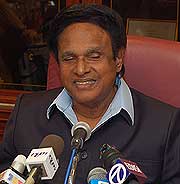 Taking MIC as an example: only S Samy Vellu believes that the majority of Indians still support him and his party. MIC is so discredited among the Indians, that it will take more than new leaders, directions and policies before it can regain its traditional support. Substantial Chinese support for PAS and Malay for DAP were unparalleled; whether it will be replicated in future elections would require crystal ball gazing. Abdullah is the sixth president of Umno. Four of his predecessors were disillusioned with the Umno they left behind, and Onn Jaafar, Tunku and Hussein Onn left the party. Only Tun Abdul Razak remained loyal to Umno, but he died in office. Hence, criticism of Umno is nothing novel: the issue is whether it is sufficiently nimble and flexible to respond to new challenges and adjust to changing times. Can we dare to hope that the racial rubicon in Malaysia has been crossed, and the emergence of voters thinking as Malaysians.
28. At the minimum, the 2008 elections represents a watershed in Malaysian politics. The climate of fear evaporated and May 13 was not relevant. For Malaysians who aspire a true two-party system alternating in power, there is hope in the future. Malaysia will hopefully join the ranks of mature and functioning democracies in Asia like India and Japan when a Barisan Nasional government will be replaced by a Barisan Alternative government which in turn will be replaced by a Barisan Nasional in successive general elections. Dare we hope!
TOMMY THOMAS is a lawyer and political observer.


