




Parental politics
My wife has complained or at least hinted several times recently that I leave an unfair amount of supervision and guidance of our teenage daughter to her.
And having no desire for this issue to escalate into the 'Mother of all Battles', I’ve been doing some serious soul-searching on the subject.
Could it be true that in my enthusiasm for playing the good pop, I’ve forced my wife into the role of bad cop?
My wife has complained or at least hinted several times recently that I leave an unfair amount of supervision and guidance of our teenage daughter to her.
And having no desire for this issue to escalate into the 'Mother of all Battles', I’ve been doing some serious soul-searching on the subject.
Could it be true that in my enthusiasm for playing the good pop, I’ve forced my wife into the role of bad cop?
In my distaste for repression and detestation of discipline, am I really condemning my long-suffering spouse to being the perpetual nay-sayer and nag?
If so, I can’t blame her for objecting, as she’s by nature even less of a disciplinarian than I am, and my wife is as rebellious as they come. So I can relate to her resentment at having to lay down the law to our offspring in the very areas in which she once fought for her own adolescent freedoms, like studies, self-adornment and socialising.
 So maybe she’s right that I should bear more of the burden of command and control.
But how?
By somehow becoming more parental, paternal or paternalistic?
Possibly so. But before I rush in and try living up to these concepts, let’s take a look at their meanings and implications.
Starting with ‘parental’, which my dictionary tells me is derived from the Latin parentere , to give birth. Though my wife undoubtedly performed most of the hard labour involved in this long, arduous and ultimately painful and messy procedure, the daughter in question turned out to physically resemble me sufficiently to dispel any doubt that I’m as parental as can be in the strictest sense of the word.
But when it comes to being ‘parental’ in helping raise this girl-child, I have to confess to being more indulgent, not to say doting than what is widely considered ideal.
'Pa' plus 'rental'
The trouble is, whatever the dictionary has to say on the subject, my personal definition of ‘parental’ is so liberal, not to say lax, that it might as well be a combination of the terms ‘pa’, as in the common abbreviation of ‘father’, and ‘rental’ in the sense of temporary custody as opposed to ownership.
In other words, I see my daughter, as I did with my now-adult sons, not as my possession, property, chattel or whatever, but as a person in her own right. A free and independent individual with whose custody, care and companionship I’ve been entrusted, for as long as I can afford to pay for the privilege or until she gets what she considers a better offer, or otherwise chooses to call the deal quits.
Certainly I’m happy to give her as much advice, support and encouragement as she’ll accept, plus all the protection I can. And I’ve provided her with the best role model a girl could wish for in the person of my wife, her mother.
Which brings us right back to the burning question of how much more of the burden of behaviour-regulation I should shoulder, or in other words, how bossy I should be. If my version of ‘parental’ doesn’t measure-up, how about ‘paternal’, ‘paternalistic’ or even ‘patriarchal’?
Unfortunately, despite the benevolent possibilities implicit in these words, and thus their desirability in ideal terms, in the real world they too often smack of authoritarianism.
‘Father knows best’ was fine as the name of a 1950s sitcom in which the male parent was portrayed as a lovable petty-despot that none of his family took too seriously. But true-life patriarchy isn’t always so amusing.
In fact it can all too readily result in the male’s belief in his own infallibility and his right to rule his captive realm like some trumped-up domestic dictator.
And when power corrupts, as everybody knows it does all too often even in the family arena, it can lead to a reign of terror characterised by everything from callous neglect to emotional, physical and sexual abuse of the patriarch’s cowering victims.
General Nae Win
Paternalism all too often turns pathological at political levels. For every national father-figure who displays genuine concern, respect and care for his people, like Nelson Mandela of South Africa did so admirably, there are countless self-styled patriarchs like Robert Mugabe of Zimbawe and Kim Jong-il of North Korea and the late General Nae Win of Burma who turned into power-crazed predators of their own subjects.
It’s especially symbolic that Nae Win’s successors keep the mother of Burmese democracy, Aung San Suu Kuy, in endless confinement like an unwanted, abandoned housewife.
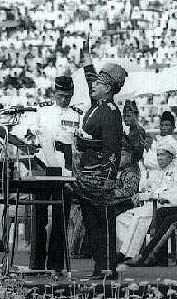 Closer to home, the father of Malaysia, Tunku Abdul Rahman, would surely be disgusted at the way his successors have progressively perverted his spirit of paternalism and set themselves up as potentates.
For example, I doubt that if the Tunku was alive today that he’d still be kidding his 50-year-old Malaysian family that it’s not yet mature enough to be told the truth by its government and media.
I doubt that he’d have spurned the Indian members of his Malaysian family so thoughtlessly all these years, then turned on them with water cannons, tear gas and the Internal Security Act when they complained through the Hindraf movement.
And I’ll warrant that Tunku wouldn’t have turned a blind eye to the mistreatment of people in Bandar Mahkota Cheras by crony-capitalist bullies of Grand Saga, then had them beaten bloody by the police when they eventually stood up for their rights.
The ugly effects of corrupted paternalism are all too evident in national and global affairs, I’m afraid, for me to risk inflicting its pernicious influence on my family.
So, with all due respect to my wife and her concerns over my being too parentally permissive, I think I’ll try and persuade her to relax- lah , and try and have more faith in our darling daughter’s intelligence, good nature and growing sense of responsibility, plus the civilising power of domestic democracy.


