




Where the claim fails Pt 1
So, the Moro National Liberation Front leader Nur Misuari has threatened to take his claim on Sabah to the International Court of Justice (ICJ).
The Filipino influx has reached a stage where there is real fear that where Misuari’s claim fails; our porous borders and the lackadaisical handling of these illegals by the federal government will help him succeed in making Sabah part of the Philippines, in substance if not in form.
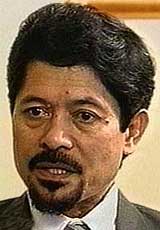
So, the Moro National Liberation Front leader Nur Misuari ( photo below ) has threatened to take his claim on Sabah to the International Court of Justice (ICJ).
The Filipino influx has reached a stage where there is real fear that where Misuari’s claim fails; our porous borders and the lackadaisical handling of these illegals by the federal government will help him succeed in making Sabah part of the Philippines, in substance if not in form.
Even if the tide ends now the one-million plus immigrants who are already here, coupled with the high birthrate among them have already set the clock ticking towards that eventuality.
The territorial claim may not cause a ripple on the geopolitical scene. It is a non-issue, to use Sabah chief minister Musa Aman’s words. So far we have relied on our right to self-determination to defend our rejection of the claim.
That’s why Rais confidently brandished the Cobbold Commission Report, as it were, when he commented on the Philippines government claim to Sabah.
 But if one may toy with a poser, in the unlikely event that the claim goes to the ICJ, and in the even more unlikely event that the ICJ orders another referendum, UN sponsored or otherwise, is there a chance, however remote, that self-determination this time around may turn out differently, taking into account to the changed demographic factors in Sabah?
The possession of MyKad as qualification to take part in the referendum would come in handy for tens of thousands of Filipinos residing in Sabah, thanks to ‘Project IC’.
The Sabah claim has come from two quarters, one by descendants of the Sultan of Sulu to whom Malaysia still pays ‘Cession Money’ annually, and the other by the government in Manila based simply on the logic that what belonged to Sulu, belongs to the Philippines.
Sabah in the Philippines map
Granted, few in Peninsula Malaysia know much about Sabah’s history, or the claim, but when Rais insisted that the Philippines claim to Sabah is only made by a ‘small group who are political in nature’, he substantially undermines the gravity of the situation.
The Philippines passed a law many years ago to declare Sabah their territory, and for good measure published a map that included Sabah as part of the Philippines.
They have not rescinded declarations of sovereignty over Sabah despite many changes of presidents since Ferdinand Marcos. Furthermore, despite our numerous requests they have consistently refused to set up a consulate in Kota Kinabalu, obviously to drive home the point that you do not set up a consulate in your own territory.
Yet we close our eyes while waiting for a diplomatic note from the Philippines that officially recognises Sabah as being part of Malaysia. Kinabatangan MP Bung Moktar Radin was right, we ought to deal with the Philippines more forcefully. Diplomatic niceties have got us nowhere.
 Meanwhile, the Filipinos in Sabah quietly tell their children that Sabah is theirs, whatever the people of Sabah may say.
Which leads us to the proposed royal commission of inquiry that the Democratic Action Party (DAP) tried to present in Parliament recently.
The whole idea of the proposed royal commission is not so much to directly bring about the repatriation of the illegal migrants as it is to establish the truth about ‘Project IC’ which grants citizenship status to tens of thousands of Filipinos in Sabah.
If we can establish their correct legal status, the government under Prime Minister Abdullah Badawi will then be able to decide more confidently what to do with those who obtained their MyKad by fraudulent means. This is why the facts about Project IC must be ascertained.
Quasi-judicial
 Some leaders are in two minds about having a royal commission. In a recent statement Musa (
photo right
) said that a concerted effort by all concerned would probably produce better results than setting up the proposed royal commission.
Some leaders are in two minds about having a royal commission. In a recent statement Musa (
photo right
) said that a concerted effort by all concerned would probably produce better results than setting up the proposed royal commission.
He was of course correct in the sense that whatever findings and recommendations that come out of the commission’s inquiry would still have to be considered by the government for possible action, and action must necessarily involve a concerted effort by many government agencies.
But let it be said that the problem has festered for more than 30 years and the idea of ‘concerted effort’ to deal with the problem is not new. Regrettably, today we are no nearer to finding a solution than when the problem first emerged in the seventies.
Of course, one would much prefer that we do not have to resort to a royal commission which is costly, time consuming and a step that may lead right to where we were in the 70s. But as the supposed concerted effort by the government enforcement agencies has not produced the desired results, many people want to know why.
This is where the inquiry commission may be able to shed some light on the problem. But few in Sabah are so naïve as to consider such a panel a total remedy. The involvement of those in senior federal government positions will make truth seeking even more difficult.
You need to interrogate big shots who can simply ignore your ‘invitation’ to give evidence, who refuse to answer questions that they do not like or simply tell fibs. This is why we need a royal commission with quasi-judicial powers, even though these powers are restricted to the ‘Terms of Reference’ of the commission and possibly also a date by which the commission must finish its work.
Because of its quasi-judicial powers and the likelihood that it will comprise people who command respect and presumably untarnished by any known scandal, a royal commission may have sufficient clout to get to the bottom of the illegals problem.
The work will involve research into the issue, consultations with people in the know both within and outside of the government. The warrant may grant immense investigatory powers, including summoning witnesses under oath, seizing of documents and other evidence, including those protected by the Official Secrets Act (OSA), and enlisting the assistance of the government officials.
In the process of the open inquiry, the daily report of interrogations would highlight many of the problems that led to the intractable problems of the illegals in this country.
That in themselves may throw light on the way our government functioned during the three decades that saw Sabah slide to its depth of misery.
STAN YEE is a retired government officer in Kota Kinabalu.


Are you sure you want to delete this comment?
This action cannot be undone.