




Preventing floods in Penang, Part 1
When flash floods occurred in Penang on Sept 6, state Drainage and Irrigation Department director Hanapi Mohd Noor denied any shortcomings in the flood mitigation plan.
He attributed the situation to a combination of high tides and torrential downpours. The state had received 180ml of rain within 24 hours and "the unusual heavy rains...clashed with the high tide at about 2am".
When flash floods occurred in Penang on Sept 6, state Drainage and Irrigation Department director Hanapi Mohd Noor denied any shortcomings in the flood mitigation plan.
He attributed the situation to a combination of high tides and torrential downpours. The state had received 180ml of rain within 24 hours and "the unusual heavy rains...clashed with the high tide at about 2am".
Flash floods are a frequent occurrence in Penang. The state is responding by expanding and deepening major rivers, building water pump stations and more retention ponds in critical areas, and upgrading the drainage system.
On Oct 22, Star reported that the Penang government had asked the premier to consider allocating RM970 million for implementation of flood mitigation projects in the state.
 Chief Minister Lim Guan Eng said RM670 million of the allocation will be used for seven projects:
- Phase 2 of the Sungai Junjung flood mitigation project (RM125 million);
- Phase 2 of the Sungai Pinang project (RM125 million);
- Sungai Juru, Bukit Mertajam catchment area, Permatang Rawa, Sungai Ara and Sungai Rambai project (RM300 million);
- Bayan Baru Cyber City project (RM30 million);
- Bukit Panchor, Byram, Transkrian and Jawi project (RM30 million);
- Bukit Tambun/Tanjung Ketupat project (RM20 million); and
- Valdor project (RM20 million).
Lim said the work would involve upgrading, widening and deepening of the rivers; building of bunds and retention ponds to prevent rivers from overflowing; building of pump houses to channel water out of flooded areas; and constructing and upgrading drainage systems where drains are directly connected to rivers or the sea.
He also urged the federal government to expedite approval of RM327 million for four flood mitigation projects by 2011 in Bertam (RM110 million), Sungai Prai (RM158.2 million), and the first phase at Sungai Junjung (RM10 million) and Sungai Pinang (RM7 million).
Lim seemed upbeat about the chances of success if the money comes through.
Foolish practices
The previous Barisan Nasional state government had spent several hundred million ringgit on flood mitigation projects especially the Sungai Pinang programme.
When it was completed, residents enjoyed couple of years of flood-free life, but their nightmare returned after the September downpours.
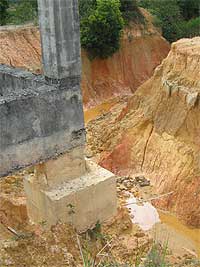 Through foolish practices, we have built more and more impervious surfaces, such as pavements, rooftops, sidewalks, roads, parking lots and compacted soil in the name of development, without realising we have initiated a chain of events that have caused the formation of storm water runoff or surface runoff.
Storm water that does not soak into the ground becomes surface runoff, which either flows into surface waterways or is channeled into the drainage system.
When the volume and the flow rate of cumulative storm water runoff reach a critical mass, it will overwhelm the flood-carrying capacity of drains or rivers, and flooding occurs.
Ignoring storm water runoff while solving flash flood problem is like allowing an uncontrolled number of vehicles on the roads while solving traffic jams by building more roads.
Similarly, without addressing the issue of storm water runoff, no flood mitigation plan will have a lasting effect.
Flood mitigation is not merely about solving flooding. It is about looking for the most effective and cost-efficient solution. It is about responsible planning and management of the landscape that depends on accurate assessment of the changes in runoff brought on by land development.
An effective, cost-efficient, eco-friendly and sustainable long-term solution for addressing flash floods is found in storm water drainage wells.
These are designed to drain excess rain and ground water from paved streets, parking lots, sidewalks, and roofs into the ground.
ONG EU SOON is a software programmer with a factory automation background. He describes himself as a simple layman who still has a bit of common sense.


Are you sure you want to delete this comment?
This action cannot be undone.