




A perfect defence against terrorism
Whenever one brings up the ‘Uniquely Singapore’ campaign, (s)he can be assured of howls of derision. It is not so much that it is bad, for that would be a matter of taste (and hence surely you would find someone who actually likes it), but more because it is an absurd campaign.
The most telling sign would be the fact that the city state is branded a ‘global city’. Whilst there is nothing intrinsically problematic about calling oneself ‘global’, it would suggest that there is nothing unique about Singapore.
Whenever one brings up the ‘Uniquely Singapore’ campaign, (s)he can be assured of howls of derision. It is not so much that it is bad, for that would be a matter of taste (and hence surely you would find someone who actually likes it), but more because it is an absurd campaign.
The most telling sign would be the fact that the city state is branded a ‘global city’. Whilst there is nothing intrinsically problematic about calling oneself ‘global’, it would suggest that there is nothing unique about Singapore.
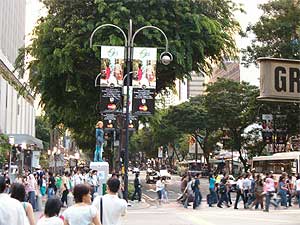 Singapore and globalisation have always been synonymous. Perhaps one can argue that this has been a brilliant economic strategy. One would be hard pressed to contradict that, even in the face of the current economic crisis.
However, the fact that Singapore’s economy (and psyche of its people) is so closely linked to the world economy suggests that the people there are inter-changeable with people from everywhere else.
A simple example would be the foreign talent scheme adopted by the Singapore Sports Council: the underlying logic is that as long as you are productive (that is you can generate surplus value in the form of medals), you are Singaporean.
In this sense, the strategy of the state is that of a perfect seductress: she who gains power not through a show of strength (and personality and identity) but precisely through a demonstration of emptiness and weakness.
And this is why one finds banners lining the streets with information concerning the upcoming Korean festival, Fashion Week or Oktoberfest; all under the over-arching banner of ‘Uniquely Singapore’.
And this is also precisely why we will always be safe from terrorism.
For there are no iconic targets in Singapore to attack and this is what the ‘Uniquely Singapore’ campaign is attempting to convey.
When read in this way, the ‘Uniquely Singapore’ campaign is a brilliant strategy by the state to attempt to secure the safety of its people. By showing that there is absolutely nothing inherently Singaporean about Singapore, the state is taking away any possible terrorist targets.
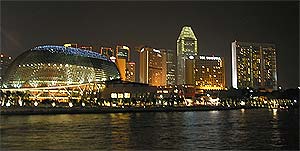 Of course at this point one might attempt to suggest that The Esplanade might be a potential icon, after all, it does take up a significant portion of the famous skyline of Singapore.
However, one must not forget – and in fact one is never allowed to forget – that The Esplanade is merely a poor replica of the Sydney Opera House; which is a way of saying, "if you want to blow something up, why not blow up the real thing". The same logic applies to the Singapore Flyer: "go take out the London Eye instead".
The problem with icons
For many years, the Merlion had the potential to be iconic. Even though many claim that it is hideous, there is no denying the fact that it is unique – there is perhaps no other union between a lion and a fish anywhere else in the world.
Which meant that for a long time, it was potentially a target. After all, the only reason that terrorist groups would blow something up is due to its iconic status and the fact that it is unique to that particular place.
The state’s response to this potential threat was an enlightened one; one that Sun Tzu would have been proud of.
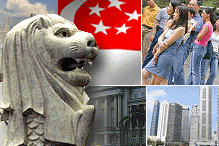 Instead of attempting to secure the Merlion with armed guards and the latest gizmos from the security industry, the potential threat was dissipated by making its iconic status disappear, not by removing the Merlion but by multiplying it, by building other Merlions (at the moment there are five such statues within the state and one each in China and Japan).
The moment there is more than one Merlion, none of them is unique: the mistake of the Twin Towers was of course the fact that they were not two separate towers, but part of one icon.
In April 2007, Singapore Airlines changed it advertising agency and there were many worried cries over the future of the ‘Singapore Girl’. After all, she has long been the symbol not just of the airline but also of the state.
It is of no coincidence that the only terror attack suffered by the state involved the ‘Singapore Girl’. On March 26, 1991, SQ 117 was hijacked by four male passengers.
The response of the state again was enlightened. In 1995, the policy of hiring stewardesses from only Singapore and Malaysia was changed – now females from China, Indonesia, Japan, Korea and Taiwan are also included in the recruitment drive.
From that point, the ‘Singapore Girl’ is no longer uniquely Singaporean (or Malaysian if you must), anybody and everybody can be a ‘Singapore Girl’ as long as she fits the criterion.
In this respect, all fears over the new direction of the advertising campaign are unfounded: since the ‘Singapore Girl’ can now be anyone, she is an empty icon, one that can be anything that anyone wants her to be.
All of these strategies came together on March 9, 2004, when the ‘Uniquely Singapore’ campaign was officially launched. And from that moment, we all felt much safer.
JEREMY FERNANDO is a Teaching Fellow at the English Division, School of Humanities and Social Sciences, Nanyang Technological University. He is also the author of 'Reflections of (T)error' and is based in Singapore.


Are you sure you want to delete this comment?
This action cannot be undone.