




A battle of wills in Perak
During a tense press conference, in the midst of a constitutional crisis in Perak, which is peninsular Malaysia's second largest state, a reporter's mobile phone began ringing.
During a tense press conference, in the midst of a constitutional crisis in Perak, which is peninsular Malaysia's second largest state, a reporter's mobile phone began ringing.
The embattled chief minister, Mohd Nizar Jamaluddin, asked the reporter to pick up the phone and pretended to answer it: "Hello? Oh, it's Barack Obama. Thank you, thank you, thanks for your support. I appreciate that, Mr President. I think you are wonderful."
The room full of reporters burst out in laughter.
 But Nizar's relaxed demeanor belies a steely determination as he engages in a battle of wills that has pitted him against the country's Deputy Prime Minister Najib Razak and the monarch of Perak, Sultan Azlan Shah.
A member of PAS, one of three parties in the Pakatan Rakyat coalition, Nizar has quickly won widespread admiration - and praise that cuts across ethnic and religious lines - for his open and non-racial approach to governance and his fiscal discipline in managing the state's budget.
Still, dramatic scenes unfolded in the previous weeks when a series of defections among state assembly members from the coalition government that Nizar leads, threw the state into political turmoil.
The federal ruling coalition of Barisan Nasional has been attempting to dislodge the Pakatan coalition government that has led Perak since last March's general election with support from the sultan.
Led by Zambry Abdul Kadir, BN last Tuesday began the process of forming a new government with Pakatan continuing to challenge its legitimacy.
When Nizar, accompanied by his state executive council members, went to the state secretariat as usual, he found his path barred by riot police.
Nizar has so far refused to resign as chief minister and the sultan has turned down his advice that the state assembly be dissolved and fresh elections called to resolve the impasse. Nizar has maintained that the BN government is illegal and that the sultan has no constitutional right to dismiss him.
Sentiment on the ground can be gauged from the fact that as Zambry was being sworn in at the state palace, about 5,000 worshippers outside a mosque 300 meters away blocked the road to the palace and demanded that the state assembly be dissolved and fresh elections held.
Can the sultan really decide?
The crisis was triggered when three state assembly members, two of whom are facing corruption charges, defected from Pakatan, overturning the state government's slim majority. A fourth assembly member had earlier defected from BN to Pakatan, but later returned to BN.
With that, the current status of the house is 28 Pakatan members, 28 BN members - and three independents who are pro-BN.
The Sultan of Perak, the constitutional monarch, consented to the appointment of a new BN government after he was convinced the BN had the majority in the state assembly.
The crux of the matter appears to be: who decides whether a chief minister commands the confidence of the majority of the state assembly members, the sultan or the state assembly?
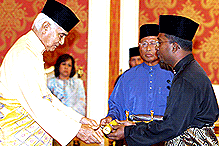 Pakatan supporters are insisting that under the constitution, Nizar can only step down if he resigns or if he ceases to command the confidence of the majority of the assembly.
Before that can happen, many have argued, the status of the defectors has to be determined, as they had signed undated resignation letters after the last general election. The speaker of the assembly, a Pakatan appointee, had used these letters to declare their seats vacant.
But the Election Commission has refused to recognise the letters and hold by-elections. The commission's head pointed out that the defectors have now denied the validity of their earlier letters. Critics, however, argue that the commission has no power to dispute the speaker's decision; that only the courts can overturn the speaker's decision.
Nizar and his state government committee members, for their part, are insisting they remain the legitimate government and continue to hold executive committee meetings.
To add to the complications, those who disagree or protest the sultan's move are at risk of finding themselves described as menghina (showing no respect) or worse, derhaka (traitorous) to the sultan. The sultan, a former Agong (or constitutional monarch for the whole country) who once served as chief justice, this year celebrates the silver jubilee of his reign in Perak.
As riot police fired tear gas at determined and angry protesters outside the mosque on the road to the palace, one furious man said: "Please tell the people that the menteri besar is not derhaka against the sultan. Nizar is trying to defend the administration of the state from corruption in the people's interest."
Behind the legal technicalities, the current impasse reflects a larger battle for political control of Malaysia. Perak, along with Selangor, Penang, Kedah and Kelantan had fallen into opposition hands in the last general election.
Desperate, Machiavellian methods
Following the setback for BN, leaders of Umno thrashed out a transition agreement to phase out Prime Minister Abdullah Ahmad Badawi by March to be succeeded by his deputy Najib, who has also assumed Abdullah's finance ministry portfolio.
But Najib's star has failed to shine brightly. He has been persistently linked to the murder of a Mongolian national, for which a court trial is ongoing - although he has vehemently denied any involvement in the case. Since the general election last March, Najib has led two key by-election campaigns for BN and lost them both.
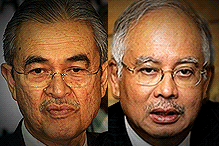 Delivering Perak to BN would go some way in appeasing restive Umno members still coming to terms with the shock of last year's general election, which saw the coalition lose its coveted two-thirds parliamentary majority and five out of its 13 states in the federation.
"What this shows to me, is that the new prime minister in waiting, Najib, is getting increasingly desperate and might resort to Machiavellian methods (to secure his position)," said Pakatan-aligned blogger and analyst Din Merican.
Many Malaysians are unhappy about the spate of defections to BN and have nicknamed the defectors ‘frogs’. BN supporters on the other hand are quick to point out that Pakatan supporters did not seem to mind when their leader Anwar Ibrahim tried to - unsuccessfully - seize federal power last September by trying to get BN parliamentarians to defect to his camp.
But many are unsurprised that BN is reluctant to hold fresh elections in Perak to resolve this issue once and for all.
As a result of frequent excesses and allegations of abuse of power, BN has seen its public support steadily erode since 2003, when premier Abdullah scored a landslide victory after his predecessor Mahathir Mohammad stepped down.
During a televised forum, a phone-in viewer expressed a common sentiment: "BN may think they have won the crisis in Perak but don't they realise that in the next general election, many more people will be voting for the opposition?"
For now both Nizar and BN are engaged in a battle of wills.
While BN may have won this round, its troubles are far from over. The party faces two tough by-elections, maybe even three, and Nizar may opt to stand for one of these and return to Parliament.
- IPS


