




Can PRS hope to represent Dayaks?
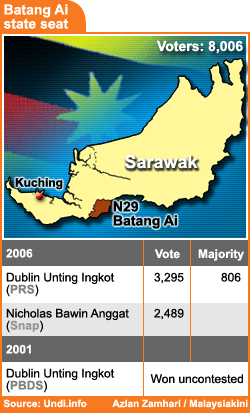
analysis The Batang Ai by-election on April 7 offers Parti Rakyat Sarawak (PRS) - which is trying to project itself as a Dayak-based party - the opportunity to gauge how much support it can get from this community.
analysis The Batang Ai by-election on April 7 offers Parti Rakyat Sarawak (PRS) - which is trying to project itself as a Dayak-based party - the opportunity to gauge how much support it can get from this community.
The Batang Ai state seat is not only an Iban-majority constituency, also a hotbed of Dayakism preached by the defunct Parti Bansa Dayak Sarawak (PBDS).
After a protracted leadership crisis, can PRS exert its influence and take over the role played by the PBDS?

 PRS was registered on Oct 21, 2004 by leaders who were responsible one way or another for the deregistration of PBDS when they challenged Daniel Tajem
(left)
and Joseph Salang
(right)
and their faction for control of the party at the 2003 triennial delegates conference.
PRS was registered on Oct 21, 2004 by leaders who were responsible one way or another for the deregistration of PBDS when they challenged Daniel Tajem
(left)
and Joseph Salang
(right)
and their faction for control of the party at the 2003 triennial delegates conference.
The tussle turned into a crisis leading to the creation of two presidents, two sets of supreme councils and two headquarters. And since the crisis was unsolvable, the best thing was for the Registrar of Societies to deregister the party - and it happened the day PRS was formed.
 Initially PRS had problems in getting ex-PBDS members, numbering nearly 200,000, to join the party. They blamed PRS leaders such as James Masing, Sng Chee Hua, Sidi Munan, Dublin Unting Ingkot (
left,
the late assemblyperson for Batang Ai), Joseph Entulu and Wilfred Nissom for the deregistration of PBDS.
Initially PRS had problems in getting ex-PBDS members, numbering nearly 200,000, to join the party. They blamed PRS leaders such as James Masing, Sng Chee Hua, Sidi Munan, Dublin Unting Ingkot (
left,
the late assemblyperson for Batang Ai), Joseph Entulu and Wilfred Nissom for the deregistration of PBDS.
While Dayaks shunned PRS, non-Dayaks were attracted and soon made up about half of the membership. The party canvassed state-wide for membership drive, but response was lukewarm even in areas that it controlled.
So the first test for PRS was the 2006 state election, when it contested nine Dayak-based constituencies - it won eight seats by rather comfortable margins, but lost Ngemah to an Independent. However, its strength was not really tested.
Promises not kept
After the election, PRS was bogged down by a leadership crisis, similar to that faced by PBDS. This time the tussle was between Masing and his deputy, Sng Chee Hua after Masing terminated those office-bearers who were Sng’s supporters.
They included secretary-general Sidi Munan, treasurer-general Clement Eddy, deputy information chief Earnest Chua and deputy secretary-general Larry Sng.
 Sng’s faction disputed the legality of the dismissals, since Masing
(right)
had failed to issue them with show-cause letters.
Sng’s faction disputed the legality of the dismissals, since Masing
(right)
had failed to issue them with show-cause letters.
The crisis ended last April with the Registrar of Societies recognising that Masing has the power to fire and hire under the party constitution.
However, the influence and credibility of PRS had been undermined by then, as more than half of its members, especially the Chinese, had either been sacked or had quit the party.
 Now it appears that the party, although multi-racial, is leaning towards the brand of politics practised by the defunct PBDS, if speeches of its leaders are anything to go by.
Another issue that may weigh against Masing is that he was a research officer with the state economic agency in the early 1980s before the construction of the Batang Ai hydro-electric dam.
The project promised a better life to the people and compensation for land and properties that were submerged in the man-made lake.
More than 25 years after the dam was completed, the people are still crying for electricity supply although the dam is at their doorstep; clean water; compensation for lost property; and land for farming that had been promised to them.
Can PRS win over the hearts and minds of former hardcore members of PBDS? They may have forgiven Masing for what he has done to their beloved party, but certainly they will not forget him.
As observers see it, the Batang Ai by-election is really a watershed for PRS.


Are you sure you want to delete this comment?
This action cannot be undone.