




Sabah plans buy back of water catchment areas
Increasingly frequent flash floods, other devastating occurrences of water run-offs, landslips and cases of forest fires being started deliberately have become a growing source of public concern in Sabah in recent days. This is becoming a hefty financial burden on the cash-strapped state government.
Increasingly frequent flash floods, other devastating occurrences of water run-offs, landslips and cases of forest fires being started deliberately have become a growing source of public concern in Sabah in recent days. This is becoming a hefty financial burden on the cash-strapped state government.
Not surprisingly, there have been a chorus of public protests and finger-pointing at the policies of successive state governments, loggers, land developers, the DID (Drainage and Irrigation Department) and the Land and Survey Department, among others.
For starters, the state government has pledged to consider buying back water catchment areas currently in private hands and more immediately halting activities in such areas.
 “Land offices in the state have been giving out land where water catchment areas are located,” admitted Tourism, Culture and Environment Minister Masidi Manjun.
“Villagers have complained that suddenly their water catchment areas have been alienated to land applicants.”
“This is bad. The state government has decided that, if necessary, it will buy back such areas.”
He also cited the Kundasang high country, now getting increasingly warmer, as an example of bad land management policies. Cutting down trees and burning down forests have become an “illness” among Sabahans, he added.
“When we alienate land, we just give away a whole chunk of it instead of leaving pockets of green lung buffer zones between alienations to mitigate the effect of land development,” noted Masidi.
Association not impressed with explanations
“There is nothing wrong in leaving some zones untouched. Development must be well-planned. We need to know what land to preserve and what to develop.”
Apparently, the Collector of Land Revenue and the Land and Survey Department (LSD) are now in the midst of determining how many water catchment areas have been alienated, reportedly unintentionally, to land applicants.
 LSD sources say that survey maps sometimes don’t indicate water catchment areas and such land are routinely alienated without any on the spot inspection.
It is only after the new landowners clear their property that neighbouring villagers discover that it is their only source of water supply.
The LSD pleads an avalanche of land applications for its failure to make it a point to visit and check every land application.
The Sabah Environmental Protection Association (Sepa) is not impressed with such explanations.
“LSD officers who rush to approve such applications cannot be said to have done so unintentionally,” said Sepa resident Wong Tack. “We know of cases where the EIA (Environmental Impact Assessment) was prepared in-house without the participation of the stakeholders and the public who can only watch their farms and properties overwhelmed by frequent flooding.”
However, Sepa concedes that most of the damage was done during the Parti Bersatu Sabah (PBS) government years from 1985 to 1994 when whole swathes of land were alienated to bring in revenue but remained dormant until recently.
“Those catchment areas known to be contributing to the worsening floods and landslips in the state should be identified and all activities in these areas should be stopped pending the state government’s buy back plans,” demanded Wong Tack.
Not one drop of rain in six months
“There’s so much flooding in Lahad Datu, Tenom, Beaufort and across Sabah because upstream forests have been alienated without respecting catchments. Buying back catchments may sound expensive but in the long run, the cost of extreme flooding and protracted droughts will be much higher.”
“People in Sabah should remember what happened during the mega El Nino in 1998 when not one drop of rain fell in Kota Kinabalu for six months.”
 Sepa witnesses of the recent Tenom floods reported seeing water gushing down many parts of the Crocker Range, apparently a rather unusual phenomenon which no one has witnessed in living memory.
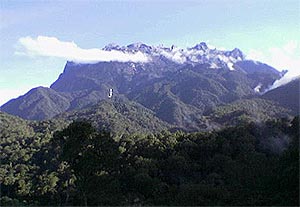
The Crocker Range, the mountainous heart of Sabah which includes Mount Kinabalu, links up with other high country areas inland and forms the difficult long, thickly-forested mountainous border terrain between the Malaysian and Indonesian halves of Borneo.
The finger of blame is being pointed at logging activities in Tenom but Masidi cautions against apportioning blame without a proper study.
“The allegations are that deforestation in the upstream areas of the Padas and Pegalan Rivers have caused the floods in Tenom and other districts,” said Masidi. “The suspicion is on the logging activities of the Sabah Forest Industries but we need to study this further.”
Tenom Hospital, a case in point, has been hit four times so far this year by flooding. The hospital authorities have been unable to do anything about the flooding beyond cleaning up the muddy mess left behind by the receding floodwaters and this is straining their manpower and affecting the quality of public healthcare.
After the recent flooding, the hospital had to evacuate an apartment block housing its staff after there were fears that the nearby state-owned Hotel Perkasa teeters on the edge of an imminent landslip.
Indiscriminate housing development
As many as 20 temporary evacuation centres have to be opened every time Tenom floods. The last flood was in mid-March.
Luyang state assemblyperson Melanie Chia lays the blame squarely on the DID for the devastating series of floods hitting the state with increasing frequency.
“For the last two years, we have been chasing the DID about this matter but they always say they have no money,” said Chia. “The problem not only occurs in flood prone areas but is also now affecting newer areas which in the past were flood-free. They have promised to come up with a comprehensive master plan but we have not seen anything yet.”
Chia notes the existence of a large flood mitigation monsoon drain system in places like Kota Kinabalu but these have been infested by water hyacinths, weeds, reeds, refuse and silting.
The water is also a blackish hue, stagnant and foul-smelling in most places, and this is a constant complaint of city dwellers. Much of the Likas Bay area used to be a mangrove swamp which provided a natural drainage for the city.
Except for the Likas Lagoon, most of it has since been drained for development in land-starved KK which hugs a narrow stretch of land between the South China Sea and the mostly mountainous inland.
Moyog DAP branch chairman Dr Jeffrey Wong thinks the role of indiscriminate housing development without a proper drainage system should not be overlooked when considering long-term solutions to the flooding problem.


Are you sure you want to delete this comment?
This action cannot be undone.