




Flag burners must pay for their crime, says Sabahans
Outraged by a group of Suluks burning the state flag last Saturday in Lahad Datu, Sabahans want the sternest possible action to be taken against the suspects who are still in police custody.
Outraged by a group of Suluks burning the state flag last Saturday in Lahad Datu, Sabahans want the sternest possible action to be taken against the suspects who are still in police custody.
"This (flag burning) is not our culture and we will not tolerate it," said Sabah Chief Minister Musa Aman in a public statement as chair of the state security council. "The police must get to the bottom of the incident and ensure that it is not repeated."
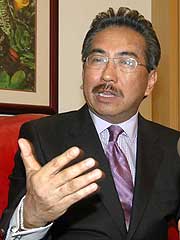 Musa pointed out that the Philippines claim to Sabah was a non-issue since Malaysia, the United Nations and the world has never recognised it.
Musa's remarks have been echoed by politicians across both sides of the political divide and various associations like the Sabah Bangsa Sungei Association, the United Sabah Bajau Association led by former chief minister Salleh Keruak, the Consumers Association of Sabah and Labuan, the Malaysian Youth Council for Sabah, the Kadazan Society of Sabah and the Junior Chamber International for Sabah.
Suggestions range from incarceration under the Internal Security Act to public flogging and deportation after stripping them of their MyKads if genuine. According to the police, all 12 suspects are holding Mykads.
Sepanggar MP Eric Majimbun and Tawau MP Chua Soon Bui are convinced that "someone must be behind the 12 and the police should grab the real culprits."
Sabah police took into custody the suspects, apparently all Suluks including one who claimed to be the heir to the Sultanate of Sulu and Sabah, following the early morning incident in Lahad Datu. They are being investigated under Section 149 and 143 of the Penal Code and other relevant sections.
They are likely to be charged with burning the state flag, illegal assembly and attempting to force their way into the district police headquarters compound in the east coast town sandwiched between Sandakan and Tawau.
Flags with red-coloured lion emblem
District police chief Mohd Suhaimi Abdul Rahman confirmed the suspects aged between 14 and 41 were detained in front of the police headquarters and several items were seized from them. These included six burnt Sabah flags and several yellow flags bearing a red-coloured lion emblem, said to be from the old Sulu Sultanate.
"One of the suspects claimed to be the group leader and heir to the Sulu Sultanate," said Mohd Suhaimi.
Tracing the events which unfolded last Saturday, the police chief said the incident began at 8.40am when the suspects, holding yellow flags, began demonstrating in the town area and went on to burn six Sabah flags in two separate locations - at the Pasar Rakyat and in front of a supermarket. It is not known what they were demonstrating about.
"When we reached the suspects, they split into two groups, boarded two 4WDs and made for the police compound," said Mohd Suhaimi. "We are still trying to establish the motive of the group in staging the illegal assembly and burning the Sabah flags."
An 80-man police team from had been deployed in Lahad Datu since Saturday to maintain public order and security.
Lahad Datu state assemblyperson Datu Nasrun Datu Mansor, who is a Suluk himself, described the incident as "an isolated one caused by individuals trying to cause a disturbance in town."
"This is nothing more than the actions of an irresponsible group,"
he said. "The people have nothing to worry about as the police have the security situation under control."
Lahad Datu was the landing spot for the Sulu datus who settled along the east coast of a land they referred to as Sabah (a kind of banana).
The British colonial administration in Sabah, upon assuming responsibility for the state from the virtually-bankrupt North Borneo Chartered Company after World War 11, declared that the Sulu Sultanate had died out without leaving a male heir. However, decedents of the last Sulu sultan subsequently "transferred suzerainty" to the Government of the Republic of the Philippines on the eve of the formation of Malaysia.
The Philippines has since laid claim to the east coast of Sabah, said to be part of the Sultanate of Sabah, and the northern third of Sabah which was handed over to the Sulu Sultan by the Sultan of Brunei in return for his help during a palace dispute in Bandar Seri Begawan involving two claimants to the throne.
Home to immigrants
Malaysia is still paying RM5,000 a year in stipend monies – for the transfer of Sulu's right to collect toll along some of the waterways in Sabah to the North Borneo Chartered Company in return for a yearly stipend - to nine decedents of the Sulu Sultan as decreed by an order of the Sandakan High Court in 1939 upon their seeking a court ruling.
The yearly stipend has been variously interpreted as pajak (lease) monies by the Sulu heirs and the Manila government but the Sandakan High Court did not rule on this claim but instead referred to the sovereign right of a people to be free and democratic.
The present nine heirs of the Sulu Sultan are said to be eager to drop their claim to Sabah in return for a better yearly stipend while the question of suzerainty is left to the governments of Malaysia and the Philippines to sort out. There has been no response so far to a memorandum they sent last year to former premier Abdullah Ahmad Badawi.
Meanwhile, Sabah People's Progressive Party (Sapp) has issued a statement giving public notice of its intention to table resolutions in the state assembly and Parliament on the Sabah claim.
The party wants the federal government to take concrete steps to get the Philippines to drop its claim once and for all. The party, which pulled out from the ruling Barisan Nasional last Sept 17 citing loss of confidence in the federal leadership since the political tsunami of March 8 last year, has two state assemblypersons and two members of Parliament.
Sabah has a large population of legal and illegal immigrants including Suluks from the Philippines and this has been cited as a potential security concern and threat in the event of hostilities with that country, especially over its longstanding Sabah claim which is reflected in the Manila Constitution and maps.
Other immigrants, legal and illegal, come from Indonesia, Timor Leste, Bangladesh and Pakistan, among other places.
Anti-immigration activist Dr Chong Eng Leong estimates conservatively that only 1.6 million of the state's 3.1 million population are Malaysians or eligible to be considered Malaysian citizens.


Are you sure you want to delete this comment?
This action cannot be undone.