




India begins voting in month-long election
India kicked off its month-long election today that will see hundreds of millions of people cast their ballots in the world's biggest exercise in democracy - and one likely to end in stalemate.
Indians voted in their tens of millions Thursday as month-long general elections - the world's largest democratic exercise - kicked off with little hope of a clear winner at the end of it all.
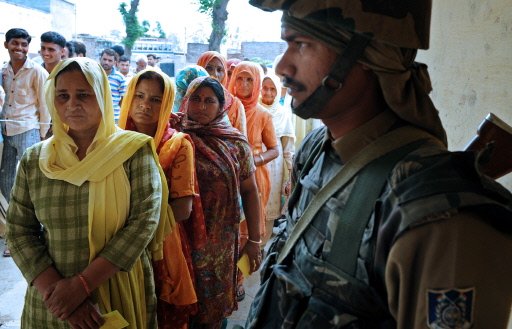
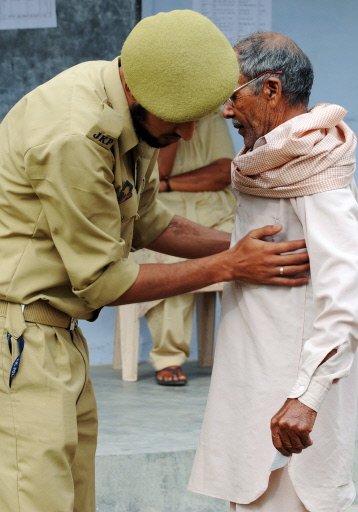
From the southern tropical state of Kerala to the Himalayan foothills of Kashmir in the north, voters cast their ballots at the start of a five-stage process so spread out that six million civil and security personnel are needed to keep it on track.
 Neither the ruling Congress party nor its main rival, the Hindu nationalist Bharatiya Janata Party (BJP), is expected to win outright when voting wraps up on May 13, setting the stage for some old-fashioned political horse-trading to build a coalition that can govern India's one billion people.
The vote comes at a pivotal time for India, with the once red-hot economy feeling the strain of the global downturn and relations with neighbouring Pakistan at a new low since the deadly Mumbai attacks in November.
Domestic security concerns were highlighted soon after polling opened Thursday when Maoist rebels launched attacks in several eastern states, killing at least 16 people, including nine paramilitary troopers and five election workers.
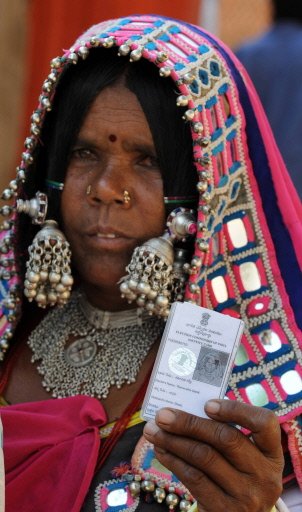
But elsewhere, patient voters formed long and often colourful queues to use the electronic voting machines and have their fingers stained with indelible ink to prevent any fraud.
 "As citizens of this country we want basic facilities for development like electricity, water, jobs for our young," said Chotte Lal Singh Patel, 60, village elder from the outskirts of the Hindu holy city of Varanasi.
Such grassroots issues are behind the rise in recent elections of regional and local groupings who have succeeded in splintering national support for the established parties by catering to small constituencies.
India has countless small parties that cater to small constituencies but the real showdown is between theruling Congress party and the opposition BJP, which are led by two of the grand old men in Indian politics.
Current Prime Minister Manmohan Singh, 76, is squaring off against LK Advani of the Hindu nationalist Bharatiya Janata Party (BJP). Either will likely need support of smaller regional parties to build a coalition to govern.
Photographic electoral rolls and indelible ink
India's 15th general election since independence combines modern electronic vote machines and photographic electoral rolls, with simpler methods such as marking voters' thumbs with indelible ink to ensure no one votes twice.
Many voters are expected to make their choices along religious and caste lines or on the basis of strictly regional issues that affect their daily lives.
 "Our kids are so desperate for food. People can?t get ahead because of the expenses," said Ruksana Begun, as she cast her vote in Varanasi, with only her eyes visible from under an all-enveloping black burka.
"Everything is expensive and the people here are very distressed by the prices," she said.
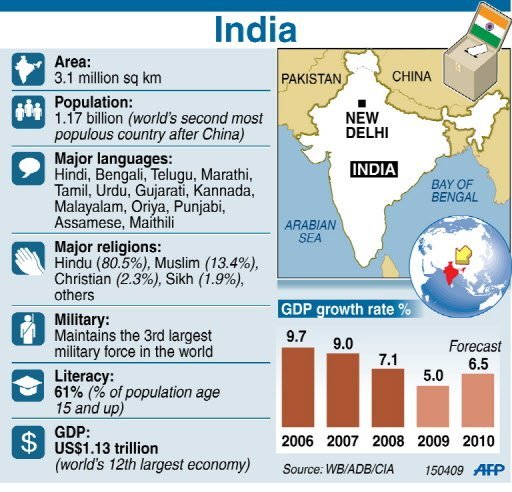
After five successive years of near-double digit growth which lent the country the international clout it has long sought, the economy has been badly hit by the global downturn.
India's fiscal deficit for the last financial year was six percent of GDP - more than double the target - and 11 percent if the deficits of regional state governments are included.
And there are major security concerns over growing instability in the South Asia region, particularly arch-rival Pakistan with whom relations plunged to a new low following last year's bloody militant attack on Mumbai.
 "India needs a strong government at this stage to be able to tide us over the economic crisis in particular, besides issues like relations with Pakistan and instability elsewhere in South Asia," said analyst Rasheed Kidwai.
"But it seems increasingly likely that we're going to get a weak coalition that will probably only last two to three years," Kidwai said.
Polling is to be staggered over five phases, with the final round on May 13 and results expected three days later.
Roughly 714 million people are eligible to vote, including around 143 million - more than the population of Russia - on today alone.


Are you sure you want to delete this comment?
This action cannot be undone.