




Indonesia bemoans slow worker legalisation in Sabah
The Indonesian Consulate in Kota Kinabalu has 250,000 brand new passports in its strongroom ready to be issued to illegals in Sabah.
However, since the ‘crackdown’ on illegals began in August last year, only 4,300 Indonesian workers in the state have been issued with their travel documents. Most of these workers are maids, gardeners, construction and restaurant workers.
The Indonesian Consulate in Kota Kinabalu has 250,000 brand new passports in its strongroom ready to be issued to illegals in Sabah.
However, since the ‘crackdown’ on illegals began in August last year, only 4,300 Indonesian workers in the state have been issued with their travel documents. Most of these workers are maids, gardeners, construction and restaurant workers.
Another 6,700 have paid their levies, under the discounted system which expires next month, and are tentatively eligible to apply for their passports. It costs just RM22 to obtain an Indonesian passport.
These figures come under the screening of foreign workers in Sabah programme, an amnesty of sorts for illegal workers.
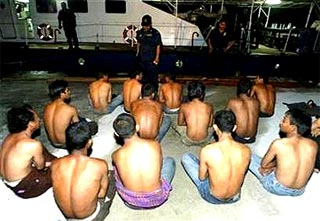 The Immigration Department, meanwhile, has registered a total of 217,267 and 95,000 illegals from Indonesia and the Philippines respectively since August last year. Dependants form half the number of illegals.
The Indonesian consul-general estimates that there are at least 200,000 illegal workers, minus their dependants, in Sabah. The bulk of them are in the plantation and manufacturing sectors.
Acting consul-general Rudhito Wisagdo disclosed these figures yesterday on the sidelines of the voting process for Indonesian workers in the state. Over 37,000 or 55 per cent of the registered voters in Sabah cast their votes in KK and Tawau for the general election.
Apparently, the non-payment of levies by local employers, the lack of insurance coverage and the absence of written employment contracts are holding up the issuance of passports to the illegal workers. The Jakarta government will not issue a passport unless and until all three key conditions, among others, are met.
Takes just one day to process passport
“What we can do now is to process their registration for passports. The documents would be handed to them once they comply with all the conditions for the issuance of a passport,” said Rudhito.
“It takes us just a day to process the passport. So, they do not have to wait too long.”
Other problems delaying the issuance of passports include applicants who wanted to change their names and identities. The policy is not to entertain such requests.
Applicants must ensure that their names as registered with the Immigration Department must tally with that used back home, warns the consul-general.
Applicants for passports have to undergo a stringent interview process. Many illegal Filipinos have also been caught trying to obtain Indonesian passports.
One problem seems to be the absence of a Philippines consulate in Sabah to speed up the issuance of passports to illegals from that country.
Manila refuses to set up a consulate in Kota Kinabalu, citing the moribund Sabah claim. Filipino illegals are served by a mobile passport team from Kuala Lumpur visiting the state at regular intervals.
Rudhito confirmed that his offices in KK and Tawau can currently serve an average 120 to 150 persons daily. It used to be 10 to 12 applicants daily as recently as December last year when only 188 illegals had been issued with their passports. The passport exercise for illegals began in that month.
Mobile passport teams
Rudhito’s offices in KK and Tawau are also willing to send mobile passport teams to all plantations and factories in the state. The workers must either have their levy and other receipts ready for the mobile team or declaration letters as proof of their registration with the Immigration Department.
The consul-general would be sending reminder letters to employers in the plantation and manufacturing sectors on the need to legalise their workers from Indonesia by the May 31 deadline to take advantage of the discounted levy payment system.
It can be assumed that 150 applicants, all for passports, are issued with the document by the Indonesian consulate daily. This means it will take more than 1,448 days or 3.96 years or 47.62 months to issue passports to all Indonesians currently working illegally in Sabah.
Not counted are those illegals yet to be registered by the Immigration Department, and those who continue to pour across the long porous border with Kalimantan Indonesia, in seasonal waves.
Rudhito thinks the problem can be kept under control “if the local authorities in Sabah, especially the Immigration Department, and local employers are willing to step up their co-operation with the consulate”. This has been Rudhito’s constant lament in recent months.
State Immigration Department director, Baharom Talib, attributes the delay in processing the work permits for foreign workers to teething problems with their new computer system.
“The system is online nationwide and sometimes it faces glitches
that could also cause delays,” explained Baharom. “We will ensure that whatever revenue is due to the government is collected.”
The Sabah state government has given all local employers until next month end to settle the levies for their foreign workers in the state illegally. After May 31, the discounted levy payment system will no longer be applicable.
The Federal Government has pledged to take action against all errant employers and their workers in Sabah after the May 31 deadline. Such threats, routinely made in the past, are no longer taken seriously by the illegals given the severe shortage of detention facilities in the state.
20,912 illegals deported last year
“It is imperative that these employers grab the opportunity and avoid legal action being taken against them,” advised Rudhito.
“In fact, it is not the employers who are paying the levy but the workers themselves. I have been receiving complaints from workers that their employers have been making monthly deductions from their salaries to pay for the levy.
"There are even employers who make a lump sum deduction. Not known is whether these employers pay the government promptly or pay at all.”
Meanwhile, some 20,912 illegal immigrants in Sabah were deported to their home countries last year, according to Misri Barham, director of the Federal Special Task Force in the Prime Minister’s Department, Kota Kinabalu.
These are people, mostly males, who could not prove that they had local employers who were willing to sponsor their stay. Filipino males outnumbered Indonesian males two to one. Nationals of other countries numbered 83.
In addition, there are 12,000 Indonesian and 81,000 Filipino holders of the IMM13 “Refugee Status” document that enables them to reside and work in Sabah without a work permit, according to Misri.
The IMM13, it is public knowledge, was meant for those fleeing the civil war in the southern Philippines in the 1970s. About 81,000 entered the state in the 1970s and 1980s and it is a mystery why the figure has remained the same.
The disclosure that there are Indonesians who hold the document as well comes as a complete surprise.
Misri explains that 3,000 Indonesians fled to Tawau in 1965 at the height of Indonesia’s policy of confrontation with Malaysia. Apparently, their numbers have since swelled to the 12,000 cited by Misri.
He attributes this to increasing births in Sabah. This does not seem to be the case with the Filipino holders of the IMM13, fueling suspicion that they may have been quietly granted permanent resident status.


Are you sure you want to delete this comment?
This action cannot be undone.