




Nepal in political turmoil after Maoists quit gov't
Nepal's Maoists vowed today to bring thousands of protestors onto the streets of the capital after a bitter stand-off with the army chief forced their leader to resign as prime minister.
Nepal's Maoists vowed today to bring thousands of protestors onto the streets of the capital after a bitter stand-off with the army chief forced their leader to resign as prime minister.
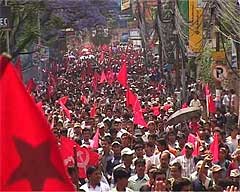 The collapse of the ultra-leftists' administration after just eight months in office leaves the impoverished country without an effective government, and threatens a 2006 peace deal that ended a decade of civil war.
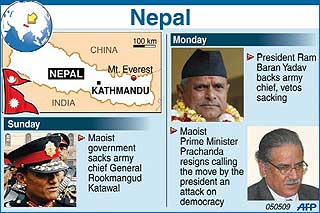
Maoist leader Prachanda announced on Monday he was quitting as premier after his decision to sack the head of Nepal's army, a longtime rival, was vetoed by President Ram Baran Yadav, a member of the main opposition Nepali Congress party.
Prachanda, who led a bitter insurgency before signing up for peace and pushing through the abolition of Nepal's Hindu monarchy, accused the president of being "undemocratic" and undermining the peace process.
His supporters vowed a campaign of civil disobedience.
"We are planning protests in different parts of the Kathmandu valley on Tuesday afternoon," said Uma Subedi, secretary of the Maoists' feared youth wing, the Young Communist League.
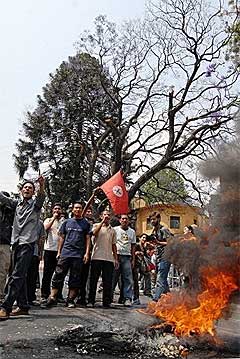 "We will launch regular protests until the president takes back his decision," she said.
Maoist spokesman Dinanath Sharma also said all left-wing "sister organisations" had been ordered to join the protests, including in the national parliament, "unless the president apologises."
The Maoists tried to sack the army chief, General Rookmangud Katawal, for refusing to integrate 19,000 former Maoist fighters - currently confined to United Nations-supervised camps - into the regular army as stipulated by the peace accord.
The army views the guerrillas as politically indoctrinated, and also accuses the Maoists of not fulfilling commitments to dismantle the paramilitary structure of their feared youth wing.
Prachanda, however, has long argued that the dispute is merely part of a wider campaign to undermine his democratically-elected government, which was formed after the ex-rebels scored a surprise win in landmark polls last year.
Maoists have 40 percent of seats
The resignation of Prachanda - whose real name is Pushpa Kamal Dahal, but who goes by a nom-de-guerre meaning "fierce one" - now leaves the landlocked Himalayan nation in political limbo.
Officials said the president had asked Prachanda to stay on as a caretaker premier until a new government is formed.
 In last year's elections, the Maoists won 40 percent of the seats in a new constitutional assembly - which functions as an interim parliament - making them the largest single party, but short of an absolute majority to govern alone.
Their main rivals have sided with the president, and have said they will start talks on Tuesday on forming a new government.
"We will build national political consensus to form a new government," said Ishwor Pokhrel, head of the centre-left UML party, which holds fewer than half the number of seats the Maoists hold.
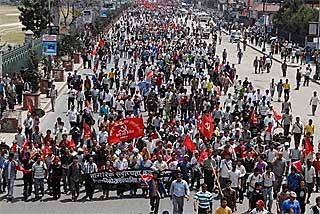 But observers say the Nepali Congress and the UML - the second and third-largest parties - will have trouble garnering support from a host of smaller ethnic parties and independents to form a government.
Even if they do get the numbers, a coalition without the Maoists would be fragile.
The political process is further complicated because Nepal's new, post-royal constitution has yet to be written.
A statement from the European Union issued by embassies in Kathmandu voiced "serious concern" over the crisis.
"We call on all political parties to act responsibly and in accordance with democratic principles. There can be no place for violence," the statement said.


Are you sure you want to delete this comment?
This action cannot be undone.