




NGOs plead for end to child marriages
NGOs and social activists are close to admitting defeat on the longstanding practice of child marriages in Sabah's rural and interior areas.
NGOs and social activists are close to admitting defeat on the longstanding practice of child marriages in Sabah's rural and interior areas.
Apparently, they have been conducting workshops and seminars on the social evil for many years but it seems to no avail. Sabah Women Action Resource Group (Sawo) is one of the NGOs in the forefront of the battle against child marriages in the state.
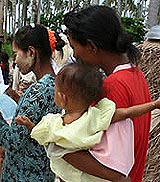 "We have been conducting workshops and seminars in rural areas in Tambunan, Keningau and Nabawan in particular where participants have reported that child marriages are still happening in their districts," said Sawo president Winnie Yee.
"Child marriages are still practiced today mostly in the more remote parts of Sabah by poor communities who have few better options for survival."
Worst hit areas also include Pitas in northern Sabah, the poorest place in Malaysia, Tenom, Paitan and Kota Marudu.
Paitan and Kota Marudu are particular hotspots for child marriages, according to social activist Maria Sandra Sho, an outreach co-coordinator with the Catholic Church in Sabah. She cites, as an example, a visit in 2004 to Kampung Magandoi Sonsogon in Kota Marudu.
"Most of the girls had babies or toddlers in their arms," said Sho. "They had been married off at about 13 or 14 while their husbands were barely 15 or 16."
"The firstborn of some of these young mothers, especially those suffering from malnutrition, die within days or a few months due to health complications."
Sho also noticed that the incidence of cleft lips and thalassemia, generally associated with in-breeding, were quite high and compounded by rampant cases of incest.
Thalassemia is also blamed not only on in-breeding but Dusun marrying Dusun for millennia into the same gene pool. Cleft palate, it is said, can also be caused by environmental degradation of the soil, air and water.
Law seems to be powerless
The law seems to be powerless when it comes to the rural areas. Sexual intercourse with an under-aged girl is considered statutory rape under Section 376 of the Penal Code.
Local Adat (native law) likewise frowns upon marriage between close relatives which is defined as including the third cousin. Any marriage between 'close relatives' is considered incestuous in rural communities. Violators, in the case of first cousin marriages, could be banished for life from the district under native law.
Similarly, adultery and any sexual relations outside of marriage are forbidden by tradition but are more often observed in the breach. In the olden days, people suspected of committing incest were either put to death or tied to a raft that was let loose to float away. This was to avert the anger of God and prevent supernatural punishment from falling on the whole community, according to local belief.
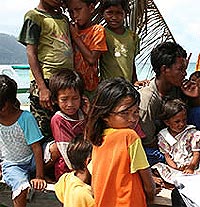 Now, Sawo and other NGOs and social activists want the state government to step in and get the cooperation of local leaders, district offices and the Native Court (
Mahkamah Anak Negeri
) to eradicate the problem once and for all.
Now, Sawo and other NGOs and social activists want the state government to step in and get the cooperation of local leaders, district offices and the Native Court (
Mahkamah Anak Negeri
) to eradicate the problem once and for all.
The plea is a follow-up to the 14th International Inner Wheel (IIW) Convention in Kota Kinabalu last week which ended on Saturday. IIW is a NGO which observes and questions various committees of the United Nations.
If cooperation in the fight against child marriages isn’t forthcoming, the NGOs and social activists want the authorities to use the big stick in the form of the Child Act and the Penal Code. Sawo and other NGOs, it is said, have brought specific cases of child marriages to the attention of government agencies but received no response.
Young girls have fewer options
Enforcement measures must go hand in hand with socio-economic programmes, according to the NGOs. These, it is urged, must cover the babies and toddlers produced by the child marriages "to ensure that they are not doomed to another generation of poverty and wasted lives". The measure, it is urged, must include more options for young girls who are now considered a burden by their families when they reach puberty.
"Young girls in the child marriage areas have fewer options than boys. Most girls stop schooling after Primary Six as secondary schools are usually less accessible and require more expenditure which parents can’t afford," said Yee, a Gender and Development expert, who has observed the rural scene for than 20 years.
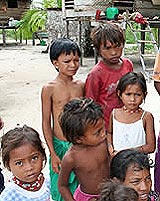 "Boys are more mobile and will migrate to look for jobs elsewhere while most girls remain at home where they are considered an extra mouth to feed in a family already struggling for the basic necessities."
Sawo thinks that the main solution to child marriages is to ensure the affected communities have access to appropriate educational and economic opportunities, and basic infrastructure and amenities.
Added Yee: "It is unacceptable that after more than four decades of development where poverty eradication is one of the primary focuses, the lives of young girls and communities in the rural areas of Sabah remain unchanged."


Are you sure you want to delete this comment?
This action cannot be undone.