




PKFZ scandal: Freeze their bank accounts
The PricewaterhouseCoopers (PwC) audit report on the Port Klang Free Zone (PKFZ) fiasco has lend greater credibility to claims that have long been reported but swept aside by the government – that serious shortcomings, irregularities and abuses have from the very beginning plagued the publicly-funded project.
The PricewaterhouseCoopers (PwC) audit report on the Port Klang Free Zone (PKFZ) fiasco has lend greater credibility to claims that have long been reported but swept aside by the government – that serious shortcomings, irregularities and abuses have from the very beginning plagued the publicly-funded project.
Among the facts confirmed by PwC is that PKFZ has been hobbled by inflation of costs, weaknesses in governance and management of the project, improper and poor decision-making, and conflict of interests by PKFZ and other officials.
However, the manner in which the PwC report has been unveiled by the Port Klang Authority (PKA) should also be questioned. Why is the report available only until June 10? Why restrict the number of hard copies available to only 15?
It is also incredulous that PwC has not only stated that it is not obliged to respond to any queries, and does not owe a duty of care to any party other than PKA, but has also stipulated that readers are not authorised to use or rely on the report to arrive at any conclusion!
 If PwC is so afraid of being identified with even the conclusions people reach on the basis of its own report, will the international firm stand by its own auditors? Why is there no party willing to defend the integrity of the document?
The decision to submit the 51-page report to the Malaysian Anti-Corruption Commission (MACC) should nevertheless be applauded.
But will there be serious action taken against all those responsible for the shortcomings, irregularities and abuses in the scandal? If there is such action, to what extent and to what level will it be taken against these individuals?
The government should freeze the bank accounts of all persons implicated in the fiasco – and those in government positions should be immediately suspended – until MACC investigations have been completed.
 This may include – but should not be confined to – MCA and Umno figures, members of parliament and Selangor executive council, former or current PKA and PKFZ officials, developers, lawyers and consultants, as well as the various shareholders and directors.
Among the pressing questions for the government to answer pertains to the issue of the runaway project costs.
Assuming the project costs RM7.453 billion – and may balloon to RM12.453 billion by 2051 – where will the government find the money, especially given the global financial crisis that has hit Malaysian shores?
RM7 billion is after all the total amount allocated in the government's first package to stimulate the national economy and RM12 billion is one-fifth of the second RM60 billion stimulus package. How will this affect plans to address the economic crisis confronting us?
Many questions left answered
In light of the many failures and breaches of regulations brought to light by PwC, what do our domestic regulators have to say for themselves?
-
 In particular, the Auditor-General Department, which was instrumental in revealing the ballooning of costs of PKFZ and the financial viability of PKA to undertake the project. Could it not have done more? To what extent did it warn the government about the heavy price that taxpayers would have to pay when the PKFZ bubble bursts?
- Is the Auditor-General Department satisfied with merely crunching accounts numbers and stating these in its annual reports? How does the department today compare with the times during the likes of such vibrant, vigorous and vigilant auditors as the late Ahmad Noordin Zakaria? The RM2.5 billion BMF scandal that Ahmad Nordin investigated pales in comparison to the gargantuan RM12.5 billion PKFZ scandal.
- How far did the Attorney-General's Chambers go to ensure that legal procedures, provisions and standards were adhered to? Were there any steps taken once it was determined that all these were bypassed by PKA officials?
- Could the Bar Council not have played a role in probing the possible breach of legal ethics – such as the element of conflict of interest – by lawyers involved in the PKFZ project? What can be done to lawyers who are supposed to represent the interests of the state – and thus its citizens – and yet act contrary to them?
- Bursa Malaysia had “reprimanded” the PKFZ developer in 2006 when it failed to inform the stock exchange and obtain the consent of its shareholders on the disposal of the land. Was that the best Bursa could have done?
- What did the Finance Ministry do when it was determined that many Treasury regulations and procedural requirements had been trampled upon?
- Did Parliament's Public Accounts Committee play its role when probing the PKFZ? Why did the investigations end with the exit of Shahrir Abdul Samad as the committee’s chairperson? Is the PAC truly serving as a watchdog of public accounts or merely posturing as one?
- The MACC’s predecessor, the Anti-Corruption Agency (ACA), had also gone through the motions of “interviewing” PKFZ officials and carted away documents from PKA. Needless to say, nothing came out of that.
Our regulators fail to do their job
It’s been five years since the first police reports were lodged against the PKFZ, shouldn’t the MACC take the issue more seriously?
Scandalous as it is, the significance of PKFZ lies not only in the billions of ringgit of public funds involved, especially at a time when a global financial crisis of unprecedented scale looms over us.
The long-term implications of this debacle are equally troubling given the crucial and critical role that should be played by the nation's regulatory agencies – such as the Auditor-General Department, the Attorney-General's Chambers, the Securities Commission.
It is partly due to their dismal failure in performing their job that this scandal has exploded in our face.
The country's viability and prosperity lies in the hands of regulators such as those above. If they cannot be trusted to do their job, then what are they actually doing in the offices they are occupying?
Among the main factors said to have caused the global financial and economic crisis is the failure of US regulators to monitor and control the increasingly risky and adventurist instruments and activities of financiers and bankers.
Given the failure – or unwillingness – of Malaysia's regulators and enforcers to do their job, it looks like we're headed towards a similar disaster.
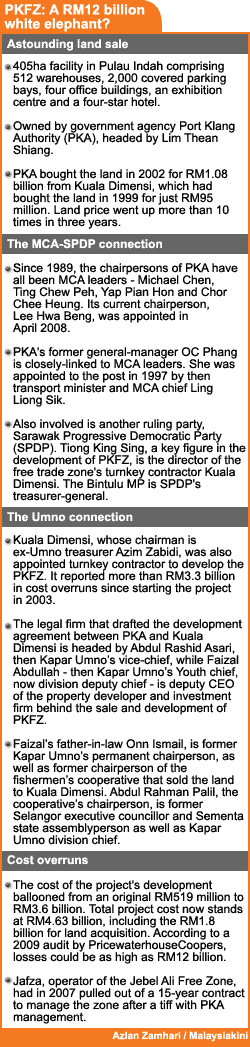
See chart on the players involved
CHARLES SANTIAGO is the DAP member of parliament for Klang.


Are you sure you want to delete this comment?
This action cannot be undone.