




Nine dead in Washington rush-hour metro crash
Rescue workers searched through a mangled mess into the night after a Washington metro train rammed into another one during the evening rush hour, killing at least nine people and injuring 76.
Rescue workers searched through a mangled mess into the night after a Washington metro train rammed into another one during the evening rush hour, killing at least nine people and injuring 76.
Rescuers used powerful blades to cut through the wreckage to find any more people trapped after a train slammed into a stationary one, forcing one subway car on top of the other and sending passengers hurtling through the air.
Mayor Adrian Fenty warned the toll could rise in what he described as "the deadliest accident in the (33-year) history of our Metro train transit system".
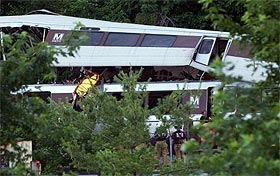 Fenty suggested the moving train may have been travelling too fast when it hit the stationary one.
The rear car of the lead train compressed like an accordion before leapfrogging on top of it on an above-ground portion of the popular Red Line.
"It was going at a speed that would have made that initial car literally compress to about one-fourth of the original size," Fenty told CNN , strongly hinting the toll could rise.
"We have to go in (to the compressed rear car) and find out if there are any remaining bodies."
The collision involving the six-compartment trains took place at 5:02 pm (2102 GMT) near the Fort Totten Metro station, said Washington Metropolitan Area Transit Authority (WMATA) general manager John Catoe
Probe launched immediately
Fire Chief Dennis Rubin said at least 76 people were hurt, including two with life-threatening injuries.
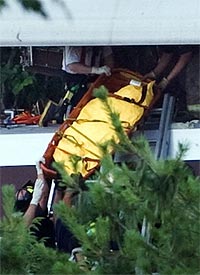 The collision occurred at 5:02 pm (2102 GMT) near the Fort Totten Metro station close to the District of Columbia's border with the state of Maryland, said Washington Metropolitan Area Transit Authority (WMATA) general manager John Catoe, who offered his condolences to the families of those who died.
One of those who died, a woman, was the operator of the second train that rammed into the first as it awaited orders to proceed along the tracks, Catoe said.
"The next train came up behind it and for reasons we do not know plowed into the back of the train, he added.
"To the families of those who are injured, our deep heartfelt pain is with you, and we will do whatever we can to help through this process."
National Transportation Safety Board (NTSB) officials were on the scene and had launched an investigation into the crash.
It was like train bombs in London
Dozens of stunned passengers, safely evacuated from the train, were standing by the train tracks close to the collision site, or were being helped down off the other carriages by rescue workers.
For passenger Abra Jeffers, the crash was a harrowing welcome to the nation's capital, where he was heading home from his first day of work Monday.
"I was on the train that got hit. I thought it was an explosion," Jeffers, 25, told AFP . "I thought it was like the train bombings in London. There was smoke and dust everywhere."
Train passenger Jody Wickett told CNN she was texting a friend when she was sent hurtling through the air of the subway car.
"We felt like we hit a bump and about five or 10 seconds later, the train just came to a complete halt and we went flying," Wickett said.
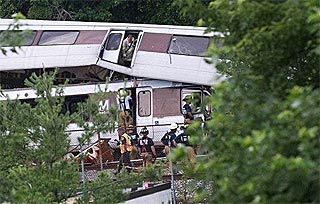 "I went in there to try and help and (there was) debris and people pinned under and in between the two cars. We were just trying to get them out and help them as much as possible, pulling back the metal and whatnot," she said.
"Some we couldn't, some we could, until an emergency crew got there."
Metro carries an average of some 800,000 people a day in and out of the nation's capital, and is divided into five lines criss-crossing the city and traveling deep into the neighboring states of Maryland and Virginia.
On the January 20 inauguration of President Barack Obama, more than 1.5 million people used Washington's public transportation system to see the swearing-in.
But many Metro officials have been urgently calling for more funds to repair the aging system, warning it was coming under increasing strain.
The last crash was in Setember
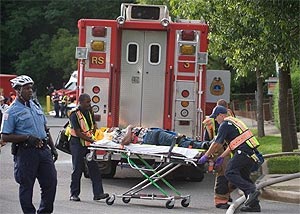 Mayor Fenty warned of huge delays to commuter traffic, including non-Metro train services along the heavily traveled East Coast corridor near Washington.
The last major train crash in the United States was in September, when 25 people were killed when the conductor of a train in Los Angeles was sending text messages on his mobile phone while in charge of a commuter train.
The deadly collision in Chatsworth, north of Los Angeles, also injured 134 people and was the worst train accident in the United States in some 15 years.


Are you sure you want to delete this comment?
This action cannot be undone.