




Sabah explores going beyond Ambalat dispute
Sabah needs to revisit the legal aspects of any previous agreement with the federal government on the oil and gas issue, according to a closed-door forum held in Kota Kinabalu on Friday by the Borneo Heritage Foundation (BHF).
Participants decided that at the same time there was “a need to press for greater transparency on the mechanics of the oft-cited five percent royalty to the state governments of oil states”.
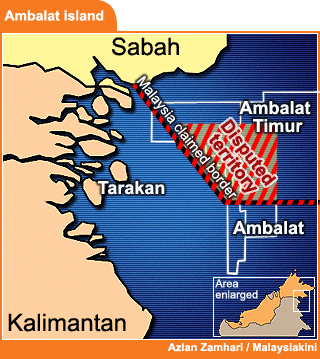
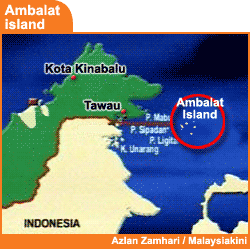
The trigger-off point for the forum - the swirling controversy over who owns the oil and gas rich 15,235 sq km Ambalat block in the Sulawesi Sea has brought back the production sharing contracts (PSC) with the oil contractors into sharper focus and greater public scrutiny.
Sabah needs to revisit the legal aspects of any previous agreement with the federal government on the oil and gas issue, according to a closed-door forum held in Kota Kinabalu on Friday by the Borneo Heritage Foundation (BHF).
Participants decided that at the same time there was “a need to press for greater transparency on the mechanics of the oft-cited five percent royalty to the state governments of oil states”.
The trigger-off point for the forum - the swirling controversy over who owns the oil and gas rich 15,235 sq km Ambalat block in the Sulawesi Sea has brought back the production sharing contracts (PSC) with the oil contractors into sharper focus and greater public scrutiny.
“Ambalat has raised the issue of who owns what in territorial waters and beyond, and what provisions the PSC makes for this,” said BHF chairman Jeffrey Kitingan in summing up the ‘Exploring Ambalat and beyond’ forum.
 “Ambalat is a Borneo heritage issue and that goes as well for the oil and gas reserves in the rest of Borneo waters with specific reference to Sabah and Malaysia.”
Meanwhile, blogger Mutalib MD of the IC PALSU fame, chipped in: “Natuna off Sarawak may be an even bigger problem (than Ambalat) with Indonesia in the near future.”
Forum participants were less than impressed with the fact that Malaysian and Indonesian warships were currently squaring off against each other in the Ambalat waters. Apparently, there have been numerous incidents, participants learnt.
Citing one example, Mutalib told the forum that an Indonesian warship grazed a Malaysian Cobra ship on Friday at about 2pm. The blogger said he got the information from a reliable source.
“One of these days, Indonesia will sink a Malaysian ship and there will be an international uproar.
“Dr Mahathir Mohamad won Sipadan and Ligitan, Abdullah Ahmad Badawi lost Pulau Batu Putih, and Ambalat will be a test of Najib Abdul Razak’s leadership.”
Jakarta wants sovereignty, KL wants oil
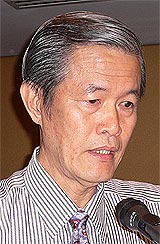 Anti-immigration activist Dr Chong Eng Leong (
left
), also a PKR leader, wanted to know why Malaysia was not taking the Ambalat issue to the International Court of Justice (ICJ) in The Hague, Netherlands.
Anti-immigration activist Dr Chong Eng Leong (
left
), also a PKR leader, wanted to know why Malaysia was not taking the Ambalat issue to the International Court of Justice (ICJ) in The Hague, Netherlands.
“Malaysia does not want to go to the ICJ after the loss of Pedra Banca (Pulau Batu Putih) to Singapore,” explained Mutalib in citing federal cabinet sources.
“However, Malaysia probably can’t do much either if Indonesia resorts to the ICJ but is confident the latter won’t after the loss of Sipadan and Ligitan islands at The Hague.”
Earlier, forum participants reviewed audio-visual material from Indonesia on the media coverage of the Ambalat issue, especially in the run-up to the presidential elections.
Indonesia, according to media such as Metro TV, SC TV and TV One, was pre-occupied with sovereignty over Ambalat while this was the least of Malaysia’s concerns.
Malaysia, it was noted by Indonesian media, was more focused on the economic returns from Ambalat “and has offered to share the oil- and gas-rich block with Indonesia”.
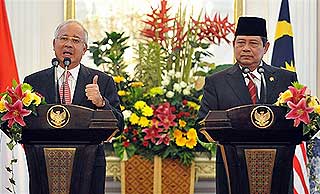 Underlining Indonesian concerns was the pledge by President Susilo Bambang Yudhoyono in the national media that “Ambalat harga mati kedaulatan Indonesia” (Death is the price for Indonesian sovereignty over Ambalat).
Yudhoyono however still hoped that “diplomacy would win the day” for Ambalat.
Forum participants also expressed concern over the saber-rattling in other disputed areas - in Pulau Sebatik - shared by Malaysia and Indonesia - and in the nearby island of Nunukan in Indonesian waters.
Kitingan proposed that BHF members organise a peace tour of Tawau, Sebatik and Nunukan in the near future.
“We should be able to better assess the on-the-ground situation for ourselves,” suggested Kitingan. The motion was carried after some initial reservations expressed by some of the 30-odd participants.
No oil royalty from Ambalat
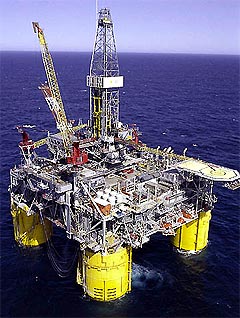
Much of the discussion during the forum, however, centred on why Sabah wasn’t getting its five percent royalty from the four wells in the ND7 Block in Ambalat which Malaysia has reportedly been draining for the last four years and claims in full.
Indonesia meanwhile has sunk two wells in the adjacent ND6 Block which Malaysia is also claiming in part. This is the area which has witnessed a stand-off between Malaysian and Indonesian warships in between cat-and-mouse games.
 Malaysian maps accompanying a discussion paper for the forum showed the Ambalat Block to be fronting 3 nautical miles of territorial waters at best and 11 nautical miles if reckoned conservatively.
Apparently, the revised mapping follows the decision by the ICJ recently to award Sipadan and Ligitan islands to Malaysia.
Lawyer Martin Idang queried whether anyone had seen a copy of the PSC which, according to the federal government, allows the oil contractor to take 70 barrels out of every 100 barrels produced as cost oil.
The balance 30 barrels or profit oil, according to the PSC as reported, is shared equally between the oil contractor and Malaysia.
Of Malaysia’s 15 barrels, five goes to the state government concerned and 10 to the federal government but held in trust by Petronas, the national oil corporation.
“Sabah is not getting any royalty from Ambalat or from 70 oil wells off Sabah beyond the 12 nautical miles territorial waters,” confirmed Mutalib who researched a paper for the forum.
“Sabah is only getting royalty from three wells - Kimanis, Mengalum and Layang Layang (Labuan). These are not in territorial waters either.”
A form of tokenism?
The federal government has briefed Parliament on several occasions that oil states are only entitled to five percent royalty on oil and gas produced in territorial waters and nothing from beyond.
 Forum participants could not generally decide whether the non-payment of oil royalty from Ambalat, in territorial waters, was “reimbursement” for the payment of oil royalty from the three wells – Kimanis, Mengalum, Layang Layang – all outside territorial waters.
“It’s strange that Brunei stayed out of the Federation primarily over its oil and gas reserves but Sabah and Sarawak ended their independence two weeks later and opted for Malaysia,” said university student Joseph Francis.
“Didn’t they realise then that they would have to soon sign away all their oil and gas reserves and perhaps risk get nothing in return.”
One poser for forum participants was whether the five percent royalty that Sabah presently gets from some wells outside territorial waters was a form of tokenism and a political face-saving gesture at best.
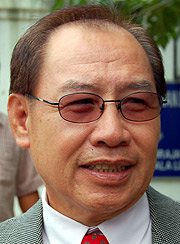 “We tried to get a copy of the ‘oil’ agreement that the state government under then acting chief minister Harris Salleh signed with the federal government on June 14, 1976 - eight days after chief minister Mohd Fuad Stephens perished with almost his entire state cabinet in a tragic plane crash,” disclosed Kitingan (
left
), who is also PKR national vice-president.
“We tried to get a copy of the ‘oil’ agreement that the state government under then acting chief minister Harris Salleh signed with the federal government on June 14, 1976 - eight days after chief minister Mohd Fuad Stephens perished with almost his entire state cabinet in a tragic plane crash,” disclosed Kitingan (
left
), who is also PKR national vice-president.
“However no one seems to have a copy, not even the state government. It would be interesting to see what that agreement spells out.”
Kitingan noted that ousted chief minister Mustapha Harun had refused to sign the so-called oil agreement in his time “and must have good reasons not to do so”.


Are you sure you want to delete this comment?
This action cannot be undone.