




Bar Council rules inquest out of order
The Bar Council has added its weight to get the Royal Commission of Inquiry (RCI) into the death of political aide Teoh Beng Hock expand its terms of reference to include the circumstances surrounding his demise.
The Bar Council has added its weight to get the royal commission of inquiry (RCI) into the death of political aide Teoh Beng Hock expand its terms of reference to include the circumstances surrounding his demise.
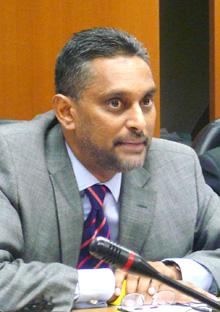 Its chairperson Ragunath Kesavan (l
eft
) said the scope of the royal commission, the formation of which was decided upon by the cabinet on Wednesday, must not be limited to only reviewing Malaysian Anti-Corruption Commission's interogation techniques.
Its chairperson Ragunath Kesavan (l
eft
) said the scope of the royal commission, the formation of which was decided upon by the cabinet on Wednesday, must not be limited to only reviewing Malaysian Anti-Corruption Commission's interogation techniques.
"This falls far short of the desired objective. An independent, far-reaching and effective enquiry into the circumstances and cause of Teoh's death is also needed
These two aspects (MACC's interrogation techniques and Teoh's death) are intrinsically interlinked and cannot be analysed in isolation from one another by two separate mechanisms. Nothing less than a holistic and inclusive examination of all relevant facts by a royal commission would suffice, he added
On Wednesday, Najib announced the formation of a royal commission to investigate the interrogation techniques employed by MACC, and also conduct an inquest to determine the cause of death.
Vast powers normal for RCI
RCI is usually adopted in Commonwealth countries to conduct a public inquiry into a burning issue.
Commissioners, appointed to oversee an inquiry have considerable powers but are restricted by "Terms of Reference".
Normally, appointed by the Yang di Pertuan Agong, they would comprise eminent persons and when a commission has started sitting the government has no powers to stop it.
 The royal commissions are called to look into matters of great importance and controversy. So far Malaysia has had nine royal commissions, the most recent being the VK Lingam (
right)
video clip affair (2007) and the one on police reform (2004).
The royal commissions are called to look into matters of great importance and controversy. So far Malaysia has had nine royal commissions, the most recent being the VK Lingam (
right)
video clip affair (2007) and the one on police reform (2004).
At the end of a royal commission, a white paper on its findings is normally tabled at the cabinet with a report on it made available to the public.
An inquest, is meanwhile an inquiry into the cause of death of a person where the coroner, normally a senior magistrate would gather information to assist in determining the cause and circumstances of the event.
Inquest: restricted in scope
Ragunath said an inquest is usually restricted in scope and far less effective than a RCI where the presiding magistrate is generally a junior member of the judiciary without the power to order investigations nor the medical expertise necessary to draw the appropriate conclusions.
"In comparison the RCI members can consist of specialists in legal as well as medical fields," he added.
Ragunath's reasoning was echoed by his precedessor S Ambiga, who said the RCI is certainly without doubt the preferred mode of investigating Teoh's death as it enjoys wide powers.
"More importantly, there is a distrust in the existing institutions investigating the matter. That is why we need the RCI as it would be viewed as being more independent."
As to the terms of reference limited to MACC's interrogation techniques, Ambiga also agreed it is much too narrow, as it should also include investigations into the cause of Teoh's death
"It is disappointing as it is restricted in my view. The RCI should also be allowed to investigate the events surrounding Teoh's death including the interrogation procedures."
"An inquest is too limited...and an RCI is precisely what the people need as they have no trust in our institutions," said Ambiga.
She pointed out that these institutions (police and MACC) have only themselves to blame for they were the ones who created the situation that's affecting their credibility.
If people had faith in these instiutions there would be no such mistrust and calls for a RCI, said Ambiga.


Are you sure you want to delete this comment?
This action cannot be undone.