




Borneo forum okays bilingual policy approach
The Borneo Heritage Foundation (BHF) has given a cautious thumbs-up to the federal government's new 'language policy approach' for schools and universities come 2012.
The Borneo Heritage Foundation (BHF) has given a cautious thumbs-up to the federal government's new 'language policy approach' for schools and universities come 2012.
Education is one of the foundation's heritage issues and support for the government's language options in education was by no means unanimous.
It came with some caveats and concerns as underscored by several BHF special forum group members during a two-hour closed-door extraordinary meeting yesterday evening in Kota Kinabalu.
BHF's backing follows subtle shifts in the government's thinking on the best way forward in balancing the benefits of the English language with mother tongue education.
It can be attributed to the government's re-think after the public backlash, which momentarily silenced language fanatics of all shades.
"Malaysia can be expected to embrace the benefits of bi-lingualism and, hopefully, even tri-lingualism in the teaching of maths and science in particular," said an optimistic BHF chair Jeffrey Kitingan after the meeting.
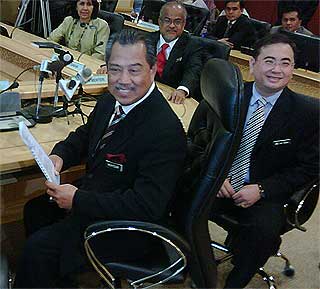 "BHF has detected hopeful signs in Education Minister Muhyiddin Yassin's 'double-speak', albeit positive, on the subject in recent days."
Muhyiddin initially announced that Year 1, Year 4, Form 1 and Form 4 students would switch to mother tongues - Malay, Tamil and Chinese (the schools have since pledged to retain English for maths and science in secondary schools) - for the teaching of mathss and science from 2012.
This meant that Form 1 students this year, for example, would switch in 2012 from English to the mother tongue in Form 4 for maths and science. By that time, they would have spent three years studying both subjects in English.
In 2014, two years later, the same students would switch back to the English language for maths and science when they enter STPM (Form 6), matriculation classes, diploma level, foundation studies and A levels (all subjects in English), according to the government's initial new policy initiative.
English, the government has decided, would continue to be the medium of instruction in the universities, nurseries and kindergartens. This confusing approach has now been abandoned.
Those who began studying maths and science in English in the schools, according to Muhyiddin, would now continue to do so until they pass out from Form 5.
Students views not sought
Forum members were pleased that public examinations - UPSR, PMR, SPM - would continue to be conducted in both English and the mother tongue until the students in Year 1 this year (2009) pass out from SPM.
"What is missing from this equation is that the students themselves, who are the most affected, have not been consulted at all amidst the continuing debate on our language options in the schools," said senior university student Joseph Francis to the delight of Forum members who tapped the U-shaped conference table in agreement.
"Instead, we have witnessed the spectacle of all sorts of people jumping on the bandwagon, holding demonstrations and even threatening court action against the government."
Forum members, one by one, expressed the hope that key stakeholders in the language debate would not be edged out by a vociferous minority "who are not directly affected by the issue".
They unanimously urged the government to "take a firm stand against those who are distorting the issue at the expense of the country's long-term interest".
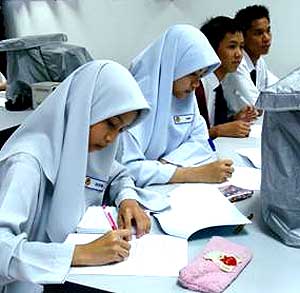 The BHF consensus on Malaysia's continuing language dilemma was preceded by a unanimous pledge among the members that rural students must not be forgotten on the language question.
Narawi Ahmad, a senior civil servant, related his personal experience with rural students. "Students in the towns, even in Sabah, have no problems coping with the English language," said Narawi.
"The problem is actually more in the rural areas. But we should not deny the urban students just because of those in the rural areas. At the same time, we should not forget the rural students or they will be left behind forever."
Narawi said the government's claim that Malaysia had more than enough English language teachers was a delightful surprise. "But what they don't tell us is that these teachers are not willing to serve in the rural areas."
"Even the Education Ministry's recall of retired English language teachers has not helped despite increasing their allowances. None of these teachers are willing to venture out to the rural areas."
Sandakan member Ahmad Thamrin Jaini, blogger Abdul Mutalib MD speaking in Malay, anti-immigration activist Dr Chong Eng Leong and cultural expert Raymond Tombung all echoed Narawi's remarks.
'Best not becoming teachers'
Retired teacher Bernadette Wong complained that many retired English language teachers are rusty and have poor teaching skills and the new ones are not experienced enough to teach the language.
"I had a problem once when my class was offered to another teacher. I sat at the back and observed her teaching on the first day," said Wong.
"I was really disappointed and wanted to take back my class immediately. But the headmistress wouldn't hear of it. She said that she had a quota system to follow. The students came second to the quota.
"Another thing is that many English language teachers can't really teach maths and science in English. They lack the necessary skills."
Francis suggested that the government offer higher education scholarships to all SPM students scoring a distinction in English, or any other subject. These students should in return undertake a form of national service by volunteering to teach the subject of their choice in the schools for at least two years before embarking on their university studies. Perhaps, such students can be exempted from doing their Form 6, he ventured.
"At present, it's not our best students who are becoming teachers," said Francis citing his personal experience. "It's mostly those who scrape through the Form 5 and simply want a job. The Education Ministry has long practised a quota system in the intake of teacher trainees. How can a poor student make a good teacher? It's the children that suffer. This kind of politics has been going on for long and no one seems to care."
Forum members agreed that government ministers were not sensitive enough to the plight of the students "because their children were either studying in the international schools or in schools overseas".
Many members recalled the various education ministers and the changes, mostly negative, that they had instituted over the years. It was noted that every education minister has made an about-turn in education policies and not just on the language question.
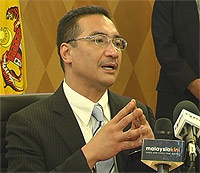 Comparisons were made between Muhyiddin and his predecessor, Hishammuddin Hussein Onn (
left
), and their contradictory pronouncements debated.
Comparisons were made between Muhyiddin and his predecessor, Hishammuddin Hussein Onn (
left
), and their contradictory pronouncements debated.
Other education ministers mentioned included Abdul Rahman Yakub, Dr Mahathir Mohamad and Anwar Ibrahim, "all of whom politicised the education issue for their own ends".
Dr Anthony Tibok related his personal difficulties in coping with education in the Malay medium after going through an English-medium education throughout his schooling years.
"I was the last batch to study in English. After that, they switched all English-medium schools to the Malay medium. I had extreme difficulties in attending further education lectures in the Malay language. Also, I had to answer in the Malay language in examinations although all my texts were in English. That's something that I will never forget."
Culture expert Benedict Topin and Tibok both expressed fears for their children's future and think that Malaysia, as an important trading nation, "could not afford to keep discarding the English language".
Several other personal testimonials, in brief, punctuated the meeting. They provided the material for the SFG members to reach consensus on the language question, caveats and concerns notwithstanding on the continuing politicisation of education.


Are you sure you want to delete this comment?
This action cannot be undone.