




Rights groups tell IGP to call it a day
Twenty-three civil rights groups have urged Inspector-General of Police Musa Hassan not to accept the government's decision to extend his services and to step down.
Twenty-three civil rights groups have urged Inspector-General of Police Musa Hassan not to accept the government=s decision to extend his services and to step down.
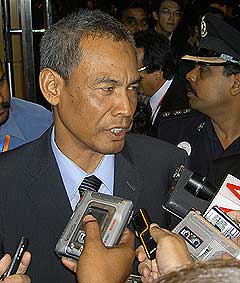 In a joint statement today, the groups - which include human rights organisation Suaram and Sisters-in-Islam - said the move was necessary because Musa
(left)
had failed in his duties over the past three years.
In a joint statement today, the groups - which include human rights organisation Suaram and Sisters-in-Islam - said the move was necessary because Musa
(left)
had failed in his duties over the past three years.
The three areas of contention was his inability to reduce crime, eradicate corruption and stop police related human rights abuses.
The groups noted that since Musa's appointed as IGP in 2006, he had failed to reduce crime by 20 percent as recommended by the Royal Police Commission in 2005.
On the contrary, figures derived from Parliament has shown that the crime index had instead increased by a staggering 35.5 percent from 2004 to 2008.
"This clearly demonstrates that the IGP has failed in performing his main role of leading the police force in reducing crime," read the joint statement.
The groups also noted that the police, under Musa, had shown partiality towards Barisan Nasional, particularly in the Perak constitutional crisis.
Corruption unabated
On corruption, the joint statement said Musa had failed to tackle police corruption and is himself alleged to be corrupt, pointing to an alleged affidavit by his former aide-de-camp over supposed manipulation of promotions and postings in the police force.
"Until this date, he has yet to respond to this allegation," read the joint statement.
"With these failures, we strongly urge Musa not to accept the extension and the government to appoint a new IGP to provide a new leadership which could ensure an efficient, incorruptible and professional police force," the groups added.
Musa started his career as an inspector in 1969 and rose up the ranks to become the top police chief in 2006 after spending a year as the deputy IGP.
His name came to prominence when he was the chief investigating officer in Anwar Ibrahim's sodomy and corrupt practice trials in 1998.
He reached his mandatory retirement age in 2007.


Are you sure you want to delete this comment?
This action cannot be undone.