




Sabah vows no limits on outsiders owning land
The Sabah state government has given an undertaking that land titles can and will be revoked "if there is evidence of fraud which can be proven in court". At the same time, it has ruled out imposing a limit on non-Sabahan Malaysians owning land in the state "since this will amount to stopping them from coming".
The Sabah state government has given an undertaking that land titles can and will be revoked "if there is evidence of fraud which can be proven in court".
At the same time, it has ruled out imposing a limit on non-Sabahan Malaysians owning land in the state "since this will amount to stopping them from coming".
In cases of land fraud however, the catch is that they must first be brought to court. It is not good enough to just have the evidence as no action can be taken by the Land and Surveys Department (LSD) until and unless the court makes a ruling on the matter.
"For example, if the court decides that a person is not qualified to have the Sijil Anak Negeri (native) certificate (SAN), then we have the power under the law to cancel the transfer of the title," said LSD director Osman Jamal.
 Osman, a Bugis, was commenting on growing public unease over the "amount of land falling into the hands of non-Sabahans".
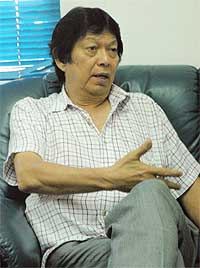
Debate on the issue re-ignited in recent days when former Berjaya Minister Ayub Aman ( left ), a Dusun, raised the issue in the New Sabah Times which he runs as the executive chairman.
Ayub is an elder half brother of Sabah Chief Minister Musa Aman, a Dusun-Pathan.
In the case of dubious SAN cases involving land, the fraud is on the validity of the certificate itself and is fairly straightforward. In short, land obtained via dubious SAN certificates will be confiscated by the state government.
It is not so simple in other land cases which might involve the element of fraud but does not involve SAN certificates. "There's a ruling that there must be 30 per cent Bumiputera participation in lands alienated to non-Sabahan Malaysian companies," said Osman.
Plenty of land for natives
One accusation is such Bumiputera participation is just on paper and does not exist in practice. The major blunder cited in officialdom is the division of forests lands into parcels of between 50,000 hectares and 75,000 hectares and awarded to 12 mostly non-native owned companies.
Osman gave an assurance that there would be plenty of land for natives and other Sabahans nevertheless, despite non-Sabahans, including foreigners, buying up land in the state.
He disclosed that nearly half a million hectares have been earmarked for natives, excluding land that the state has in reserve for them. Of the areas earmarked, 12,000 hectares would be released for a start, added Osman. "This is being done under the LSD's new Fast Track Planned Land Alienation Programme."
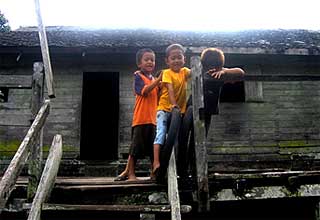 "What this means is that rural folk will not see their land behind their kitchens being given (as in the past) to someone else," said Osman, who added that the scheme involved a committee screening those identified as qualified and, if they passed, the land title would be issued to them. There would be a condition in the title that "it can be sold only if it is advantageous to the land owner."
About 3,200 hectares are being alienated for 20 villages in Nabawan. Other areas identified for the 12,000 hectares are Kinabatangan in Orang Sungei country, Tongod and Beluran. The Orang Sungei are a Dusun Muslim group.
The LSD can process 16,000 applications a year against the estimated 40,000, 70 per cent from native applicants, that pour in yearly. Meanwhile, the accumulated backlog of applications now stands at 265,000. That means a 19-year wait to get a land title if one applies today.
Up to Dec 31 last year, the LSD claims to have issued 185, 122 native titles involving 550,000 hectares i.e. 57 per cent of the overall land titles issued and 24 per cent of the total titled area.
Osman didn't comment on allegations that half the native land in Kinabatangan alone, oil palm country, are in the hands of people whose both parents were from China but were subsequently classified, mistakenly or otherwise, as natives of Sabah.
Title approved in record time
Tuaran PKR chief Ansari Abdullah, in supporting Ayub's statement, made this allegation. Ansari, of Indian and native origin but regarded a native under Sabah laws, claims that many so-called natives in Sabah have in fact forged SAN.
The LSD director, however, is puzzled that claims could be made to native land on the basis of forged SAN.
"We have a committee tasked with getting the verification that SAN used by land applicants are genuine," said Osman who admitted that the committee was only set up last year but could in any case probe previous SAN cases. He could not say whether the committee had indeed probed previous such cases.
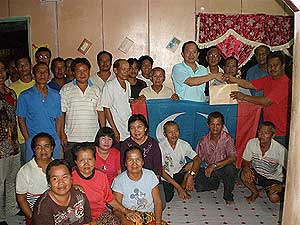 Ansari pointed out that he and Sabah PKR deputy chief Kong Hong Ming, a native land rights activist, had been to court countless times over the native land issue.
"There are thousands of acres of Native Titles now in the hands of nominees of public-listed companies," said Ansari.
"Just go to Kinabatangan and see the huge plantations owned by public-listed companies sitting on native title lands.
One company had its application for a change of land title from Native to Country Lease (ownership open to all) approved within a record five days."
"One individual was recently adjudicated by the court as a non-native who owned thousands of acres. Now, the natives of Kinabatangan and all over Sabah are being displaced from their own land, their ancestral land, as in Sarawak."
"Osman is painting a picture that the natives are in heaven," fumed Kong, having the last word, and promised to call for a press conference soon to clear the air. "His statement is nothing but a pack of lies."


Are you sure you want to delete this comment?
This action cannot be undone.