




Sabah's tryst with a divided destiny
Bidayuh villagers in Kampung Sagah in Singghei, nestled between Kuching and the ex-gold mining district of Bau, are puzzled like many others in Malaysian Borneo by an intriguing fact about Sept 16: why do very few people in Peninsular Malaysia seem to remember the date?
Bidayuh villagers in Kampung Sagah in Singghei, nestled between Kuching and the ex-gold mining district of Bau, are puzzled like many others in Malaysian Borneo by an intriguing fact about Sept 16: why do very few people in Peninsular Malaysia seem to remember the date?
After all, wasn't it on that day in 1963 that Malaya, Singapore, Sabah and Sarawak come together in a burst of euphoria to form the new Federation of Malaysia? (Brunei opted out in an 11th hour surprise.)
 So, it appears that the real divide across both halves of Malaysia is not the South China Sea.
It is Sept 16 which is remembered as a public holiday in Malaysian Borneo but largely ignored in Peninsular Malaysia.
Apparently, that's the way the federal government wants it, in a sort of collective amnesia.
The single-minded emphasis in Putrajaya is on Aug 31, Independence Day, now celebrated as National Day.
For Peninsular Malaysia, independence came on that day in 1957 and for the others on the same day, six years later, in 1963.
Both the federal government on the one hand and Sabah and Sarawak on the other hand have the same reasons for wanting to forget, in the former case, or remember the day: what has Malaysia's key performance indexes (KPI) been since 1963 in Sabah and Sarawak?
Whatever happened to the 20 Points, the basis on which Sabah agreed to help bring Malaysia into being along with Brunei, Sarawak, Singapore and Malaya?
The truth, they say, is stranger than the fiction.
Failure to remember and protect
From lawyer and Tuaran PKR (Parti Keadilan Rakyat) Division Chief Ansari Abdullah, came this short text message: "Brother, USDA's (United Sabah Dusun Association) Malaysia Day countdown has been moved to Kalakau Untul's - a former state and Federal Minister ‘s residence.
Police have banned any video or speech at Padang Kampung Selupoh."
The police concerns are clear on video-taking and speech making.
If for nothing else, Sept 16 serves as a dismal reminder that Malaysia has failed to protect and honour the 20 Points.
Sarawak has a similar arrangement under an 18 Points framework.
The last time someone campaigned for the 20 Points, he was rewarded with a stretch behind bars under the draconian Internal Security Act (ISA).
Jeffrey Gapari Kitingan, PKR vice-president does not have pleasant memories of his enforced stay in the 90s at the infamous Kamunting Detention Centre in Perak.
He was perennially hungry. He was thrice lucky over a two year stretch. The first time, he caught a rat and the other two times a bird, which he had to share with four other equally skinny inmates.
 Kitingan's
(extreme right)
crime, a charge he says the police cooked-up, was "plotting to pull Sabah out from the Federation of Malaysia".
Kitingan's
(extreme right)
crime, a charge he says the police cooked-up, was "plotting to pull Sabah out from the Federation of Malaysia".
"Sabah is not just one of the states in Malaysia," moans Kitingan. "Sabah was supposed to be an equal partner - under the 20 Points - with Sarawak, Brunei, Malaya, Singapore."
Dusun culture and adat expert Raymond Tombung, fervently religious, sees Malaysia as "a failed nation".
He cites several curses for violation of an oath - 20 Points - by way of proof viz. the traditional Malay curse, the traditional Dusun curse, the curse mentioned in Genesis (Verse 16: 20) which is the first book in the Holy Bible and other unspecified multiple curses.
It takes two to tango
"All this is the result of the federal government corrupting our local leaders," claims Tombung who has a regular column in a local newspaper.
Miri-born lawyer Colin Lau, who practices in Kota Kinabalu, reinforces Tombung's views but says that "it takes two to tango".
"My view about the failure to protect the 20 Points is that both sides, federal and state, have to be faulted," said Lau.
"In Sabah and Sarawak, the leaders must take the brunt of the responsibility as the people, particularly the rural ones, are not so educated."
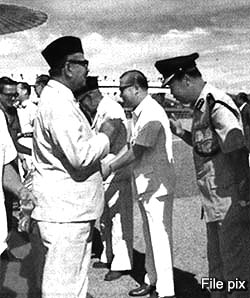 Consumer activist Patrick Sindu, having forgotten the brutal example of Kitingan, is in favour of Sabah and Sarawak taking their case for independence to the United Nations.
"The 1963 Malaysia Agreement has been null and void ever since Singapore's pull-out from the Federation," said Sindu without batting an eye-lid.
"Actually, Sabah is being colonised by Malaya now," he said.
Singapore was the only reason why Sabah and Sarawak were persuaded to help form Malaysia.
Merger between Singapore and Malaya was inevitable to prevent a communist state waiting at the doorstep but one problem was that the combined Chinese population would be in the majority.
The non-Chinese population of Sabah and Sarawak was the balancing factor.
Forty six years after the advent of Malaysia in Malaysian Borneo, the answers are becoming increasingly clear.
Approaching 50 brings on changes
The dreaded half-century mark which looms ahead will be a crucial barometer for the rest of the century.
Then, the proverbial cat will be out of the bag, cynics swear, "and no one can deny the case for Malaysia to rethink the need for its presence in Borneo".
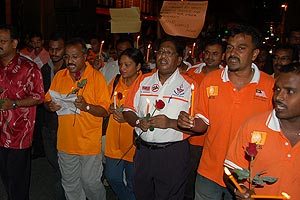 It was at the half century mark that Hindraf (Hindu Rights Action Front) emerged like a many-headed hydra in Kuala Lumpur street demonstrations and continues to hold sway over much of Malaysian Indians, if not Malaysians in general and public opinion.
Indian voters decide the winner in 67 Parliamentary seats in Peninsular Malaysia and paved the way for the March 8 political tsunami last year which saw five states, including the richest, and the Federal Territory of Kuala Lumpur fall to a shell-shocked Opposition Alliance.
Sabah and Sarawak with a combined 56 seats in Parliament saved the day for the ruling Barisan Nasional coalition which lost its coveted two-thirds majority for the first time since 1957.
Only two of the 56 seats, one each in Kuching and Kota Kinabalu, fell to the Opposition.
Yet it seems that Sabah and Sarawak have been largely taken for granted as reflected in the Federal Cabinet line-up and the issue is being re-visited on Sept 16.
Long before the half-century watershed of Malaysia in Borneo, it's extremely difficult to find a great deal of enthusiasm for a Federation which spans both sides of the South China Sea.
Ordinarily, this would have sounded like an opposition fairy tale making the rounds in cyberspace.
Sabah's public healthcare facilities are in a shambles, like in Sarawak, and all pleas have fallen on deaf ears in Putrajaya.
The Federal Administrative Centre, in its Bollywood-style Moghul splendour, seems too remote to be real.
Unhealthy nightmare
The Health Ministry for one, failed to plan and planned to fail in Sabah and Sarawak.
Life is cheap these days in these two states.
However, most comparisons in Sabah as in Sarawak are not with Brunei which "wisely" stayed out of the Malaysian Federation after disagreements on sharing oil revenues.
 There were also suspicions that first Prime Minister Tunku Abdul Rahman instigated the 1962 Azahari Rebellion, blamed by Kuala Lumpur on Indonesia, to overthrow the Sultan of Brunei for dragging his foot on Malaysia.
The comparisons these days in Sabah are with the tiny city state of Singapore which pulled out from the Federation on Aug 10, 1965 i.e. within two years of Sept 16, 1963.
Sabah wanted to follow suit but was not allowed to do so by the federal government.
Singapore, note Sabahans from all walks of life, has come a long way since Malaysia, "having an economy which is almost as large as that of Malaysia".
To add insult to injury, Sabah gets only 5 percent of the oil revenue but only from a small number of oil wells in its inner waters.
No one is actually checking how much is being pumped out.
The state doesn't get even a sen from the oil wells within its exclusive economic zone.
There are perennial power blackouts and water shortages and there are accusations that the federal government has failed to prevent the influx of illegal immigrants from the Philippines, Indonesia, Timor Leste, even Bangladesh and Pakistan.
Quite a number of them have got their hands on MyKads and entered the electoral rolls. One major case was successfully filed by anti-illegal immigration activist Dr Chong Eng Leong.
Hindarf-styled Dayak movement
The other case, equally successful, but aborted midway for witness protection reasons, was filed by lawyer Kong Hong Ming, now Sabah PKR Deputy Chief.
 "The federal government must review the position of Sabah and Sarawak in Malaysia and redress past injustices and imbalances," said Kong.
Like Kitingan, Kong added that Sarawak, like Sabah, wasn't just a state in the federation in the peninsula.
Already, in Sarawak, a Hindraf-like ad hoc movement is in the works.
Dayak activists envisaged a similar organisation like Hindraf but the Indians in KL beat them to it.
In the aftermath of Hindraf's street demonstrations, followed by police tear-gassings, beatings, court cases and ISA arrests, the Dayak activists slowed down their momentum.
But indications are that they plan, sooner rather than later, to take the British government to task "for betraying them to Malaysia".
Barisan Nasional leaders in Kota Kinabalu and Kuching, in a Sept 16 series run by national news agency Bernama, repeat the mantra of poverty reduction, infrastructure development and the security benefits of being in the Federation of Malaysia.
"Indonesia didn't over-run Brunei which stayed out of Malaysia. What security are you talking about when the place is crawling with illegal immigrants?, asks Sabah-retired insurance broker from Penang, Jared Kong.
"Singapore and Brunei are proof that you don't have to be in Malaysia to make economic progress."
The return of political autonomy to Sabah, it is said, could unleash the economic potential of the region.
Kota Kinabalu for example, a key air hub that rivals Singapore, sees enormous economic potential in the golden heartland of Borneo - the west coast, Labuan, Bandar Seri Begawan, Miri and northern Sarawak - Manila and the southern Philippines, Hong Kong and onward to Macao, Taiwan, South China, Korea and Japan.
Besides, there are direct air links with Singapore, Bangkok, Penang and northern Australia via Bandar Seri Begawan, a 20 minute hop away.


Are you sure you want to delete this comment?
This action cannot be undone.