




MIC - the 'change' that never came
It is clear that the results of the MIC elections did not reflect the aspirations of the Indian community. The delegates decided to follow their party president S Samy Vellu's choice of candidates.
Threats and pressures were said to be freely used on the delegates to secure votes. Money politics was allegedly rampant. In Melaka, delegates were said to have received RM300 each and the party leadership is not even uttering a word about it let alone investigating and taking disciplinary action.
It is clear that the results of the MIC elections did not reflect the aspirations of the Indian community. The delegates decided to follow their party president S Samy Vellu's choice of candidates.
Threats and pressures were said to be freely used on the delegates to secure votes. Money politics was allegedly rampant. In Melaka, delegates were said to have received RM300 each and the party leadership is not even uttering a word about it let alone investigating and taking disciplinary action.
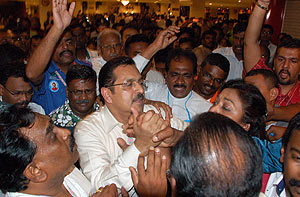 A week before the elections, Samy Vellu threatened the delegates with a central working committee (CWC) decision that S Subramaniam would face disciplinary action after the party elections, a clear message to the delegates that even if they elect Subramaniam it would end up as a futile attempt.
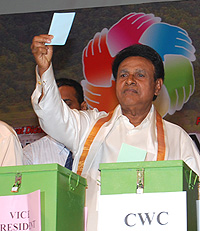
Finally the fate of the Indian community and the party that was founded in 1946 to represent every Indian in this country was sealed by the decision of just 629 delegates.
The only consoling factor is that the number of votes against Samy Vellu's candidate G Palanivel is 827 indicating more than 50 percent of the delegates were against the choice of the party president.
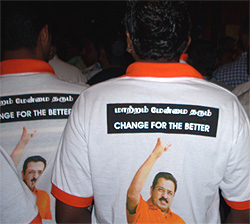 The debate would go on forever whether Subramaniam could have won if S Sothinathan had not contested. However, looking at the 2006 MIC election results and the pattern of voting for this year's elections, there is no doubt that Subramaniam would have still lost even if Sothinathan had not contested.
This is because the votes for Sothinathan seems to have come from the Samy Vellu-Palanivel camp and therefore Sothinathan's votes would have still gone to Palanivel if Sothinathan was not a candidate.
Furthermore, if Sothinathan had not contested for deputy president, he would have stood as a vice-president again under Samy Vellu's line-up and the delegates in his favour would have still supported Samy Vellu's line-up.
Where will MIC go from here?
With Samy Vellu having said that he would not leave for now or in the near future, the public animosity against Samy Vellu and the MIC would remain and is set to continue. MIC might soon become irrelevant to the Indians who might opt for Pakatan Rakyat parties to continue with their political aspirations and struggles.
 In the present political scenario, many of the Indian voters are either supporters of Subramaniam or people with anti-Samy Vellu feelings and therefore, MIC would find it difficult to go to the ground to convince the Indian voters to support MIC or vote for Barisan Nasional in a by-election or the next general election.
To make matters worse, Palanivel has never connected himself with the Indian community on the ground all this while as he is not a good orator in Tamil, a quality that is mandatory to win the hearts and minds of the Tamil speaking majority Indians.
Palanivel, if accepted by the MIC's rank and file as the rightful heir to Samy Vellu, must move quickly to consolidate his position by getting himself appointed as cabinet minister by becoming a senator thus replacing Dr S Subramaniam. If not, the latter with his powerful position as cabinet minister and as the first vice-president in the party might emerge as a power-centre in MIC within the next three years to take on Palanivel for the deputy presidency provided he also has the blessings of the party president.
As for the second echelon leaders of MIC - elected or appointed as the principal office-bearers of the party after the general assembly - even though they hold positions in government, they do not have the charisma or the confidence of the Indian community to reach out to the Indian voters.
These second echelon leaders of MIC are seen as mere cronies of Samy Vellu who are there at the pleasure of the party president and therefore would obediently remain in the shadows of Samy Vellu.
In the given circumstances, whether MIC would be able to help BN secure the Indian votes remains very doubtful.
Anyway, MIC would have its first test case in the Bagan Pinang by-election and the outcome of the by-election would indicate whether the 20 percent Indian voters in the state constituency were still in favour of MIC despite Samy Vellu continuing as its leader.
Will Subra change hats?
Subramaniam who was defeated again by Palanivel in the contest for the deputy president, has reached another cross-road in his political journey. There is no future for him in MIC even if Samy Vellu steps down as president because MIC branches would always rally behind the new president, jostling for party positions and other incentives or party hand-outs.
Subramaniam's fate in MIC would become clearer when the next CWC meeting takes place and a decision would be reached as to whether or not to take disciplinary action against him. However, Samy Vellu is expected to drop his plans for disciplinary action against Subramaniam because he knows that it would catapult Subramaniam into the limelight and would give him justification to move to another party which might even be the opposition.
In the event the BN leadership keeps away from the expulsion of Subramaniam by saying that they would not interfere in the internal affairs of one of their coalition members, then Subramaniam has to decide on whether to continue his political struggle or call it a day. He would be in a difficult position to call it a day because he still enjoys substantial support and sympathy from the Indian community and still wields considerable support among the ordinary members of MIC.
His supporters might also press him not to give up his political struggle as many feel that if Subramaniam is prepared to lead they would be able bring about some political change through Pakatan Rakyat.
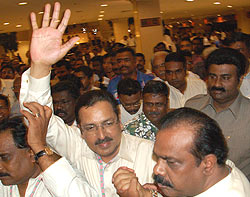 Subramaniam who has fought several battles with Samy Vellu might not be willing to end his career in politics. With all the political parties already talking about the next general election, Subramaniam might have a prominent role if he decides to join PKR and might even become the de facto leader for Indians in PKR and Pakatan Rakyat, something which is clearly lacking in the opposition alliance.
"The problem with Subramaniam is that he is looking at Malaysian Indian politics only from the MIC and BN perspective and is not willing to look beyond that.
"He should emulate Zaid Ibrahim who left Umno to join PKR and should look at playing a role in Pakatan just to show MIC and BN the political mistakes they had been making by continuing with Samy Vellu's leadership. This is what we are pressuring him to do" said one ardent supporter.
However, for a man who had always worn only one hat throughout his political life, it is not an easy decision to "change hats" overnight as he might have to do a lot of soul searching before joining the opposition front.
Aware of the options available for Subramaniam, Samy Vellu might not be willing to take the risk of expelling Subramaniam from MIC.
In 1981, the president had made an attempt to expel Subramaniam but backed off after having a private discussion with him. Expelling him now would only revive Subramaniam's political fortunes and give him all the ammunition he needs to recharge his political career.
Such a move would also give "teeth" to Pakatan which is looking for something to divert the attention of the Indian community away from the Kg Buah Pala issue.
Palanivel wants him out
Party insiders said that more than Samy Vellu, it is Palanivelu who is interested in getting rid of Subramaniam from the party now itself while Samy Vellu is president.
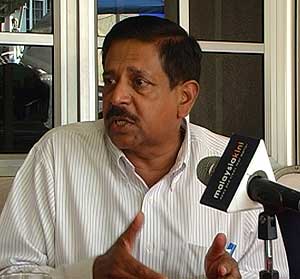 Palanivel would be inheriting a party where a substantial number of delegates had voted against him for deputy president. Therefore Palanivel would have a tough time in handling Subramaniam on one side and Sothinathan on the other if at all they decide to mount a joint coup d'etat on Palanivel's leadership.
In view of this, there is also the probability that Subramaniam would be expelled through a disciplinary action so that once and for all the party would be cleaned up of his supporters.
Samy Vellu and Palanivel would then be able to retain complete control of the party with their mighty presidential powers but whether they would be able to get the support of the Indian community is totally another matter.
This was also the message sent across by Prime Minister Najib Abdul Razak when opening the MIC general assembly and the same views were also expressed by Dr Mahathir Mohamad, who had even predicted doomsday for BN comparing it to the liberal democratic party of Japan.
Since the "change" that was promised never came to MIC, the party would now be waiting for the next game-play between Samy Vellu, Subramaniam and Palanivel which would determine the future path of the party and the Indian community.
R Mutharasan is an observer and writer on Malaysian politics and has been closely following the MIC elections. He is the web-master of www.indiantoday.net and has also authored the book "Winning Strategies of Anwar Ibrahim".


Are you sure you want to delete this comment?
This action cannot be undone.