




KK mayor livid over 'feng shui' tree felling
Mayor Iliyas Ibrahim is not amused that unholy hordes of tree choppers are running amok in Kota Kinabalu. Apparently, they are citing "superstitious beliefs" for being too handy with the axe.
Mayor Iliyas Ibrahim is not amused that unholy hordes of tree choppers are running amok in Kota Kinabalu. Apparently, they are citing "superstitious beliefs" for being too handy with the axe.
This comes at time when the city sees tourism as helping to stem urban decay and keeping it on the international map as the most important air hub in Borneo.
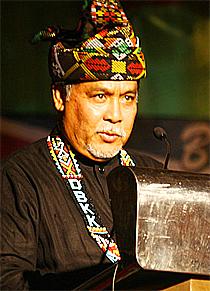 "Anyone caught chopping down a tree in future will be hauled to court," warned Iliyas on the sidelines of the launching of the Go Green Programme for the proposed KK City Waterfront project this weekend.
"If there is a tree blocking their way, people should not just simply chop it down."
Iliyas dismissed the popular notion that whether trees are retained as part of the landscape or otherwise should depend on feng shui.
Iliyas wants to promote the theme that trees are life-giving and should not be seen as blocking the flow of energy, the main pre-occupation with feng shui adherents.
Energy, for the feng shui crowd, translates into the kind of luck that brings fame and fortune.
The mayor is not impressed and wants the public to report anyone seen vandalising trees to call the hotline number: 088-2 44 000. The feng shui theory, according to the mayor, can be put to test in the courts.
Iliyas was taking his beef public after the City Hall landscape department complained to their boss about the "indiscriminate cutting of trees in parts of the city." In the latest case, several trees in the mini-park along Lorong Pinang, Tanjung Aru, were axed by a contractor. The project is part of the national landscape department’s beautification work in the city.
City Hall has since pledged to introduce Pokok Tanjung and Yellow Flame of the Forest trees in the mini-park to replace the axed trees. The replacements would be shorter varieties compared with the ones that were removed and this is a sore point with many city-dwellers.
Young trees planted almost everywhere
A City Hall spokesperson denied that it has been equally guilty of uprooting existing trees all over the city.
"We don't cut down trees at our whims and fancies as many members of the public believe. We inspect all trees carefully and spare the healthy ones. Only the sick ones have to be put down. We replace them with beautiful plants. These don't grow very tall but they are easy to maintain."
Many would agree that young trees are being planted almost everywhere in the city at the moment. However, they have been left wondering at the same time why the taller shady varieties are fast disappearing as well.
"Many of our trees were in fact planted in the 1980s," recalled Leong, a former KK municipal council worker, who stays in Tanjung Aru. "Many people praised our trees. They grew tall and leafy after a few years and served as a payung (umbrella) on a hot, sunny day. We went through a lot to plant trees all over the city."
Iliyas himself has pledged that Tanjung Aru will be preserved as a historical place in a wooded setting. Besides, it has managed to maintain most of its buildings built during the long chartered company years and a brief colonial period after the second world war.
"There are still a lot of trees in Tanjung Aru which can in fact be turned into a green town and a model and trademark for Sabah,” said Iliyas in expressing hope that there would be no indiscriminate tree-cutting in the popular resort. "It has historical value and we would like to keep it that way as a tourist destination."
Trees are an important part of Iliyas Go Green Agenda for KK which is being touted as a resort city by the tourist trade, a rainforest city by Sabah tourism and a "zero rubbish" city by the mayor himself.
City undergoing noticeable facelift
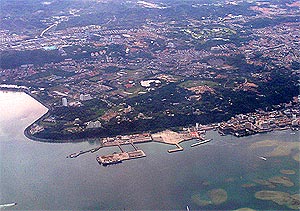 The city is undergoing a noticeable facelift. Traffic islands are being landscaped and showy flowers can be seen everywhere. Newly-planted instant trees have been springing up as far as the eye can see but being shorter and less leafy, they don't help to cool the city as the older varieties in the past. The emphasis in future, it is understood, may be towards fragrant varieties like Jasmine which leave their scent lingering in the evening air.
It’s not easy to come up with the right mix of tress and flowering shrubs as the landscape department at City Hall has discovered. The colourful, bright and eye-catching Dutch flowers, for example, live only a few weeks in the heat. The plants have to be replaced from the nursery just as quickly and this is proving to be an expensive proposition.
The Go Green Agenda is expected to manifest itself best along the KK City Waterfront project which is headed by former Mayor Abdul Ghani Abdul Rashid.
One key feature of the Waterfront is a two kilometre public waterfront boardwalk. This boardwalk would be constructed with techwood planks made from rice husk and recycled plastic. Other areas of the waterfront boast a vertical garden and a rainwater harvesting system to reduce tap water consumption to water the landscape.
KK is presently undergoing a mini building boom with many new hotels and shopping malls dotting the landscape. The rush is on to tap the tourist dollars which might otherwise slip through the regional air hub that the city has become.
KK has direct connections to all the important cities in the region. Besides, Kuching, Kuala Lumpur, Johor Bharu and Penang, these include Singapore, Bangkok, Manila, Hong Kong, Macao, and cities in Taiwan, China, South Korea and Japan.


Are you sure you want to delete this comment?
This action cannot be undone.