




Sabah to link up fragmented forests
Sabah’s many fragmented forests are to be linked by wildlife corridors and 100-metre wide riparian reserves with utmost urgency, before the current window of opportunity closes.
Sabah’s many fragmented forests are to be linked by wildlife corridors and 100-metre wide riparian reserves with utmost urgency, before the current window of opportunity closes.
State Culture, Tourism and Environment Minister Masidi Manjun confirmed this following a two-day colloquium on orang utan conservation in Tuaran, an hour’s drive from Kota Kinabalu.
 “We will make use of the legal clout available under the state land laws,” said Masidi, citing Section 26 of the 1968 Sabah Land Ordinance.
“We have the tools to ensure that people comply so that future generations will be able to see wildlife in their natural habitat. They will be able to see what we can still see.”
Masidi was commenting on several resolutions passed at the colloquium which brought together the Sabah Wildlife Department, Borneo Conservation Trust and HUTAN, a French NGO working on conserving tropical forests.
One issue touches on compensation for landowners who are affected because the wildlife corridors and riparian areas are off-limits to them.
The resolutions were handed over to Masidi by colloquium co-chair Cyril Pinso who also heads BCT.
In turn, Masidi requested Sabah Wildlife Department director Laurentius Ambu to prepare a position paper to be tabled before the state cabinet and to be submitted to the federal government for funding.
 The Sabah Lands and Survey Department does not have any plan that anticipates the movement of wildlife within the jungle setting. Even so, it has never alienated land up to riverbanks as per Section 26.
In addition, the conditions in land titles stipulate that 25 percent of the area covered must be left free for environmental conservation efforts.
But forest areas continue to be fragmented despite the fact that 56 percent of the state’s land area have been designated as forest reserves.
That fact did not prevent 22ha the Deramakot Forest Reserve from being logged, while timber extraction appears to be continuing in the Maliau Basin - the Lost World Heritage site - buffer zone.
Wildlife habitats shrinking
Masidi agreed that once linked, the fragmented forests would witness the movement of fauna from one patch to another through the wildlife corridors and riparian reserves.
 This is particularly important to ensure that the wildlife do not run out of food in their natural habitat, he said.
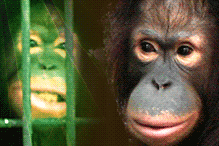
The orang utan, pygmy elephants and rhinoceros are among the animals affected by fragmentation of forests.
The shrinkage of habitats was best illustrated recently when a hungry proboscis monkey wandered onto the Beaufort-Menumbuk Highway, near Kampung Perinan.
It was knocked down by a car, suffering a broken leg and loss of its right eye. It died while being rushed to the Veterinary Department in Menumbuk by a passer-by.
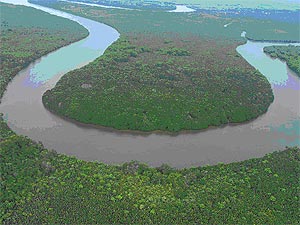
Masidi, who denied that his ministry has been sleeping on the job, said the state government has worked out a basic plan for the overall development of the Kinabatangan river basin, the largest in the state.
 “We are looking at the legal issues. The implications are many since numerous stakeholders are involved,” conceded Masidi without revealing details.
“I think there is also a question of voluntary action by the landowners to help create the wildlife corridors.”
Masidi lamented the fact that many estates have planted oil palm trees on riparian reserves along the Kinabatangan in particular.
He said the guilty parties should volunteer to rehabilitate these areas “so that the question of taking back the land will not arise”.


Are you sure you want to delete this comment?
This action cannot be undone.