




Bandwidth turning M'sia from ICT jewel to joke
"It all began with Youtube," said Malaysiakini CEO Premesh Chandran.
"It all began with Youtube," said Malaysiakini CEO Premesh Chandran.
He was describing the significant increase in global bandwidth usage which he says is currently choking the Malaysian internet and threatening to strangle the country's economy.
 As Premesh outlined, "It used to be that most internet content are text based, one web page is roughly 0.5 to one megabit in size.
As it takes about 10 minutes for a person to read a web page, the speed incurred is roughly one megabit for 10 minutes or 1.67 kilobit per second."
However, with video streaming, and the proliferation of video sites like Youtube, the Malaysiakini CEO further explained, "With video, the current bandwidth used is close to 200 to 300 kilobits per second."
Josh Lim of RedesignMalaysia.com agreed, "The download culture of Youtube and bittorrent has clogged up the internet."
Unfortunately, Premesh said, the Malaysian bandwidth capacity has lagged way behind the vast increase in demand and usage.
The Malaysiakini CEO's fears are shared by PAS research director Zulkefly Ahmad who mentioned an Oxford study which classified the Malaysian internet bandwidth as ‘below today's application threshold.'
He was speaking to Malaysiakini yesterday during a video interview .
 Zulkefly (
far left
) who is also the Kuala Selangor MP was lamenting Malaysia's lacklustre performance in ICT infrastructure development despite our head start with the Multimedia Super Corridor (MSC).
Zulkefly (
far left
) who is also the Kuala Selangor MP was lamenting Malaysia's lacklustre performance in ICT infrastructure development despite our head start with the Multimedia Super Corridor (MSC).
Premesh pointed out that the snail's pace sluggishness of our broadband will seriously effect our competitiveness as a preferred business destination.
He views were shared by Technopreneurs Association of Malaysia president Koh Lee Ching who admitted, "connectivity and broadband availability has always been of major importance to businesses."
Slow internet speed an impediment
In fact, on Monday, the Malaysia-Australia Business Council vice-chairman, Michael Halpin, told Bernama that Australian firms are very concerned over the slow Internet speed in Malaysia.
"The Internet speed in Australia is much faster than here. Australian and American investors see this as a nuisance and an impediment to them to do business successfully here," he added.
 While acknowledging that the Malaysian broadband situation is not as worse off as some of its neighbours, the Malaysia-Australia Business Council vice-chairman asked, "Not worse off, but does Malaysia wants to be at the same level as them?"
Halpin cautioned, that while Malaysia has been the investment destination of choice for some time, the difference among Malaysia, Indonesia and Vietnam has been diminishing.
The problem here, said Premesh, is one of insufficient infrastructure and restrictive government attitude towards licensing of internet exchanges in Malaysia, explaining that all of our internet bandwidth have to go through Telekom Malaysia's two internet exchanges - Asp and Eastgate.
"This creates a choke point," he added.
He said that this is especially true since most content and sites accessed by Malaysian users nowadays, like Youtube and Goggle are internationally based. As such we will see an upsurge in usage of our international bandwidth.
Josh Lim of RedesignMalaysia.com agreed with the Malaysiakini CEO, both of them hoping that the government will issue more licenses for new internet gateways in the future.
RedesignMalaysia.com is a private sector initiative designed for collaborative change in providing ‘better broadband for the rakyaat.'
But Premesh added that the exorbitant costs in constructing new gateways may deter investors from taking up new licenses.
Likening it to a ‘chicken and egg' situation where new investors will need to find enough users to justify such an expenditure, and if they were to have the amount of users, they would sorely need the new gateway anyway.
As a solution, Lim put forward the idea of government subsidies assisting new players in financing the new gateways until they can achieve economies of scale.
Promised speed and actual speed differ
Yesterday, Ipoh Timur MP Lim Kit Siang brought up the issue of Malaysia's bandwidth capacity in Parliament.
 He asked the Minister of Information, Communication and Culture Minister Rais Yatim (
left
) what the government plans to do to realise Telekom Malaysia's (TM) High Speed Broad Band (HSBB) project and sustain growing consumer demand.
He asked the Minister of Information, Communication and Culture Minister Rais Yatim (
left
) what the government plans to do to realise Telekom Malaysia's (TM) High Speed Broad Band (HSBB) project and sustain growing consumer demand.
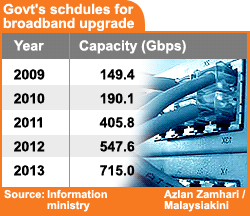
The government's answer was to detail a plan that increases our broadband capacity from nearly 150 gigabit per second to over 700 gigabit per second within the next four years from 2009 to 2013.
Part and parcel of the government's plan are further initiatives to employ ‘content hubbing' and local mirror sites to ensure efficient use of bandwidth, especially trying to reduce our outgoing international traffic.
In response to this, Josh Lim said, "Numbers are easy to promise (the added capacity), however there is a difference between theoretical (promised) speed with real (actual) speed."
He further explained that whatever the government and service providers promised, the issue is the quality of the connection and the practice of bandwidth capping by service providers.
This is despite many providers promising ‘unlimited bandwidth' to users.
Josh called for enforcement authorities responsible for monitoring the internet in Malaysia to impose measures both in incentives and punitive actions on service providers to fulfill their promises of broadband connectivity.
In a similar vein, Premesh said that the ‘last mile' connection is another issue which is troubling.
Even if more gateways are installed, most of the connections reaching to end users are still problematic and of poor quality.
The issues must be addressed hand in hand, providing new gateways, and improving our last mile connectivity, he explained.
Premesh agreed that the government ‘initiatives' of content hubbing and site mirroring may be practical in helping to reduce our international bandwidth usage, but he cautioned that there is a need to explain what is actually meant by those terms.
"Are these just jargon, or is there something real behind it?" he asked.
The Malaysiakini CEO added that in the case of content hubbing the government needs to explain what does it mean and what will it entail.
As for local site mirrors, he said that a similar concept of ‘ content caching' or the copying and storage of international sites locally by service providers to reduce international bandwidth is already standard practice.
"The question is are they doing it?" he added, questioning whether service providers are going to really implement local hosting.
I
 n the end, both agreed that in our day and age, where countries like Norway consider broadband a basic human right, Malaysia should move toward securing this important frontier of development. This, they say, is to ensure our economic competitiveness as well as our collective future.
This is in view of service providers like Digi and Maxis who announced just yesterday that they are projecting a significant increase in broadband users in the coming months.
Without real concrete effort from the government and Telekom Malaysia to address the issues of bandwidth capacity, Malaysia, once one of the jewels in the crown of ICT and economic development in Asia, will be left behind choking in the dust of once backward neighbours.


Are you sure you want to delete this comment?
This action cannot be undone.