




2010 budget: 'Won't spur high income economy'
Pakatan experts say 2010 budget won't do much to fulfill PM Najib's initiative to spur Malaysia towards a high income economy.
"We applaud him for all his good intentions, but his solutions are in vain," said Kuala Selangor parliamentarian Dzulkefly Ahmad.
Dzulkefly was referring to the 2010 budget unveiled last Friday by Prime Minister Najib Razak in a video interview with Malaysiakini yesterday.
 Joining him in the discussions were fellow parliamentarians Tony Pua (Petaling Jaya Utara) and Charles Santiago (Klang).
The trio trounced Najib's 2010 budget, likening it to a hollow shell of good intentions, which they say, is much ado about a high income economy but with solutions that are in vain.
The 2010 budget, which is the first to be tabled under Najib's administration, is also the last budget under the ninth Malaysia Plan to be succeeded by the Tenth Malaysia Plan in 2011.
Their main concern about the budget revolved around the measures-not-taken in the budget's goal of striving for a high income economy.
Paraphrasing Adam Smith in his book ‘The Wealth of Nations', Santiago said that rich economies are economies organised to make profits.
This he said is something that we need to keep at the back of our minds in considering the budget.
"After sitting in parliament listening to the PM for two hours, I did not find elements of an economy that is going to be profitable (high income). I don't see that!" he exclaimed.
Agreeing with Santiago, Pua said: "No one can dispute that everyone agrees with the PM's goal of achieving a high income society.
"Unfortunately, in the contents of the budget, there is no strategy in ensuring that productivity increases, human capital...human knowledge increases and our education becomes top quality.
"There is none of that!" said the DAP national publicity director, adding that without those key elements as a foundation it is difficult to move to a high income economy.
They also noted that the government's efforts in the field of education to harness and retain the best and brightest of our human capital is practically ineffective.
"Singapore takes advantage of our human capital more efficiently than us," said Santiago, and pointed out that most of the senior officials in Singaporean institutions are talented Malaysians.
Going even further, Dzulkefly who is also the PAS' research director said: "Not only is the foundation not there, the mind set is also not there.
"Najib has failed to identify that innovation is linked to the ability to express and access information. It requires vision and creativity.
"This is human capital, it is not all about economics and finance. He continues to stifle our best brains with acts like AUKU and the OSA. If stifled, they won't be able express and actualise."
‘Fundamental problems not addressed'
Next in the sights of the experts were what they described as the government's failure to address fundamental flaws in the economy and administration which will hamper any move to a high income society.
The problems, they pointed out are an under developed infrastructure, rampant corruption and burgeoning debts which Dzulkefly said are being addressed in "the same old way".
Pua expressed his doubts on whether the efforts to develop infrastructure as detailed in the budget, transportation especially, are going to bear fruit.
 "We can't trust the budget...The public transport commission is an old idea, announced two years ago after the price hike with RM4 billion allocated for it. Then RM35 billion was allocated for transportation improvement. But nothing was done.
"The extra cars for trains? These are recycled projects from last year. In fact, our allocation for the development of transport has dropped by 22 percent," he said.
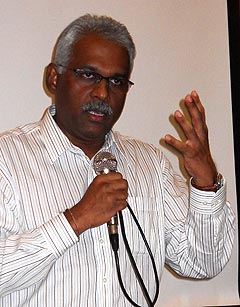
Santiago (left) agreed: "There is a letdown in the transportation sector".
Dzulkefly also said the government's failure to ensure quality internet service is causing foreign firms to shy away from Malaysia, something the budget failed to address.
The RM500 tax break annually for broadband subscription he said, will neither improve broadband connections nor accelerate its penetration.
The trio also scoffed at the government's effort in fighting corruption.
Pua said: "There is a lot of focus on the courts and the Whistle Blower Act announced in the budget. But these are measures for after corruption has already happened.
"What is needed are institutions to prevent corruption (before it happens), such as open, transparent and competitive tenders, these three things are not even mentioned in budget."
These measures, said Santiago, cannot be done piecemeal and must be systemic and concerted in order to fight corruption.
What is important he added are the "quality of our institutions". Regulators (regulatory agencies) are also important.
This, he said is something that Malaysia still struggles with as evidenced by the Malaysian Anti Corruption Commission (MACC) which is "a laughing stock".
Pua identified the problem as stemming from the fact that "our regulators are not independent...there is a cozy relationship between regulators, the government and businesses".
This, all three agreed, is something that the government must improve upon. Even Indonesia in their opinion, is doing better at this than us.
"In Indonesia those arrested for corruption and put into prison are the big guns, billionaires. In Malaysia only the ‘ikan bilis' are taken to the courts," said Pua.
Addressing the high national debt which continues to be propagated by the government, Santiago said: "We can't survive on borrowing. The debt is largely local...that's okay, but we cannot keep on doing it. It is unsustainable".
"At 52 percent," Pua added, "the debts are like passing the buck on to the future generation to pay. There are implications to taxation structure, the currency and the ability to raise funds in future.
"There are no alarm bells yet, but everyone is watching very carefully. In fact, the Ringgit has recently been downgraded to A from A+. A higher debt may lower the rating further."
Dzulkefly agreed, adding that a high debt has a knock on effect such as the lowering of our sovereign rating which may scare investors away.
"They say, investors are the worse cowards, they only go in if they can gain returns. If you are not attractive or secure enough they won't come," he said.


Are you sure you want to delete this comment?
This action cannot be undone.