




Where are the women in M'sian politics?
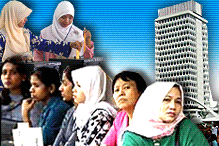
Women constitute half of the population in Malaysia, and half the registered voters are women, but there is still a big disparity in the number of women in politics.
Women constitute half of the population in Malaysia, and half the registered voters are women, but there is still a big disparity in the number of women in politics.
While more women are in the workforce and universities, and hold high level corporate positions, the number of women in politics is still small in proportion to their numbers.
Following the 2008 general election, successful women candidates went on to make up 10 percent of parliamentarians and 9 percent of state assemblypersons.
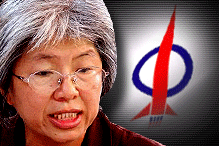 Bukit Mertajam MP Chong Eng, also the DAP National Wanita chief, noted that the majority of Malaysian women do not feel that politics have anything to do with them. They are more concerned about mainstream issues.
Women's Aid Organisation president Meera Samanther pointed to the target of 30 percent representation for women, as outlined in the Convention on the Elimination of all Forms of Discrimination against Women.
"Despite this, more often than not, women politicians are put in unwinnable seats. This results in the meagre number of women in decision making positions,” she said.
Simranjit Kaur Gill, a representative of Women's Candidacy Initiatives (WCI), agreed that there is not enough political representation and awareness among Malaysian women.
"A lot of women are (only) on the fringes of decision making position, "she said.
On the particular challenges faced, she said women have to overcome more hurdles than men to become a politician.
“Women have different roles to play - the mother, the employee, the housekeeper - but men do not have to consider those aspects when they enter the world of politics.
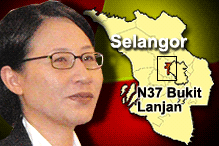 "Politicians' lives are expected to be public once they are elected, but for a woman, even her dressing and personal life are scrutinised."
This was illustrated in the case of Selangor exco Elizabeth Wong, after compromising private photos of her were circulated to undermine her political career.
Gill said violence, sexual harassment and threats are still used against women, especially those in politics.
Problems faced
But what happens when women do break through the mental barrier and join a political party? The sad reality is that another barrier awaits, as DAP’s Chong acknowledged.
The segregation of the women's wing from the main party limits opportunities for participation in the mainstream of politics, and they are confined to 'women’s areas' when it comes to decision making.
"The party leadership is still male dominated and many do not think that affirmative action is necessary, as they believe that there is already equality between men and women," Chong explained when asked about implementing a gender quota.
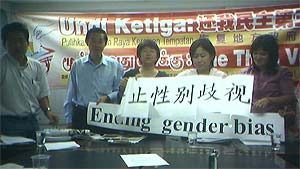 She said that racial quota should be differentiated from the gender quota, which has an emphasis on short-term special measures to fulfil the 30 percent representation.
Chong also pointed out that, while the NGOs have done tremendous work to raise awareness and advocate the women's agenda, they have also been most critical of women politicians.
She claimed that NGOs have criticised women politicians for not giving enough focus to the rights of women.
"Women in politics are in the minority. We need more qualified members to join us in this struggle. We encourage suggestions and participation from the NGOs to create more top-notch women leaders," Chong said.
Possibility of collaboration?
Asked about collaboration between WCI and political parties, Gill said: “We realise that voters are less likely to vote for independent candidates, but we hope that voters will move away from race-based politics and focus on the issues and how the candidates can serve the community better.”
Malaysians, she noted, tend to vote along racial lines and political affiliations, but not so much for the candidates and their credentials. They support the party rather than the person.
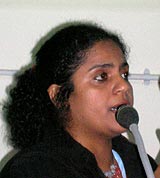 In 1999, WCI put up a candidate to run on the Barisan Alternatif platform, but the candidate - the late Toni Kassim
(left)
- stood as an Independent.
In 1999, WCI put up a candidate to run on the Barisan Alternatif platform, but the candidate - the late Toni Kassim
(left)
- stood as an Independent.
"We do not want to be attached to any party with the strings that would come with (membership)," Meera explained.
"We want to contest on a human rights platform, and let the voters decide based on the issues that we advocate.”
There was some common ground among those interviewed - they agreed that better awareness among women will greatly enhance the numbers of women politicians.
Chong said the DAP is attempting to encourage more women to enter politics.
"We try to implement workshops and programmes to create awareness within our members, and we try to identify potential women leaders in the party.
"We would also like to see the abolition of women's wings in parties, so that women have the opportunity to compete in the main party.”
 Gill too said the WCI has been creating awareness, negotiating for more posts for women in political parties, and identifying and training independent women candidates.
Ultimately, educating voters on personal and human rights issues and disregarding race are deemed as the way forward in making gender-neutral choices.
The hand that rocks the cradle, may indeed rule the world…some day.


Are you sure you want to delete this comment?
This action cannot be undone.