




Asri's arrest born of ignorance and fear
Suddenly, the term ‘Wahhabi' has been thrust into our news media. This follows the brief arrest of former Perlis mufti, Mohd Asri Zainul Abidin.
Suddenly, the term 'Wahhabi' has been thrust into our news media. This follows the brief arrest of former Perlis mufti, Mohd Asri Zainul Abidin on Nov 1.
 The incident and the reactions that greeted it bring to mind the arrest of DAP's Teresa Kok last year on the pretext that she had insulted the azan.
Then, a small but noisy group of Muslim NGOs aligned to Umno issued statements regarding Islam, most of which only revealed their deep ignorance about Islam. They see Islamic issues, such as the controversy over the azan, from a purely traditional-nationalistic Malay community perspective, instead of invoking true Islamic teachings beyond what they have been used to.
In fact, the confusion between Malay customs and Islamic rituals has been a bane in the development of Islam in the country.
The Muslim intelligentsia has failed to rise up to the challenge to explain this difference, mainly because there is an almost complete absence of Muslim intellectuals in the country who are able to articulate reforms while at the same time remaining ordinary Malays.
If there were, many of them have become politicians on a party-political level, and as such their credibility to speak on matters of Islam is overshadowed by their affiliation to a political party. Some may argue that politics and Islam are inseparable, and rightly so, but Islam and party politics is another matter.
It is in this context that individuals like the former Perlis mufti become a simmering hope in a land where even intellectual debates almost always get entangled with partisan politics.
Why the arrest?
When Asri was arrested, there were some comments on one side of the fence that it was the work of Umno who was threatened by news that he was cozying up to PAS. There were also fingers pointing at some Selangor PAS leaders as being behind the Jais action.
This shows the failure of these commentators to look beyond the noisy party-political scene and understand the ongoing debate within the larger Muslim ummah about reforms and revivalism. Alas, Asri himself hinted that there were certain people unhappy with his being offered a government post recently.
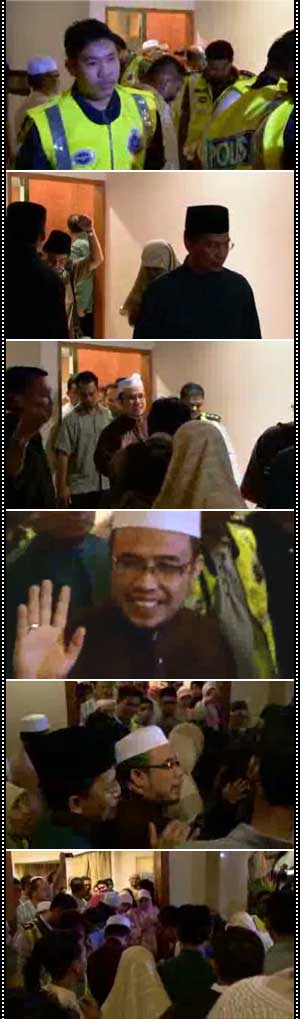 Asri's arrest is more a reactionary burst of events over his opinions on a number of issues that have stepped on the toes of the religious elites, who for ages have been getting the last say in matters of Islam in the country. Such an oligarchic hold on Islam and Muslims in the country has created a wall between the Muslim community in the country and the more than one billion Muslims outside.
As such, when Asri was labelled a Wahhabi, there seem to be very little understanding about Wahhabism other than some differences in Islamic rituals. There are also some commentators who disagree with this labelling of Muslims into Wahhabis, liberals, extremists and moderates. However, categorising people within a vast group like the Muslim community is inevitable and can serve as one of the keys to understanding the dynamics of Islam.
So what is Wahhabism? ‘Wahhabism' and ‘Wahhabis' are names, often used derogatorily by those outside its fold, given to the doctrine and followers of Muhammad Abdul Wahab, who, annoyed by practices which he claimed were un-Islamic, launched a campaign to ‘purify' the Islamic faith in the Arab peninsula (now Saudi Arabia). Many have compared the Wahhabi campaign to Islamic ‘reformation' and ‘revivalist' movements in various parts of the Muslim world.
Most non-Wahhabis already have a general idea of Wahhabism even if they have not experienced it personally. Generally speaking, Wahhabis delight in polemics, have no patience with a second opinion, are often chauvinist in their interpretations, and usually peripheral in their approach. Anyone with a Wahhabi tendency is generally liberal in the use of strong terms such as bid'ah, kufr (disbelief), aqidah (Islamic creed), shirk and khurafat (superstition).
Wahhabism may not be pursued with the same vigour today as it was during its early days, yet its influence on the Muslim world is undeniable. In the West, Muslims may have encountered Wahhabi tendencies among the more idealistic youngsters, who are influenced through Saudi-sponsored Muslim fraternities such as the Muslim Student Associations, the Muslim World League, the World Assembly of Muslim Youth (WAMY), and an array of academic institutes and publication houses.
In the East the Wahhabi success story is much shorter, although the Saudis have funded Muslim youth organisations in the Indian subcontinent and Southeast Asia. The Jamaat Muslimin group in India and the Muslim Youth Movement of Malaysia (ABIM) are examples.
It would be grossly unfair to dismiss those organisations and individuals who are close to the Saudi government as Wahhabi set-ups. Social, cultural and financial circumstances have made these unsuspecting groups embrace Saudi assistance.
In much of India and the Malay world it is admitted even by the most anti-Wahhabi that many unIslamic beliefs and practices have penetrated local Muslim traditions; various forms of Wahhabism have offered that radical ‘cleaning up’ drive that local ulama have not been able to provide.
On the other extreme are those who justify the Wahhabis’ ‘historical terrorism’ in the Arabian peninsula, destroying places of historical importance, such as old libraries and graves of the companions of Prophet Muhammad
Whether all this is done with sincere Wahhabi sentiment is highly doubtful. As British-born Muslim academic Hamid Algar notes in his book on Wahhabism, the palaces of the Saudi monarchs have somehow escaped the Wahhabis' 'purification'.
Wahhabi influences
Of late, with recent developments in the Muslim world, there emerged some offshoots of Wahhabis. Among them are the Salafis, so called after the generation of Prophet Muhammad and the four Caliphs. These are those whose interpretation of Islamic rituals is not too different from the Wahhabis, but they are generally less antagonistic in their approach.
Emerging out of these Salafis are an even more moderate form of Salafis. These are represented by a new group of Muslim scholars and intellectuals who have contacts with the Western institutions and Western way of life, and often touch on the need to co-exist and have civilizational dialogues.
Included among this latter group are those who take a more friendly stand with the Iranian Shi’i Muslims and refuse to be dragged into the sectarian debate of whether the Shi’is are Muslims or not, a favourite topic among those with crude Wahhabi inclination.
We should be careful of the tendency of some people to accuse of Wahhabism any who do not subscribe to their own political and religious views. The Salafis, and those for whom the cause of Palestine is a high priority, for example, are some of their victims in America.
In Malaysia, those who carry out their own researches and read books by international Muslim scholars, only to find that many of our Islamic practices have more to do with Malay tradition, are often accused of deviating from Islam. To make things worse, those who resort to their intellect and knowledge in understanding Islam are lumped together with those who have cultish tendencies and who have nothing to do even remotely with Islam, such as Ayah Pin or the fake prophet.
The self-appointed 'guardians' of the Muslim creed at our Islamic departments fail to understand that the old "kitab-kitab agama", which are mostly Malay translations of old Arab works, were relevant only in the era it was published.
This is not to belittle the contribution of the ulama of old towards the understanding of Islam. But the dynamic nature of Islam requires fresh interpretation based on sound understanding of the Qur'an and Sunnah.
With the emergence of the Internet, the open university of Google and the availability of imported books on Islam, an educated Muslim in Malaysia no longer feels the need to depend only on what they were taught in their ‘kelas agama' or those local television Muslim teachers who always invoke views attributed to the Shafi'i school of thought.
Resources in Islam are now available in all languages, and English being one of the languages of Islam today, offers a window to the wide world of Islamic scholarship.
What is Asri then?
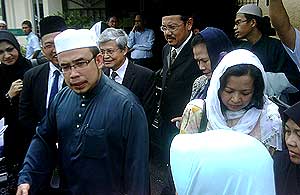 So now that we know Wahhabism and its various representations, is Asri a Wahhabi? A short tour of his website and the much liked YouTube will reveal that he is far from being the Wahhabi that he has been accused of. In fact, what he did was to challenge blind obedience even in religious matters.
He has spoken out against the obsession of Muslims in the country with matters of personal hygiene, so much so that we tend to waste a lot of water when washing ourselves before prayer. Ironically, the toilets in our mosques are some of the dirtiest in the country. It doesn't occur to a lot of Muslims in Malaysia that using more water has nothing to do with being more pious or perfect in their religious rites, until they travel to a different country
In his writings, Asri has talked about the issue of halal and haram, privacy, Muslim and non-Muslim relationship, and many other issues affecting local Muslims.
For example, it has been claimed in some blogs that Asri disagrees with one absurd practice current in many Malaysian mosques -- placing children in the back row during congregational prayers -- a stand opposed by the other muftis who justified the practice by citing old reference books. The truth is that such a practice is nowhere to be found in Islamic jurisprudence other than the opinions of some jurists. Even the Prophet's grandson would disturb the Prophet while he was performing the prayer.
A Muslim scholar like Asri, who is Malay like the majority Muslims, young, and more importantly, friendly to politicians of all hues, is a welcome relief in order to drive the fact that Islam is a religion which is easy, simple and practical.
Asri's presence in the arena of Islam in the country, as such, was a long time coming. People like him will not only forge greater understanding about Islam and Islamic practices among the Malay Muslims, but also reclaim Islam's image as a way of life. Unlike some other Muslim spokespersons who abhor the monopoly of the establishment ulama in Islamic matters, Asri does not have a lifestyle contrary to the ordinary practising Muslims.
As such, he has the advantage of the public not perceiving his views and opinions as an attempt to justify his own lifestyle or political agenda, such as his disagreement with the laws on khalwat enforcement and the ban on the usage of Allah by Christians.
Here's the problem: After decades of our Islamic education system having depended on the local establishment ulama as its guiding light, Asri's task will be herculean.
The writer, in his mid-thirties, is Editor at Islamic Book Trust, Petaling Jaya.


Are you sure you want to delete this comment?
This action cannot be undone.