




Federal Court's burden of judgment
Tomorrow, the Federal Court will hear one of the most important constitutional appeals in recent times: Mohd Nizar Jamaluddin v Dr Zambry Abd Kadir. While many readers are familiar with the facts leading to this appeal, it is useful to recapitulate the key events.
The resignation of three Pakatan Rakyat assemblymen in February this year left the ruling government with control over 28 seats in the Perak Legislative Assembly, the same number of seats controlled by the opposition BN.
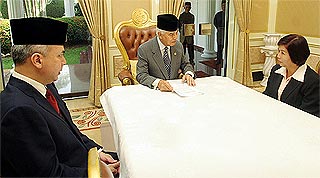
This led the incumbent Pakatan Menteri Besar Nizar to request Sultan Azlan Shah ( right ) on Feb 4 to dissolve the legislative assembly so that this numeric deadlock could be resolved. The sultan took no...
Tomorrow, the Federal Court will hear one of the most important constitutional appeals in recent times: Mohd Nizar Jamaluddin v Dr Zambry Abd Kadir. While many readers are familiar with the facts leading to this appeal, it is useful to recapitulate the key events.
The resignation of three Pakatan Rakyat assemblymen in February this year left the ruling government with control over 28 seats in the Perak Legislative Assembly, the same number of seats controlled by the opposition BN.
 This led the incumbent Pakatan Menteri Besar Nizar to request Sultan Azlan Shah (
right
) on Feb 4 to dissolve the legislative assembly so that this numeric deadlock could be resolved. The sultan took no immediate decision.
This led the incumbent Pakatan Menteri Besar Nizar to request Sultan Azlan Shah (
right
) on Feb 4 to dissolve the legislative assembly so that this numeric deadlock could be resolved. The sultan took no immediate decision.
The following day, the sultan met with 31 members of the assembly (including the three Pakatan members who had earlier resigned), satisfied himself that all of them supported Zambry as MB and proceeded to inform Nizar that he no longer commanded the assembly’s confidence.
Nizar was then asked to tender the resignation of the executive council. When Nizar did not comply, the sultan’s office issued a press statement declaring the office of MB to be vacant and that Zambry had been appointed the new MB of Perak since he commanded the confidence of the majority of assembly members. Nizar applied to the High Court for a declaration that he remained Perak’s MB.
 On May 11, High Court justice Abdul Aziz Abd Rahim ruled that since there had been no formal vote of confidence on the floor of assembly, Nizar remained the rightful MB of Perak. Zambry appealed.
The Court of Appeal unanimously reversed the High Court decision but it was some time before the three judgments were released. Two of them, those of Md Raus Sharif and Ahmad Maarop were released towards the end of June while that of Zainun Ali was released in early July.
 The three lengthy judgments come up to some 240 pages in all and a large number of issues were canvassed and discussed. I had previously commented on the correctness of the High Court decision and having already discussed the contradictions that arose from the judgments of Raus and Maarop, feel it timely to revisit the most salient issues in this case.
The sultan’s discretion
Under the Perak constitution, the sultan’s discretion with respect to the dissolution of the assembly is found in two provisions.
The first is Article 16(6) which provides: If the Menteri Besar ceases to command the confidence of the majority of the members of the Legislative Assembly, then, unless at his request His Royal Highness dissolves the Legislative Assembly, he shall tender the resignation of the Executive Council.
 The second is to be found in Article 36, the relevant parts of which reads:
(2) His Royal Highness may prorogue or dissolve the Legislative Assembly.
(3) The Legislative Assembly unless sooner dissolved shall continue for five years from the date of its first sitting and shall then stand dissolved.
(4) Whenever the Legislative Assembly is dissolved a general election shall be held within 60 days from the date of the dissolution and the new Legislative Assembly shall be summoned to meet on a date not later than 90 days from that date.
Of particular interest to us is Article 36(2) which gives the sultan the general power to ‘prorogue or dissolve’ the assembly. Article 18(2)(b) further provides that the sultan ‘may act in his discretion’ in ‘the withholding of consent to a request for the dissolution of the assembly’.
 In the High Court, Abdul Aziz made the following findings of fact:
a) Nizar’s request to the sultan to dissolve the assembly was not done ‘with reference to any provision in the Perak’s state constitution; and
b) Nizar was thus requesting the sultan to exercise his royal prerogative under Article 36(2), and not under Article 16(6).
As such, the learned judge found no ambiguity in the wording of Article 16(6) and held that:
a) The sultan had no power to dismiss Nizar; and
b) The sultan was not allowed to deem the office of MB vacant when Nizar did not resign.
To do so, he said, would be to do ‘violence to the language’ of Article 16(6).
 I previously argued that Abdul Aziz was correct in his interpretation and added that the only logical way to read these various provisions is this:
1) If the MB makes an unspecified request to the sultan to dissolve the assembly, that request falls under the sultan’s general power to dissolve the assembly under Article 36(2) and he is free to exercise his discretion as he deems fit under Article 18(2)(b).
2) If the MB determines that he has lost the confidence of the assembly and would like fresh elections, he will make a request to the sultan under Article 16(2). In that instance, if the sultan refuses the request, the MB must tender the resignation of the executive council to enable the sultan to appoint a new MB.
Court of Appeal decision
It would take a full-blown academic article to critique the three judgments of the Court of Appeal; they are too long and often dwell on subjects that were not germane to the issues. Even so, a number of observations may be made.
 First, unlike most appellate judges, the three Court of Appeal judges had no compunction about reversing the High Court’s finding of fact. The High Court had found that the request for the dissolution of the assembly was made under Article 36(2) and not Article 16(6), but this was doubted by the Court of Appeal.
Raus Sharif chastised Abdul Aziz for failing ‘to properly and adequately appreciate the evidence adduced before him’ and found that the events bore ‘out the undisputed fact that Nizar’s request for dissolution was made because he lost the command and support of the house’. This was how he found that Nizar’s request for dissolution was made under Article 16(6) and not Article 36(2).
Zainun, went to great lengths to demonstrate that Nizar must have known that he had already lost the confidence of the assembly when he made his request to the sultan to dissolve the assembly. The language is almost condescending:
 “It can safely be inferred that Nizar himself is an intelligent man. In fact I believe he is. He would be alert if not alerted, to the political dynamics existing then in the state of Perak. The information on the political situation would, without question be notified to him.
“His vigilance is displayed when he himself alerted the sultan on the uneasy political events taking place in Perak as early as Feb 2, 2009. He would have made a quick mental assessment of the effect of the depletion in the number of assemblypersons aligned to him in the assembly. Why else then would Nizar sent [sic] a letter requesting for dissolution of the assembly on Feb 4 to the sultan?”
There is much more; in fact, about 40 pages’ worth. The learned judge even went on a speculative spree, taking judicial notice of Nizar’s access to the newspapers on the morning of Feb 4 and thereby suggesting that Nizar must have known that he had lost the confidence of the assembly through the defection of the three assemblypersons who had ostensibly resigned.
 All this was done because of the troublesome ‘simple request without more, for the dissolution of the Legislative Assembly’ that Nizar had sent to the sultan. If the letter was a simple request and nothing more, some other evidence must direct the court as to which constitutional provision it was being made: Article 36(2) or Article 16(2)?
One interesting observation made by Zainun Ali was the fact that the draft ‘proclamation for the dissolution of the assembly was ‘a standard document available in the office of the Menteri Besar’. Contrary to what the learned judge held, this seems all the more to suggest that the request was really a general ‘standard’ request under Article 36(2) and not Article 16(2).
 Ahmad Maarop was less interested in the facts than in whether or not the sultan could make a determination on whether or not the MB had ceased to command the confidence of the assembly by means other than a formal vote on the assembly floor.
He simply took the view that the request for dissolution was made under Article 16(2) and proceeded on that basis. After examining the authorities, he preferred the approach of the Privy Council in Adegbenro v Akintoassembly (on appeal from Western Nigeria) to that Malaysian High Court in Stephen Kalong Ningkan v Tun Abang Haji Openg & Tawi Sli.
Who decides?
It is easy to get lost in the morass of words and erstwhile authorities cited by the judges in the Court of Appeal such that we soon fail to see the real issues at hand.
To recapitulate, the issues before the Federal Court are the same as those that were before the High Court: What is the extent of the sultan’s discretionary power under the Perak state constitution in relation to the dissolution of the assembly and the appointment or removal of the menteri besar. To answer this question, the following issues must be addressed:
1) Who decides whether a request for the dissolution of the assembly is made under Article 16(2) or Article 36(2) of the Perak state constitution?
2) How is loss of confidence of the majority of the assembly to be determine?
The answer to the first question is clear – it is the menteri besar since it is he or she who makes the request. As I explained in my earlier comment (taking issue with one aspect of Raus Sharif’s judgment), any other reading of the constitution would be problematic.
If the MB makes an unspecified request, then the sultan must accept that it is a request made under the general powers of dissolution under Article 36(2). In such a request, the sultan is confronted with a very simple binary question: Does he or does he not dissolve the assembly? As Sultan Azlan Shah had himself argued, the head of state should ordinarily accede to a request to dissolve the legislature:
“ … under normal circumstances, it is taken for granted that the Yang di-Pertuan Agong would not withhold his consent to a request for dissolution of Parliament. His role under such a situation is purely formal.”
 There is no question of the sultan making any kind of determination as to whether or not the MB still commanded the majority of the assembly.
However, if a specific request to dissolve the assembly is received under Article 16(2), with the MB stating that he has lost the confidence of the assembly, then Article 16(6) kicks into operation, and if the sultan should refuse to dissolve the assembly – whether for fear of major political convulsions or unrest – the MB must tender the resignation of the executive council.
There is no question of an MB going to the sultan and asking the sultan whether or not he (the MB) continues to enjoy the confidence of the majority in the assembly when such a request for dissolution is being made. If a request is made under Article 16(2), the MB has already determined that he has lost the confidence of the House; and the only way he will truly know this is by way of a vote on the floor of the assembly.
The issues are simple
Much ink has been spilt on whether the decision in Adegbenro v Akintoassembly (in which the Privy Council held that the governor of Western Nigeria could determine the loss of confidence by means other than a formal vote in the House) is preferable and more suitable to Malaysia than its own home-grown progeny, Stephen Kalong Ningkan where Adegbenro was strenuously and convincingly distinguished.
Furthermore, all the Court of Appeal judges quote Amir Kahar Mustapha v Tun Mohd Said Karuak & 8 Others as being both relevant and salient, especially since the court appeared to have quoted Adegbenro with approval.
This is disingenuous since the learned judges must know that in Amir Kahar, the chief minister Pairin Kitingan resigned on his own accord and the governor was never called upon to exercise his discretion as to whether or not Kitingan had lost the confidence of the House.
 While the academic community awaits the resolution of the Adegbenro versus Ningkan positions, we should not forget that this issue is really a supplementary one. The first question that needs to be addressed by the Federal Court begins with the plain words of the Perak state constitution.
The issues are simple, if we stay focused on them. This case is not about a ruler’s hereditary prerogative powers nor even of residual royal prerogatives. It is about how to make sense of three simple provisions in the constitution and paying respect to evidence as adduced and not that which is deduced.
If the High Court’s finding of fact is upheld, the question of whether the sultan can determine whether or not the MB has lost the confidence of the House by a means other than by a formal vote of the House may well remain moot; at least for this case.
KEVIN YL TAN is professor (adjunct) at the Faculty of Assembly, National University of Singapore. He is the author of numerous legal books.


Are you sure you want to delete this comment?
This action cannot be undone.