




MCA boss: Fresh polls yes, but unity first
MCA is being rocked by an internal conflict which is threatening to rip apart the second largest component party in the Barisan Nasional.
Over the months, the feud has witnessed friends becoming foes, and foes becoming friends.
On Thursday, Malaysiakini was granted an exclusive interview with the embattled president Ong Tee Keat, who has proven to be a crafty politician bent on...
MCA is being rocked by an internal conflict which is threatening to rip apart the second largest component party in the Barisan Nasional.
Over the months, the feud has witnessed friends becoming foes, and foes becoming friends.
On Thursday, Malaysiakini was granted an exclusive interview with the embattled president Ong Tee Keat, who has proven to be a crafty politician bent on seeing his term through.
As the faction led by his former comrade-turned-nemesis Liow Tiong Lai demands fresh polls to allow the central delegates to decide the leadership, Ong however stressed on the importance of unity and stability.
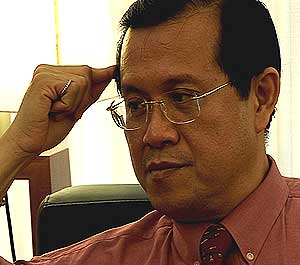 The president, who is also transport minister, vowed to hold an elections, but on the condition that MCA attains stability first.
To achieve this, he said the party must follow through with his 'Greater Unity Plan', launched on Oct 22 to unite the warring factions including his estranged deputy Dr Chua Soi Lek.
"This process must take place. If fresh polls is to be held, it cannot be held immediately. The party must be stabilised first.
“If you want fresh polls, we need a peaceful environment so that our comrades can vote with peace of mind," he told Malaysiakini at his ministry’s office in Putrajaya.
‘I cannot resign alone’
Ong said that the plan to eventually hold fresh polls was his response to the results of the Oct 10 extraordinary general meeting (EGM).
The EGM saw delegates passing a no-confidence vote against Ong, who had previously promised to step down should he lose by "even one vote".
However, Ong clung on to his post prompting a revolt by Liow and several other central committee members who wanted him to step down.
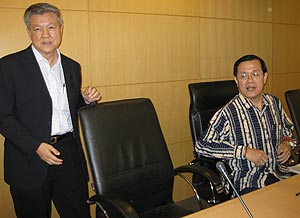 Now, Liow and his supporters are en route to convening
a fresh EGM
to seek the delegates’ approval to hold fresh polls for the top office bearers.
Now, Liow and his supporters are en route to convening
a fresh EGM
to seek the delegates’ approval to hold fresh polls for the top office bearers.
Ong said he tried to push for fresh polls following the Oct 10 EGM and presented his suggestion to the central committee on Oct 15, but this was not well received because he wanted the committee to resign en bloc.
Thus, he exercised his executive powers to call for another EGM to allow the party delegates to decide whether to keep the current central committee or dissolve it.
Ong explained that he could not step down alone because the central committee made "collective decisions" and therefore there must be "collective responsibility".
"When I mooted fresh polls (on Oct 15), I really thought everyone was prepared to do so, because they have been talking about resigning en bloc. I thought they meant it, so I planned it accordingly.
"I thought they would make their position on collective responsibility... so we should resign together and face fresh polls... Those who wanted instant gratification didn't listen to me," he said.
"They were training their sights on two things: first, on when I would step down and second, why is there a need for fresh polls. Today, this same group is trying to convene an EGM," he added.
Liow's camp was initially against fresh polls and remained adamant that Ong resigns, but upon burying the hatchet with Chua, Ong recanted on having an EGM and laid out the 'Greater Unity Plan' instead.
Liow and Co 'too impatient'
Meanwhile, Ong also accused Liow’s camp of failing to understand the unity plan and being impatient to take over the leadership reins.
"When I came back (from a holiday) to chair the (Oct 15) central committee meeting , I already had a plan in mind. But I also used the opportunity to see how they changed their minds.
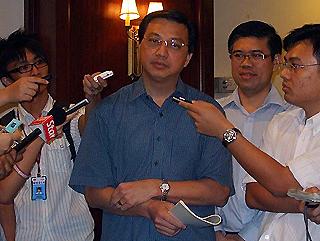 "The unity plan is only the first step, but some people made hasty decisions. Don't you think that they are being too impatient?" he asked.
He pointed out that Liow's camp had vehemently opposed re-elections at first, but is now pushing for another EGM for the same purpose as he did.
"What puzzles me is that this group was very vocal. Their opposition was very fierce. But now, they want the same. Don't you think this is comical? No matter how they put it, that is the fact," he said.
Regardless of whether the delegates vote for fresh polls during the new EGM, slated for Oct 28, Ong said the ultimate decision would fall back on the central committee, as two-thirds of the members must agree to it as stipulated in the party constitution.
"The crux of the problem is when it goes back to the central committee, whether everyone would be mentally prepared for fresh polls," he said.
For now, Ong said the first stage was to carry out the unity plan to unite the central committee and grassroots, mending months of intra-party animosity.
He however conceded that the plan would not resolve all the outstanding issues, but insisted that it was a necessary first step.
'I may re-contest'
As for his decision not to step down, Ong reiterated that he had received numerous emails, text messages and comments on his blog which urged him to stay on.
"I remember clearly, a number of people said that I should not bow out just because of one bold statement and I should fulfil my responsibility to the public," he said.
When pointed out that the central committee represented party grassroots in wanting him out, Ong said calls for him to hold on were also coming from ordinary party members.
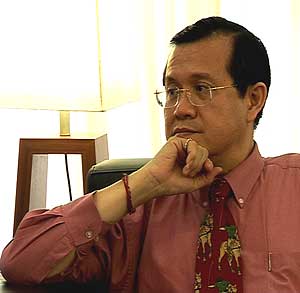 Asked if he meant that the 2,380 central delegates do not represent the voices of the grassroots, he replied: “Let the public interpret it”.
He then quickly added that this scenario was the reason why he mooted direct elections for the party presidency back in 2005.
Ong revealed that he was ready to quit on Oct 15 and even had a resignation letter, in both English and Chinese, prepared but it was not tabled after the central committee refused to do the same.
Should fresh polls be on the cards, the president did not rule out the possibility of seeking re-election.
"Even if I contest, that is my right. The power lies within the hands of the delegates. If I win, it means my mandate is renewed. If I lose, that is the end of it," he said.


Are you sure you want to delete this comment?
This action cannot be undone.