




Economist: Do worry, don't be happy
A prominent economist has questioned the government’s euphoria in projecting a high GDP growth rate and in claiming smooth sailing towards a ‘high income’ economy by 2020.
A prominent economist has questioned the government’s euphoria in projecting a high GDP growth rate and in claiming smooth sailing towards a ‘high income’ economy by 2020.
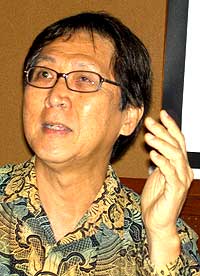 Centre for Policy Initiatives director Lim Teck Ghee said ministers “don’t really know much about what they are talking about”.
He was commenting on contradictions in Malaysia’s projected GDP growth rate, with three ministers citing varied figures over a three-day period last week.
“They are putting a political spin on economic numbers...a more realistic estimate can be found in the (International Monetary Fund) database,” said Lim.
On Nov 9, Prime Minister and Finance Minister Najib Abdul Razak told the 21st Multimedia Super Corridor implementation council meeting that Malaysia is aiming for nine percent annual GDP growth until 2020.
The next day, Minister in the Prime Minister's Department Nor Mohamed Yakcop - who oversees the Economic Planning Unit - told the media that he was confident of the country achieving 5.4 percent GDP annually over the next decade.
 Deputy Finance Minister Awang Adek Hussin then told the Dewan Rakyat on Nov 11 that the economy is expected to make a recovery to a projected growth of between
two and three percent
next year.
Deputy Finance Minister Awang Adek Hussin then told the Dewan Rakyat on Nov 11 that the economy is expected to make a recovery to a projected growth of between
two and three percent
next year.
Lim, however, rubbished the ministers’ preoccupation with the GDP and their chest-thumping over recovery from the recession.
“Malaysia is not the only country that is experiencing a GDP increase, it is happening to countries around the world,” he noted.
He said a better comparison would be against countries that were on par with Malaysia 20 years ago, such as South Korea. This would show how far Malaysia now lags in the race for economic development.
‘GDP not sole indicator’
The GDP, he cautioned, is not the only indicator of economic health, as social aspects must also be considered.
One important indicator is the United Nations Development Programme Human Development Index (HDI), which measures social and developmental aspects of an economy.
 While the GDP measures only the raw production output of an economy, the HDI also looks at standards of human capital development, education, and social well-being.
Malaysia, he pointed out, has slipped down the HDI rankings over the years - from 46 in 1996 to 56 (2001), 58 (2003), 61 (2005) and 69 (currently).
“We should not be too happy with minor GDP increases, but should focus on breaking into the top 30 or 50 of the HDI. Work on those issues and everything else will follow,” Lim advised.


Are you sure you want to delete this comment?
This action cannot be undone.