




Action needed to ensure education for all children
Currently 99 percent of Malaysian students have access to schools, with poverty no longer a valid reason for children in Malaysia to be denied education. This was the claim made by the secretary-general of the Ministry of Education, Zulkurnain Awang.
Currently 99 percent of Malaysian students have access to schools, with poverty no longer a valid reason for children in Malaysia to be denied education. This was the claim made by the secretary-general of the Ministry of Education, Zulkurnain Awang.
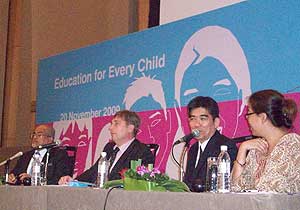 He said this at a forum held as part of the ‘Education for Every Child' programme. The programme is jointly organised by the United Nations Children's Fund (Unicef) and the Bar Council.
Zulkurnain highlighted the government's efforts in providing education for all. He noted the steady increase in percentages with regards to primary school enrolment, adult literacy and lessening gender disparities.
"If some children are not going to school, it is due to other problems, and not because they are poor," said Zulkurnain. The government, he says, has provided support in the form of programmes that include hostels, free textbooks, scholarships and a fund for poor students.
On the matter of the Convention on the Right of the Child (CRC), Zulkurnain says the government is not obliged to provide education to children of refugees and asylum seekers.
The government, he says, is in a quandary over the issue, as making the system too accessible will attract more migrants. Yet, he claims the government has so far been lenient in allowing immigrant children access to schooling.
When asked about how the government will address the issues of children who are undocumented, stateless and refugees, he said that the government welcomes cooperation with the NGOs.
Children of Borneo
Project Director of 'Borneo Child Aid', Torben Venning says that providing an education to the children of plantation workers helps keep them out of child labour.
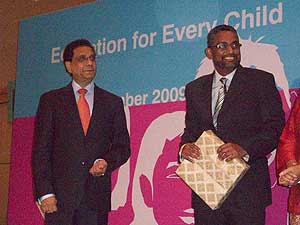 In fact, the Malaysian and Indonesian governments have been working closely with the society, facilitating the posting of Indonesian teachers to teach plantation workers' children.
The NGO has been providing education for underprivileged children since 1991 in Sabah and is presently educating more than 8000 children in 105 learning centres in Sabah.
Venning says the NGO's target groups are plantation children, children in towns without access to schools and children of Bajau Laut and other ethnic minorities.
Among the challenges the NGO faces is convincing illiterate parents to send their children to schools as well as logistics. The latter, Venning says, is an issue as those in remote areas have to travel for hours just to attend a four-hour class.
"So we see these children resorting to begging in pavements and eating the leftovers from restaurants," he said, explaining how the lack of education is detrimental to children's development.
Venning also pointed out initiatives by the owners of plantations such as Sime Darby, IOI and Genting to provide education for its workers' children and encouraged more companies to do so as corporate social responsibility endeavours.
What about children with disabilities?
Lim Boon Hock from special needs centre, 'Wings Melaka', said that needs of children with disabilities are not made a high priority, especially in developing countries.
He pointed out that enrolment rates of children who have disabilities are only a tiny fraction of that of non-disabled children.
According to the Education (Special Education) Regulations 1997-Regulation 3, the eligibility for special education is determined by whether the child is able to manage himself without help and it has to be confirmed by a panel of government officials.
Therefore, he said we need to eradicate the terms ‘educable' and ‘uneducable' as it is against the tenet in the UN convention that all individuals with disabilities are educable with the appropriate techniques.
He said that early childhood intervention is critical to optimise the learning and development of children with disabilities and special needs and it is equally important to detect and diagnose their conditions early.
The forum was held in conjunction with the launch of Unicef's State of the World's Children 2010 report , commemorating the United Nations adopting the Convention on the Rights of the Child. The report addresses the progress that has been made in the last 20 years and the role of the convention.


Are you sure you want to delete this comment?
This action cannot be undone.