




IPF: Can it be unified and resurrected?
COMMENT Since the death of its founder president MG Pandithan in April 2008, the Indian-based political party Indian Progressive Front has been torn into several factions.
Since the death of its founder president MG Pandithan in April 2008, the Indian-based political party Indian Progressive Front has been torn into several factions.
A recent attempt by some leaders to find common ground and cobble the party into a single political force seems to have drawn flak.
The problems in the pa
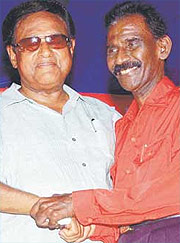 rty started way back in 2007 when MG Pandithan(
right in photo
), by then struck by a fatal disease decided to make peace with MIC president S Samy Vellu (
left
,
in white shirt
).
rty started way back in 2007 when MG Pandithan(
right in photo
), by then struck by a fatal disease decided to make peace with MIC president S Samy Vellu (
left
,
in white shirt
).
Subsequently Samy Vellu was invited to open the Annual General Assembly of IPF. In that assembly Pandithan showered praise on Samy Vellu, describing him as the best leader he had ever seen in his life.
This ignited fury among many party loyalists and supporters of Pandithan at the sudden change in their beloved leader's stand as it was Samy Vellu who expelled him from the MIC in 1988 thereby abruptly ending his bright political future.
Pandithan was then Tapah MP and a parliamentary secretary while being MIC vice-president.
Furthermore, for the previous 20 years it was Samy Vellu who had blocked IPF's entry into Barisan Nasional although Umno and MCA were said to be in favour.
However, realising Pandithan was seriously ill, other leaders in IPF although unhappy and grumbling decided to maintain silence out of sympathy and respect for his struggles for the party and community.
Soon they were dealt with another blow when Pandithan in his final days appointed his wife Jayashree as the party's new President.
Wife's meteoric rise
Until her appointment as president, Jayashree, except for attending some important party functions, had never participated in IPF's activities since its inception.
Therefore her sudden emergence as the leader extinguished the hopes and wishes of party loyalists and supporters who had hoped that the democratic process in the party would eventually determine the successor.
After Pandithan's death, the different rival groups within IPF began hurling accusations at each other eventually slicing up the party into several factions.
There were also doubts and allegations over the status of the IPF Headquarters in Serdang bought through through donations from members and the public.
 Jayashree Pandithan (
left
) also did not possess the leadership skills and charisma necessary to heal wounds and unite the party.
Jayashree Pandithan (
left
) also did not possess the leadership skills and charisma necessary to heal wounds and unite the party.
She also rejected the democratic process by refusing to hold party elections to select the leader, a key demand of those who oppose her.
Since then many petitions have been piling up on the table of the Registrar of Societies and some court cases have also been filed, pushing the party into further turmoil.
White knight charges in
At the height of infighting, a prominent businessman and community leader Vyran T Raj who was acquainted with some leaders in IPF took it upon himself to unify the various factions.
He had became popular during the recent MIC elections with his concept of "Nammavar" (meaning "our people") suggesting that a particular caste group long neglected politically and shunned, be grouped together into as a single force so that they could play a determining role in the MIC's future leadership.
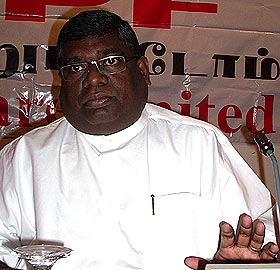 His concept simultaneously received bouquets and brickbats. Vyran (right) had supported former deputy president S Subramaniam in the contest for the deputy presidency and with Subra's defeat Vyran returned to IPF to unify the party.
It is no secret that the membership of IPF party comprises mostly Nammavars who had been rallying behind MG Pandithan all these years.
Vyran succeeded in his first attempt in bringing all the factional leaders in IPF to the negotiating table in early October 2009.
Even Jayashree Pandithan attended the meeting. However, the next day when it was announced that the IPF factions would be united under the patronage of Vyran, Jayashree hit back by saying that she was the rightful president and passed some adverse remarks against Vyran.
Jayashree's statement dashed the hopes of the key leaders trying to bring IPF together under Vyran.
Unperturbed, Vyran called for another meeting of IPF leaders in early November 2009. Jayashree absented herself from this meeting but two leaders from her faction namely M Kandiban and M Ragavan attended.
Both are brothers of late MG Pandithan. Although their attendance was seen as being receptive to Vyran's attempts at unification, unfortunately another horse had bolted by this time.
MV Mathialagan, the vice-president of IPF claiming to have the support of the largest number of branches within the party walked out of the meeting, publicly accusing Vyran of bringing the Nammavar concept into party.
Mathialagan vowed that IPF would be free of caste politics and publicly declared that Vyran's unifying role had not found favour with him.
A few days later, M Sambanthan, another leader aligned to the Jayashree faction issued a statement that their group had boycotted the meeting called by Vyran. Sambanthan also claimed that IPF was not practicing caste politics.
It is ironic that suddenly these leaders are talking about caste politics when all along in the last 20 years the party was run with the membership and support of Nammavars under the leadership MG Pandithan.
During his time none of these leaders would have dared to make such a statement as IPF not practicing caste politics.
The fear of the factional leaders in IPF seems to be that Vyran, in the name of unification would emerge as the most acceptable leader for the party.
It is also true that some sections of IPF believe that Vyran with his corporate background and financial ability would be able to inject fresh ideas and leadership skills into party, thereby taking it to the next level.
However, Vyran has persistently denied any ulterior motive in his attempts and has reiterated on several occasions that his mission is to merely unite the factions in IPF for the good of the party and that he would forego any leadership role thereafter.
Tough times for new committee head
Despite the walk-out staged by Mathialagan's faction, the meeting called by Vyran continued and appointed K Panjamoorty as the head of a xoordinationcommittee to oversee the unification of IPF and to look into the problems relating to membership and branches.
Panjamoorthy is the leader of one of the factions within IPF. The committee has been given about six months to complete their task.
However, with two key factions led by Jayashree Pandithan and Mathialagan withholding their support it is doubtful whether the committee headed by K Panjamoorthy would be able to successfully steer the unification exercise. Therefore, Vyran's noble intention of unifying IPF may not see the light of the day.
Winning back lost ground in doubt
Even if IPF is resurrected, it is still doubtful whether the party would be able to gain any momentum or win back lost ground given the present scenario of Malaysian politics.
This is because the new breeze of politics sweeping the country calls for unification of all races under the 1Malaysia concept proposed by the BN, while the Pakatan Rakyat assures Malaysians that they will demolish all forms racial discrimination.
In this new trend of politics it is doubtful whether a unified IPF can find its support from the Indian community based on the concept of caste, taboo for many Indians. They may not want to join or be aligned to a party alleged to be practicing such politics.
Even if IPF is unified whether it can sustain itself as an Indian based party and emerge stronger again is also doubtful given the fact that there are already several Indian-based parties.
PPP, another coalition member of BN, though claiming to be multi-racial also comprises mostly Indians and now we have another new entrant in Malaysian Makkal Sakthi Party.
Makkal Sakthi Party stole the limelight recently as another Indian-based party with the Prime Minister himself launching it.
We also have the Human Rights party led by Hindraf leader P Uthayakumar.
It must be noted here that IPF was formed in 1989 purely out of emotions and sympathy for MG Pandithan because of his expulsion from MIC. IPF was seen as an interim measure until he regained his foothold in politics.
Immediately after the IPF formation, Pandithan joined the Gagasan Rakyat coalition under Tengku Razaleigh Hamzah and contested the Teluk Intan Parliamentary seat under the DAP flag in the 1990 general elections and lost.
Since then he had been supporting the BN but during his lifetime, despite several attempts he could not succeed in getting his party admitted into the coalition because of resistance from Samy Vellu and the MIC.
His final surrender to Samy Vellu during his last days also signalled that he had given up his political fight.
Since his death the party has spun into disarray and many of his supporters and IPF members have already joined opposition parties like PKR and DAP. Some have returned to MIC. Some have dedicated themselves to the cause of Hindraf.
The remaining leaders and members in IPF are merely fighting among themselves for their own egos and personal motives.
If the leadership of MIC decides to open its doors to all Indians and proposes to embrace members and leaders from the IPF, we can expect another exodus to the former sort of returning to their "motherland".
Finally, it is only the middle-aged and elderly people who seem to be obsessed with the idea of Nammavar and caste politics of IPF.
The educated and more sophisticated young generation of Indians seems to be breaking away from the clutches of age old Indian traditions like caste and may not be willing to identify themselves with that distinction or join a party which has the "caste stigma".
It is in fact a good sign that should be nurtured and encouraged as it is one way the Indian community can move forward.
The pending court cases among IPF's factions may drag the party's in-fighting further and any decision of the Registrar of Societies, if at all it comes, will only plunge the party into another turmoil as the disappointed factions would still mount another challenge to the ROS decision.
In the given circumstances the future of IPF is not too difficult to predict!
______________________________________________________________________
R MUTHARASAN is an observer and writer on Malaysian politics. He is the web-master of www.indiantoday.net and has also authored the book 'Winning Strategies of Anwar Ibrahim'.


Are you sure you want to delete this comment?
This action cannot be undone.