




OSA - an odious law
COMMENT The disagreement over declassifying the Bukit Antarabangsa landslide report between the federal and Selangor government demonstrates how arduous it is for citizens to have their right to information respected.
The disagreement over declassifying the Bukit Antarabangsa landslide report between the federal and Selangor government demonstrates how arduous it is for citizens to have their right to information respected.
Selangor Menteri Besar Tan Sri Khalid Ibrahim's move to declassify the report is a right one. It is in accordance with the trend of Malaysia's new politics of openness, accountability, and good governance.
The landslide occurr
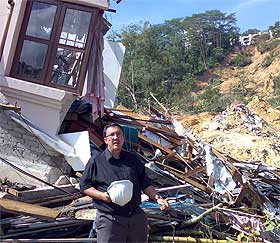 ed in Taman Bukit Mewah, Bukit Antarabangsa on Dec 6, 2008 at 3.30am.
The tragedy claimed five lives and destroyed 14 houses.
The widespread media coverage of the landslide and the rescue effort turned the nation's attention to hillside property development.
The victims, who have lost loved ones and property, have a right to know details of JKR's report of the incident. The report carries no sensitive materials that would jeopardise national security and should not have been classified in the first place.
Of course, we all know that our government needs to keep some documents and information secret to protect public interest and national security. The Official Secrets Act exists in many countries: in the UK, in the Republic of Ireland, in India, and in Australia in various forms.
Dangerous amendment
We can all accept the reality that there are military or intelligence matters that cannot be made public as disclosure would make us vulnerable to attacks within and outside our borders.
We can also accept that there are certain matters such as cabinet meeting minutes and papers that need to be kept secret.
But our Malaysian Official Secrets Act of 1972 (Act 88), amended in 1986, defines "official secrets" as "any document specified in the Schedule and any information and material relating thereto and includes any other official document, information and material as may be classified as 'Top Secret', 'Secret', 'Confidential' or 'Restricted', as the case may be, by a minister, the menteri besar or chief minister of a state or such public officer such as may be authorised to classify such documents by a minister, menteri besar or chief minister."
If you read the definition carefully, any of those persons authorised by the Act can classify any public document or information by stamping "top secret" on it, without needing to give proper justification.
I was in the Dewan Rakyat and was a witness to the parliamentary debate when the amendment bill was tabled in 1986.
The Opposition L
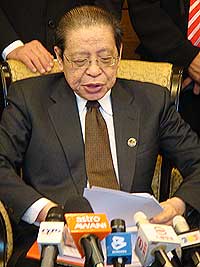 eader then, Lim Kit Siang (
left
), had already warned of the danger posed by passing this piece of legislation. Given the vast powers of government ministers and public officials to declare anything an ‘official secret", the Act could go way beyond protecting national security and maintaining confidentiality in decision-making.
eader then, Lim Kit Siang (
left
), had already warned of the danger posed by passing this piece of legislation. Given the vast powers of government ministers and public officials to declare anything an ‘official secret", the Act could go way beyond protecting national security and maintaining confidentiality in decision-making.
The Act could very well make public administration very opaque, shielding government corruption, mismanagement, and abuse of power from legitimate democratic scrutiny. Lim has been proven right more than once.
‘Government secrecy a necessary evil'
The political life of any democracy works best when government administration is open, transparent, and accountable. The need for government secrecy is a necessary evil at best.
The temptation for those individuals holding the positions of power to abuse such hidden discretionary power is simply too great.
People may want to abuse this power of secrecy to further their own interests, to hide corruption, to undertake their private agenda, to cover up government weaknesses and avoid embarrassment. It is just such a readily available means to subvert the right and power of the people who elected those public officials in the first place.
This temptation is even too great for some officials in advanced liberal developed democracies like the UK and the USA. In those countries, civil society and the press have always tried to expose their government abuse of this power of secrecy.
In the UK, whistle blowers often greatly embarrassed the government of the day. The Clive Ponting case is one in point.
In 1985, Clive Ponting was charged with leaking an internal Ministry of Defence document concerning an Argentinean cruiser, the General Belgrano, which British forces sank during the 1982 Falklands War. 360 people were killed in the sinking.
It was a landmark official secrets case. The jury acquitted Ponting of breaking the Official Secrets Act, a victory hailed by civil society.
Margaret Thatcher's government at the time had said that the Belgrano was threatening British lives when it sunk. But the document Ponting leaked showed that it was sailing out of the exclusion zone. The document's publication was a huge embarrassment for the government.
In an article entitled "An Odious Law: Overhaul the Official Secrets Act" published 16 Nov 2003, the influential London Observer stood up in defence of another whistle blower, Katharine Gün.
Gün, a translator with the Government Communication Headquarters, was charged with allegedly disclosing top-secret information. It was relating to an article published in the London Observer , revealing a secret attempt by the United States to spy on delegations at the UN headquarters in New York.
In the article, the London Observer declared its support for Gün: "A statement issued by Ms Gün shows she believed there was an illegal attempt to subvert British intelligence services. We support her courageous statement and condemn a clumsy and inappropriate use, yet again, of Britain's outdated secrecy laws."
With their much better press and judicial system, even the covert workings of the American and British secret intelligence agencies can be checked for their excesses. In Malaysia, such a day still lies in the distant horizon.
Need for accountability
In Malaysia, mammoth mega-projects are more often awarded by negotiated tender than by open tender. Thereafter, the project contract can easily be classified as an official secret, even though there is no justification at all for doing so.
Decision-making in procurement procedures by the government can also be protected and hidden from public gaze behind the veil of the secrecy provided by OSA. The cult of secrecy within our nation's officialdom has nothing to do with protecting national interests and public security, but everything to do with the rapid development of crony capitalism and enriching well-connected businessmen and well-placed public officials.
If we as a nation wish to weed out rampant pandemic and highly corrosive corruption in public life and private business, we should first lift the veil of secrecy that has been created by our own OSA.
Until we change government at the federal and state levels, it cannot be done.


Are you sure you want to delete this comment?
This action cannot be undone.