




S'gor set to rejuvenate ailing urban slums
Faced with scarcity of suitable development land, a steadily rising population, amidst a maturing populace and a changing economic environment, Malaysia's most developed state finds itself at the crossroads - learn to re-use and rejuvenate its urban and industrial centres or fall prey to the curse of urban decay.
Faced with scarcity of suitable development land, a steadily rising population, amidst a maturing populace and a changing economic environment, Malaysia's most developed state finds itself at the crossroads - learn to re-use and rejuvenate its urban and industrial centres or fall prey to the curse of urban decay.
An urban environment is a complex and dynamic 'living' and ‘breathing' system that needs to constantly adapt to the changing needs of business, employment, housing and lifestyles, as well as external physical, social, economic and environmental factors.
In order to keep up with this constant evolution and the mix of internal and external forces, city planners, developers and local authorities need to be on their toes.
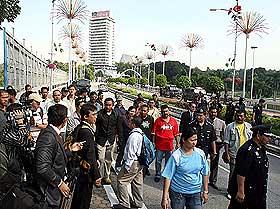 This is of particular importance to a state like Selangor, where 90 percent of its urban centre inhabitants reside in towns and cities.
Realising this, the current state government has embarked on a campaign it terms as 'urban regeneration', using the British term for the worldwide phenomenon of urban renewal.
'Urban regeneration' or 'urban renewal' is a relatively new concept born from necessity, as countries coming rapidly into the industrial age soon found that prevailing economic currents may cause industrial areas, and the urban centres which supply them with labour, to stagnate and even whither away.
A fact, that the newly industrialised Malaysia, and particularly the industrial state of Selangor, is having to learn to come to terms with.
A changing urban landscape
As Damansara Utama assemblyperson Dr Cheah Weng Yin explained, "the withdrawal of industries from some areas as well as an increasingly aging population has altered the economic and social make up of many urban centres."
He give as example, his constituency of Damansara Utama, where the "majority of its residents are senior citizens".
"Most of the residents moved into Damansara Utama 30 years ago. Now they are 50-60 years of age. Their children have since moved away."
This, he said, has altered the demographical make-up of the area and may cause the urban centre to lose some of its ‘vibrancy' usually associated with youth.
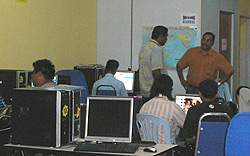 He fears that soon the shops and offices may close, and we will only see cybercafes and seedy joints like massage parlours filling the commercial blocks and shop houses.
He added, "the area will be a seedy place because owners will rent out to anyone who wants to."
Cheah said the same problem is afflicting Petaling Jaya and Kelana Jaya, as more and more factories, once prevalent there, begin to move to more attractive locales, often overseas.
Large, disused and decaying industrial facilities, he lamented, may not only become architectural eyesores, but also focal points for undesirable activities like drug addiction and its ilk.
An increasing population
Another area of concern, Selangor exco Ronnie Liu pointed out, is that Selangor's population is also climbing "at a rate of four percent annually."
This is a cause for worry as the state will soon need more land to house the population as well. Liu feels that 'urban regeneration' is needed so that these ‘brown' areas or stagnating urban or industrial areas can be converted to cater to the rising is population.
This is necessary because he believes that Selangor can no longer grow by exploiting more and more ‘green' areas of forest or agricultural land.
However, the Selangor government is looking to do more than just rebuild infrastructure. As Cheah said, "It is not only about tearing down old buildings, it is also about the people."
Selangor deputy speaker Haniza Mohd Talha explained, once particular distinction is that they are aiming for is integrated housing, instead of the more prevalent ‘gentrification' of old urban centres into areas for high-class homes. A move which may displace the existing population.
Liu agreed, "We do not want areas of rich people and poor people."
Haniza added, "Fran Wagstaff from San Francisco for one has been successful in building affordable housing for the poor without any apparent economic segregation. This is what we are moving towards."
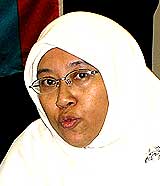 Other than Wagstaff, Haniza (
right
) also mentioned Dr Tom Murphy, the three-term Pittsburg mayor who managed to successfully rejuvenate the once industrial city.
Other than Wagstaff, Haniza (
right
) also mentioned Dr Tom Murphy, the three-term Pittsburg mayor who managed to successfully rejuvenate the once industrial city.
If the opinions of these Selangor government officials in charge of the campaign holds true, regenerating urban centres the Selangor way means the "creative use of design and space to add value to the immediate locales."
This, they indicated, will include revitalising existing buildings and the conservation of historical landmarks. in an organic process which aims to enrich areas while still maintaining as much of the original structures intact as possible.
Hub for culture
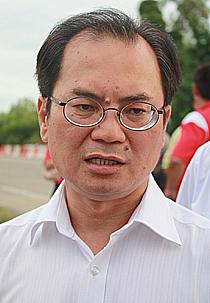 Liu (l
eft)
also mentioned cities like Liverpool "which have museums and cultural buildings in their make-up."
Liu (l
eft)
also mentioned cities like Liverpool "which have museums and cultural buildings in their make-up."
He said that this is another aim of Selangor's urban regeneration. The goal is to integrate redevelopment with making the areas as hubs for social and cultural activities.
Liu gave as examples, the success stories of places like Canary Wharf in London, Melbourne's Docklands, as well as KL Sentral and Sentul Raya in Malaysia.
However, the urban renewal process has been much criticised by some quarters because of the use of 'eminent domain' by governments to forcibly take away land for use in the reconstruction and political leaders who abuse the process to award contracts to ‘friendly', often unqualified, contractors for pecuniary gains.
This, however, won't happen in the Selangor story, or so claimed Liu.
"We will not take away land, shops and houses without good reason and without giving suitable alternatives or compensation."
On the matter of abuse, Liu added, "Only the best of the best contractors, architects, planners and designers will be used for the projects. It will all be in an open and transparent process."
In order to promote the concept of 'urban regeneration' and spread the knowledge of its practice among local governments, state agencies and effected communities, the Selangor government is holding an international conference on urban regeneration with the theme, ‘Towards Selangor's Sustainable Future'
The conference slated for Nov 30 to Dec 1 is to be held in Sunway Resort Hotel & Spa and will feature international urban renewal experts like the abovementioned Wagstaff and Murphy and is to be opened by Selangor MB Khalid Ibrahim.
The state organised event has the support of the Malaysian Institute of Planners (MIP), the Real Estate and Housing Developers Association (Rehda) and the Malaysian chapter of the UK-based Royal Institution of Chartered Surveyors.
More details can be obtained from the MIP which is acting as conference secretariat.


Are you sure you want to delete this comment?
This action cannot be undone.